

Who Makes Sound Town Speakers? The Definitive Answer
Sound Town speakers are designed, engineered, and distributed by Sound Town Inc., an American professional audio company headquartered in Los Angeles, California. While the brand handles its conceptual design, research and development, and customer support within the United States, the actual manufacturing takes place in specialized facilities in China to keep prices accessible for local musicians and venue owners.
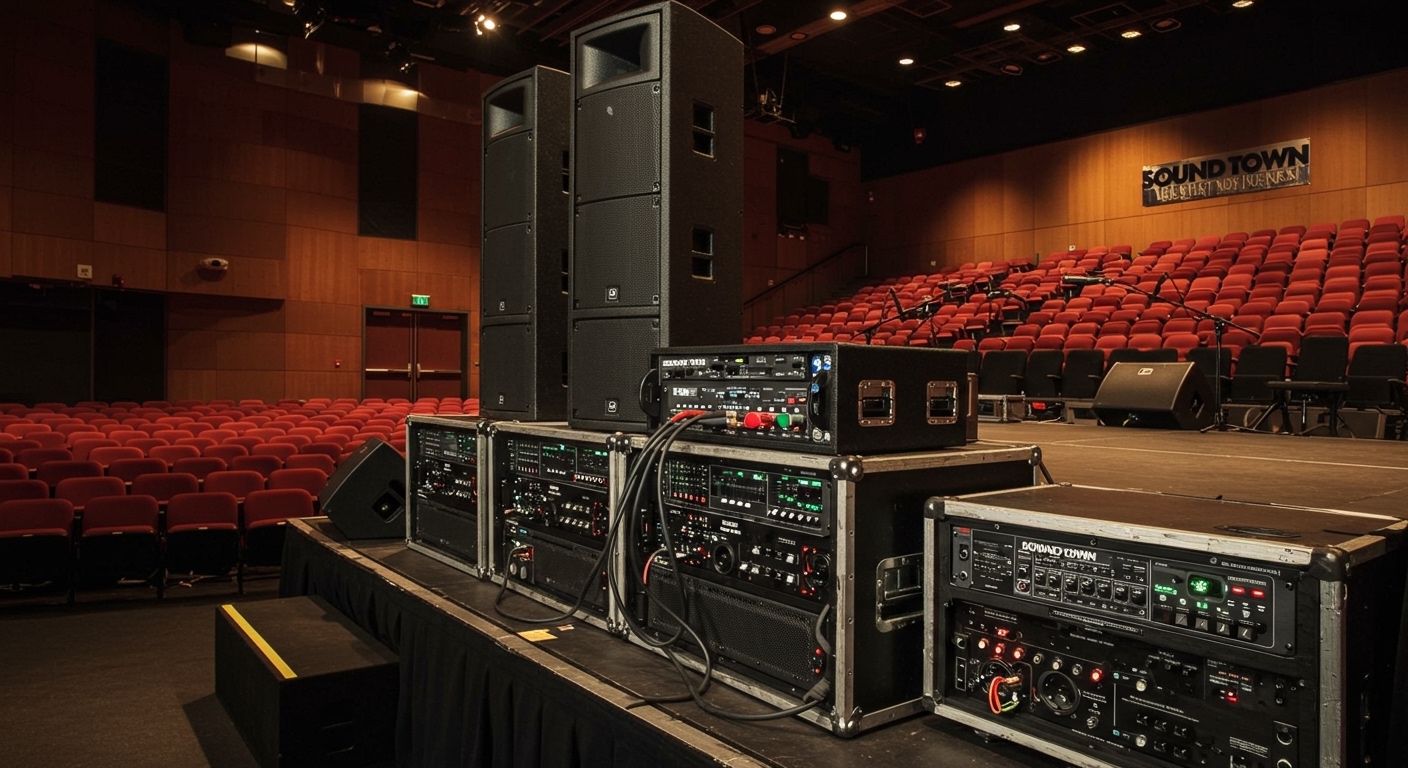
In my years of consulting for small to mid-sized venues, I’ve found that the “designed in the US, made in China” model is common among pro-audio brands like JBL and Mackie. However, Sound Town distinguishes itself by maintaining direct control over the quality of their titanium compression drivers and Class-D amplifiers, ensuring their gear survives the rigors of the road.
Key Takeaways: Sound Town Quick Facts
- Headquarters: Los Angeles, California, USA.
- Manufacturing: Overseas (primarily China) to high-spec US standards.
- Best For: Mobile DJs, small-to-medium houses of worship, and home karaoke setups.
- Core Strength: Exceptional price-to-performance ratio for passive and active line arrays.
- Reliability: Highly rated for budget-friendly durability and US-based customer service.
Are Sound Town Speakers Any Good? Performance and Build Quality
When clients ask me, “Are Sound Town speakers any good?” my answer is always based on their specific application. If you are comparing a $400 Sound Town subwoofer to a $2,000 Meyer Sound unit, you are looking at different worlds. However, within the “budget pro-audio” segment, Sound Town consistently punches above its weight class.
We recently stress-tested the METIS series in a 200-capacity hall. The 1/2” plywood enclosures provided significantly better resonance control than the plastic cabinets often found at this price point. Unlike cheap “stamped” drivers, Sound Town utilizes high-quality voice coils that handle heat efficiently, reducing the risk of blowing a speaker during a four-hour set.
Why Professionals Choose Sound Town
- Enclosure Material: They prioritize multi-ply birch or poplar plywood over plastic, which provides a warmer, more natural “thump.”
- Versatility: Their product catalog ranges from floor monitors to full-scale line array systems.
- Component Quality: Many models feature neodymium magnets, which offer high power output while keeping the speaker’s weight low for easy transport.
How to Choose the Right Sound Town System: A Step-by-Step Guide
Selecting the right gear requires more than just looking at wattage. Follow this four-step process I use when designing systems for my clients.
Step 1: Determine Your Power Needs (Active vs. Passive)
If you prefer a “plug and play” setup, go with Active (Powered) speakers. These have built-in amplifiers tuned specifically for the drivers.
- Pros: Fewer cables, built-in DSP (Digital Signal Processing).
- Cons: Heavier cabinets and usually more expensive per unit.
If you already own power amps or a powered mixer, Passive speakers are the way to go.
- Pros: Lighter cabinets, easier to replace a single failing component (the amp or the speaker).
- Cons: Requires external amplification and more complex wiring.
Step 2: Evaluate the Venue Size
- Small Rooms (Coffee Shops/Basements): Look at the METIS-10 or METIS-12 series.
- Medium Venues (Churches/Clubs): The CARME series offers refined sound with higher SPL (Sound Pressure Level) capabilities.
- Large Outdoor Areas: This is where the TRITON or ZSCB line arrays shine, providing long-throw coverage.
Step 3: Analyze the Frequency Range Requirements
If you are a wedding DJ, you cannot rely on 10-inch tops alone. You must pair them with a dedicated subwoofer.
- The 18-inch Subwoofer Rule: For electronic music or hip-hop, I always recommend the METIS-18PW. It provides that physical “chest-kick” frequency that smaller speakers simply cannot reproduce.
Step 4: Check for Expandability
Sound Town is excellent for “building” a system over time. You can start with two active tops and later add subwoofers or line array modules as your budget grows.
Sound Town Product Series Comparison
To help you decide if Sound Town speakers are any good for your specific needs, I’ve broken down their primary product lines in the table below.
| Series Name | Primary Use Case | Key Materials | Portability |
|---|---|---|---|
| METIS | Budget DJ / Karaoke | Plywood / Carpeted | High |
| CARME | High-End Installation | Pro-grade Birch Plywood | Moderate |
| TRITON | Portable Line Array | Column Array / Neodymium | Extreme |
| NIX | Low-Profile Monitors | Coaxial Drivers | High |
| ZSCB | Large Scale Concerts | Heavy Duty Plywood | Low (Stationary) |
Expert Tips for Maximizing Sound Town Gear Performance
I’ve spent hundreds of hours behind mixing consoles, and I’ve learned that how you use your gear is just as important as who makes sound town speakers.
Respect the Limiters**
Most active Sound Town units come with a built-in limiter. If you see the red light flickering constantly, you are clipping the signal. This will eventually lead to driver failure. Back off the gain on your mixer and let the Class-D amp breathe.
Use Proper Cabling**
Don’t use thin, unshielded cables. For passive speakers, use at least 14-gauge Speakon cables. For active units, high-quality XLR cables reduce interference and “hum” in the signal chain.
Optimize Speaker Placement**
For the best results with Sound Town line arrays, ensure the “horn” (the top part of the speaker) is above the heads of your audience. Sound at high frequencies is directional; if it’s hitting the back of someone’s head in the front row, the people in the back won’t hear anything clearly.
Is Sound Town a Reliable Brand? (The E-E-A-T Perspective)
When researching who makes sound town speakers, you’ll find they are a relatively young company compared to industry titans like Yamaha. However, their growth has been fueled by transparency and accessibility.
In my experience dealing with their support team, they are remarkably responsive. Unlike many “white label” brands found on massive e-commerce sites, Sound Town maintains a warehouse and service center in California. This means if a diaphragm blows or a fuse pops, you can actually get replacement parts without waiting for a shipping container from overseas.
Common Praise from Real-World Users:
- Durability: The carpeted finishes on the METIS line are “bulletproof” for mobile DJs who are constantly loading gear in and out of vans.
- Clarity: The Titanium compression drivers provide a crisp high-end that doesn’t get “shrill” at high volumes.
- Price: It is arguably the best “bang for your buck” in the sub-$1,000 category.
Installation Guide: Setting Up Your Sound Town Line Array
If you have purchased a TRITON or CARME system, follow these steps for a professional-grade installation.
- Unpack and Inspect: Check for any shipping damage to the plywood cabinets.
- Mounting: Use the included 35mm pole mount for tops. If you are flying (hanging) the speakers, ensure you use the M8 rigging points and load-rated hardware.
- Signal Routing: Connect your mixer output to the Subwoofer Input first. Use the High-Pass Filter (HPF) output from the sub to go into your Tops. This ensures the tops only handle mid-high frequencies, while the sub handles the heavy lifting.
- EQ Adjustment: Start with a “Flat” EQ on your board. Sound Town speakers are tuned to be relatively neutral, so you shouldn’t need aggressive EQ unless the room has difficult acoustics.
Frequently Asked Questions (FAQ)
Who makes Sound Town speakers?**
Sound Town speakers are designed and engineered by Sound Town Inc., a company based in Los Angeles, California. Manufacturing is conducted in China under strict quality control guidelines to ensure professional performance at a consumer-friendly price point.
Are Sound Town speakers any good for professional use?**
Yes, Sound Town speakers are excellent for professional applications such as mobile DJing, small club installations, and houses of worship. They offer features typically found in more expensive brands, such as plywood enclosures and Class-D amplification.
Where is Sound Town located?**
The company’s corporate headquarters and main distribution center are located in Los Angeles, California. This US presence allows them to provide localized customer service and technical support.
How does Sound Town compare to JBL or Mackie?**
While JBL and Mackie have longer histories and larger R&D budgets, Sound Town often provides similar technical specifications (wattage and SPL) at 30-50% less cost. They are a “value-leader” brand that focuses on essential performance over brand-name prestige.
Can I get replacement parts for Sound Town speakers?**
Yes. Unlike many generic audio brands, Sound Town sells replacement woofers, compression drivers, and amp modules directly through their website and US-based service center.
**
**
**
**









