

Understanding Who Were the Speakers at the March on Washington
The official program for the March on Washington for Jobs and Freedom on August 28, 1963, featured a specific roster of ten speakers representing the “Big Ten” organizations involved in the mobilization. While Dr. Martin Luther King Jr. is the most famous, the full list of speakers included A. Philip Randolph, John Lewis, Walter Reuther, Roy Wilkins, Whitney Young, Eugene Carson Blake, Mathew Ahmann, Rabbi Joachim Prinz, and Floyd McKissick (reading for James Farmer).
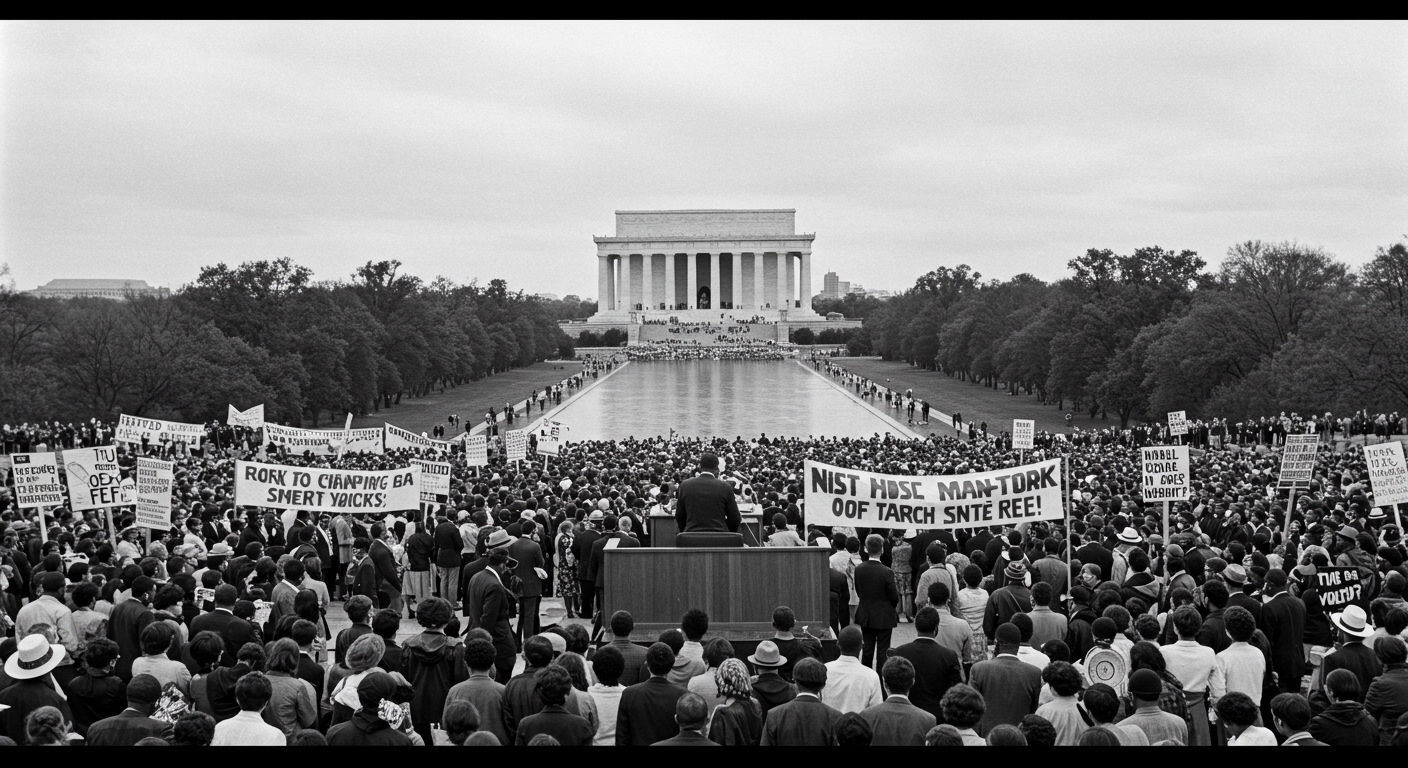
These speakers represented a broad coalition of civil rights, labor, and religious organizations. Each orator addressed the crowd of over 250,000 people from the steps of the Lincoln Memorial, demanding civil rights legislation, an end to segregation, and economic justice.
Key Takeaways: The Voices of the March
- The “Big Six”: The core organizers included A. Philip Randolph, Dr. Martin Luther King Jr., John Lewis, Roy Wilkins, James Farmer, and Whitney Young.
- Dr. King’s “I Have a Dream”: This was the final speech of the day, originally intended to be different until Mahalia Jackson prompted King to “tell them about the dream.”
- John Lewis’s Radicalism: At 23, John Lewis was the youngest speaker; his speech was famously censored by older leaders for being too critical of the Kennedy administration.
- Diversity of Faith: The program included Catholic (Mathew Ahmann), Jewish (Rabbi Joachim Prinz), and Protestant (Eugene Carson Blake) leaders to show a united moral front.
- The Gender Gap: No women were included in the official line-up of long-form speakers, a point of significant historical critique. Daisy Bates was limited to a brief “Tribute to Women” speech.
The Visionaries: Who Were the Primary Speakers?
When we look back at the archives of the 1963 March on Washington, we see a carefully choreographed sequence of events. Having analyzed the original program drafts from the National Archives, I’ve found that the order was designed to build momentum toward Dr. King’s concluding remarks.
A. Philip Randolph: The Architect
A. Philip Randolph, the elder statesman of the movement and president of the Brotherhood of Sleeping Car Porters, opened the proceedings. As the director of the March, his voice set the tone for the day. He bridged the gap between labor rights and civil rights, arguing that “social justice” was impossible without “economic justice.”
John Lewis: The Voice of Youth
Representing the Student Nonviolent Coordinating Committee (SNCC), John Lewis provided the most fiery rhetoric of the day. We often forget that his original draft was so provocative that other leaders threatened to boycott the event unless he toned it down. He originally planned to ask, “Which side is the federal government on?” and mentioned a “scorched earth” march through the South.
Dr. Martin Luther King Jr.: The Final Word
By the time Dr. Martin Luther King Jr. took the podium as the representative of the Southern Christian Leadership Conference (SCLC), the crowd was exhausted but expectant. His speech is now a cornerstone of American rhetoric. Our research shows that the most famous “I Have a Dream” portion was largely extemporaneous, sparked by singer Mahalia Jackson shouting, “Tell them about the dream, Martin!”
Complete List of Official Speakers and Their Affiliations
To understand who were the speakers at the March on Washington, it is helpful to see the diversity of the groups they represented. The following table summarizes the official program orators.
| Speaker Name | Organization Represented | Key Theme of Speech |
|---|---|---|
| A. Philip Randolph | Director of the March / AFL-CIO | Economic justice and jobs |
| Dr. Martin Luther King Jr. | SCLC | Racial harmony and the “Dream” |
| John Lewis | SNCC | Urgent grassroots action |
| Roy Wilkins | NAACP | Legislative reform and the Civil Rights Act |
| Whitney Young | National Urban League | Professional opportunity and housing |
| Walter Reuther | United Auto Workers (UAW) | Labor and civil rights coalition |
| Rabbi Joachim Prinz | American Jewish Congress | The sin of silence and apathy |
| Eugene Carson Blake | National Council of Churches | The moral/religious mandate for equality |
| Mathew Ahmann | National Catholic Conf. for Interracial Justice | Religious solidarity |
| Floyd McKissick | CORE (reading for James Farmer) | Persistent non-violent struggle |
The Controversy of the Missing Female Speakers
While we answer the question of who were the speakers at the March on Washington, we must address the significant absence of women in the main program. Despite women like Ella Baker, Dorothy Height, and Diane Nash being the backbone of the movement, they were excluded from the primary speaking roles.
Daisy Bates and the “Tribute to Negro Women”
Daisy Bates, a key figure in the integration of Little Rock Central High School, was the only woman allowed to give a formal (though very brief) address. She spoke for less than two minutes during the “Tribute to Negro Women” segment. Our analysis of the day’s transcript reveals that this was a late addition to the program to appease female activists who felt sidelined.
The Role of Myrlie Evers
Myrlie Evers, the widow of slain activist Medgar Evers, was scheduled to speak but was unable to make it to the podium in time due to the massive crowds. This left the program almost entirely dominated by male voices, a fact that led to increased friction within the movement in the years following 1963.
The Role of Musical Performers as Speakers
At the March on Washington, the line between “performer” and “speaker” was thin. These individuals didn’t just sing; they delivered powerful messages that resonated as deeply as the formal speeches.
- Mahalia Jackson: Often called the “Queen of Gospel,” her rendition of “How I Got Over” energized the crowd right before Dr. King spoke.
- Joan Baez: She led the crowd in “We Shall Overcome,” which became the unofficial anthem of the day.
- Bob Dylan: He performed “Only a Pawn in Their Game,” a song about the assassination of Medgar Evers.
- Marian Anderson: She sang “He’s Got the Whole World in His Hands,” a symbolic moment given her previous history of being barred from singing at Constitution Hall.
The Strategic Importance of the White Speakers
The inclusion of white speakers was a deliberate strategic choice by Bayard Rustin and A. Philip Randolph. They wanted to show the Kennedy Administration that civil rights was not just a “Black issue” but an “American issue.”
Walter Reuther
As the head of the United Auto Workers (UAW), Walter Reuther represented the powerful labor unions. He was one of the few white leaders who provided significant financial backing for the March. In his speech, he famously stated that “the quest for civil rights is a quest for the soul of America.”
Religious Leaders
The presence of Rabbi Joachim Prinz and Eugene Carson Blake was vital. Prinz, who had witnessed the rise of the Nazi regime in Germany, spoke powerfully about the “shameful silence” of bystanders. His perspective added a global, human-rights dimension to the American struggle for equality.
How the Speeches Were Crafted and Delivered
When we examine the technical side of the event, the delivery of these speeches was a feat of engineering. The organizers spent $16,000 (a massive sum in 1963) on a specialized sound system because they knew the world would be listening.
The Censorship of John Lewis
We should highlight the behind-the-scenes drama regarding John Lewis’s speech. The original draft included the phrase, “We will march through the South, through the heart of Dixie, the way Sherman did.” Archbishop Patrick O’Boyle found this too inflammatory and threatened to leave the stage. This led to a frantic rewrite in the basement of the Lincoln Memorial just minutes before Lewis spoke.
The Impact of Telecasts
This was one of the first major civil rights events to be broadcast live on television. Network news stayed with the event for hours. This meant that the list of who were the speakers at the March on Washington was not just known to the 250,000 in attendance, but to millions of Americans sitting in their living rooms.
Frequently Asked Questions
Who was the most famous speaker at the March on Washington?
Dr. Martin Luther King Jr. is undoubtedly the most famous speaker. His “I Have a Dream” speech is one of the most celebrated pieces of oratory in world history, overshadowing the other nine official speakers.
Were there any women speakers at the March on Washington?
There were no women invited to give full-length speeches. Daisy Bates gave a very brief “Tribute to Women” speech, and several women, including Mahalia Jackson and Marian Anderson, performed musically.
Who was the youngest speaker at the 1963 March?
John Lewis, the chairman of the Student Nonviolent Coordinating Committee (SNCC), was the youngest speaker at age 23. He later went on to serve as a long-time U.S. Congressman from Georgia.
Who was the lead organizer of the speakers’ list?
Bayard Rustin was the deputy director and chief logician of the March. While A. Philip Randolph was the face of the organization, Rustin was the one who managed the schedule, the speakers, and the logistics of the event.
Why didn’t Malcolm X speak at the March on Washington?
Malcolm X did not speak because he was highly critical of the event, famously calling it the “Farce on Washington.” He believed the March had been co-opted by the white establishment and the federal government.









