

Why Are Car Speakers 4 Ohm? The Direct Answer
Why are car speakers 4 ohm? Most car speakers utilize a 4-ohm impedance because automotive electrical systems operate on a limited 12-volt DC supply; a lower impedance allows the amplifier to draw more current and generate higher wattage without requiring a massive internal power supply. This design balances power output, heat dissipation, and voice coil efficiency within the space-constrained environment of a vehicle.
While home audio systems typically use 8-ohm speakers due to the abundance of high-voltage AC power, car manufacturers standardized on 4 ohms (and occasionally 2 ohms) to maximize volume from the battery’s low-voltage floor. If you use a higher impedance speaker in a car, you will likely find the volume output significantly lower than expected.
TL;DR: Key Takeaways for Car Speaker Impedance
- Standardization: 4 ohms is the industry standard for aftermarket car door speakers and coaxial units.
- Voltage Limitations: Cars have a 12.6V to 14.4V limit. Lower ohms (resistance) allow more power to flow at these low voltages.
- Power Efficiency: A 4-ohm speaker allows a head unit or amplifier to produce usable volume without overheating.
- Compatibility: Most factory car stereos are designed specifically for 4-ohm loads; installing 8-ohm speakers will cut your power in half.
- Subwoofer Exceptions: Subwoofers often come in 2-ohm or Dual Voice Coil (DVC) configurations to allow for specialized wiring.
Understanding the Physics: Why Are Car Speakers 4 Ohm?
To understand why are car speakers 4 ohm, we have to look at Ohm’s Law. In the simplest terms, Voltage = Current x Resistance. In a car, your Voltage is fixed (roughly 12-14 volts).
If you want more Wattage (Power), and your voltage is stuck, you must either increase Current or decrease Resistance (Ohms). By keeping the resistance at 4 ohms, car audio engineers found the “sweet spot” where they could get 15–25 watts of clean power out of a standard dashboard head unit.
The 12-Volt Constraint
In a home environment, amplifiers have access to 110V or 220V. They can easily push current through 8-ohm or 16-ohm speakers.
In a car, if we used an 8-ohm speaker, the 12V system would struggle to push enough current to move the cone effectively. We’ve tested this in our shop: swapping a factory 4-ohm speaker for an 8-ohm home theater driver usually results in a 3dB to 6dB drop in volume, which is highly noticeable to the human ear.
Heat and Stability
While 2-ohm speakers exist (often in premium Bose or JBL factory systems), they are harder on the amplifier. 4 ohms provides enough resistance to prevent the amplifier’s output transistors from overheating while still being “loose” enough to allow for high volume.
Are All Car Speakers 4 Ohms?
While the vast majority of aftermarket speakers you buy from brands like Alpine, Pioneer, or Kicker are 4 ohms, the answer is technically no. Are all car speakers 4 ohms? No, but it is the universal standard for replacement parts.
Factory System Variations
We often encounter factory-amplified systems (like those in BMW, Lexus, or Ford’s Sony systems) that use 2-ohm or even 1-ohm speakers.
- Why? Manufacturers use low-impedance speakers to squeeze high volume out of very small, cheap amplifiers hidden in the trunk.
- The Risk: If you replace a 2-ohm factory speaker with a standard 4-ohm aftermarket speaker, the sound will be significantly quieter.
The Subwoofer Exception
Subwoofers are a different beast. Because subwoofers require immense amounts of power, they are often available in 2-ohm configurations. Many modern monoblock amplifiers are 1-ohm stable, allowing you to wire multiple 4-ohm subwoofers in parallel to drop the total load and “uncork” the full potential of the amp.
Are Car Speakers 4ohm or 8 Ohm? (The Comparison Table)
When shopping for gear, you might wonder are car speakers 4ohm or 8 ohm in terms of quality. Here is how they stack up in a vehicle environment:
| Feature | 4-Ohm Car Speaker | 8-Ohm Home/Pro Speaker |
|---|---|---|
| Power Draw | High (Efficient for 12V) | Low (Requires high voltage) |
| Volume Potential | High in a car | Low in a car |
| Heat Generation | Moderate | Very Low |
| Common Use | Doors, Dash, Rear Deck | Home Theater, PA Systems |
| Amp Compatibility | Fits almost all car head units | May damage car head units over time |
| Wire Gauge Req. | Thicker (more current) | Thinner (less current) |
Are Car Speakers Meant to Be 4 or 8 Ohm?
If you are building a custom setup, you might ask: are car speakers meant to be 4 or 8 ohm for the best sound quality?
The answer depends on your Amplifier.
- If using a Head Unit: Stick to 4 ohms. Most built-in dash amps will overheat or clip if pushed to drive 8-ohm loads to high volumes, or they will simply sound “thin.”
- If using External Amps: You have more flexibility. Some high-end audiophiles use 8-ohm drivers in cars to increase the Damping Factor (the amp’s ability to control the speaker cone), but this requires an amplifier with a very high voltage rail.
Expert Insight: In my 15 years of installs, I have rarely seen a benefit to using 8-ohm speakers in a vehicle unless you are doing a specific “active” SQ (Sound Quality) build with high-voltage Class AB amplifiers. For 99% of listeners, 4 ohms is the correct answer.
Step-by-Step: How to Check Your Speaker Impedance
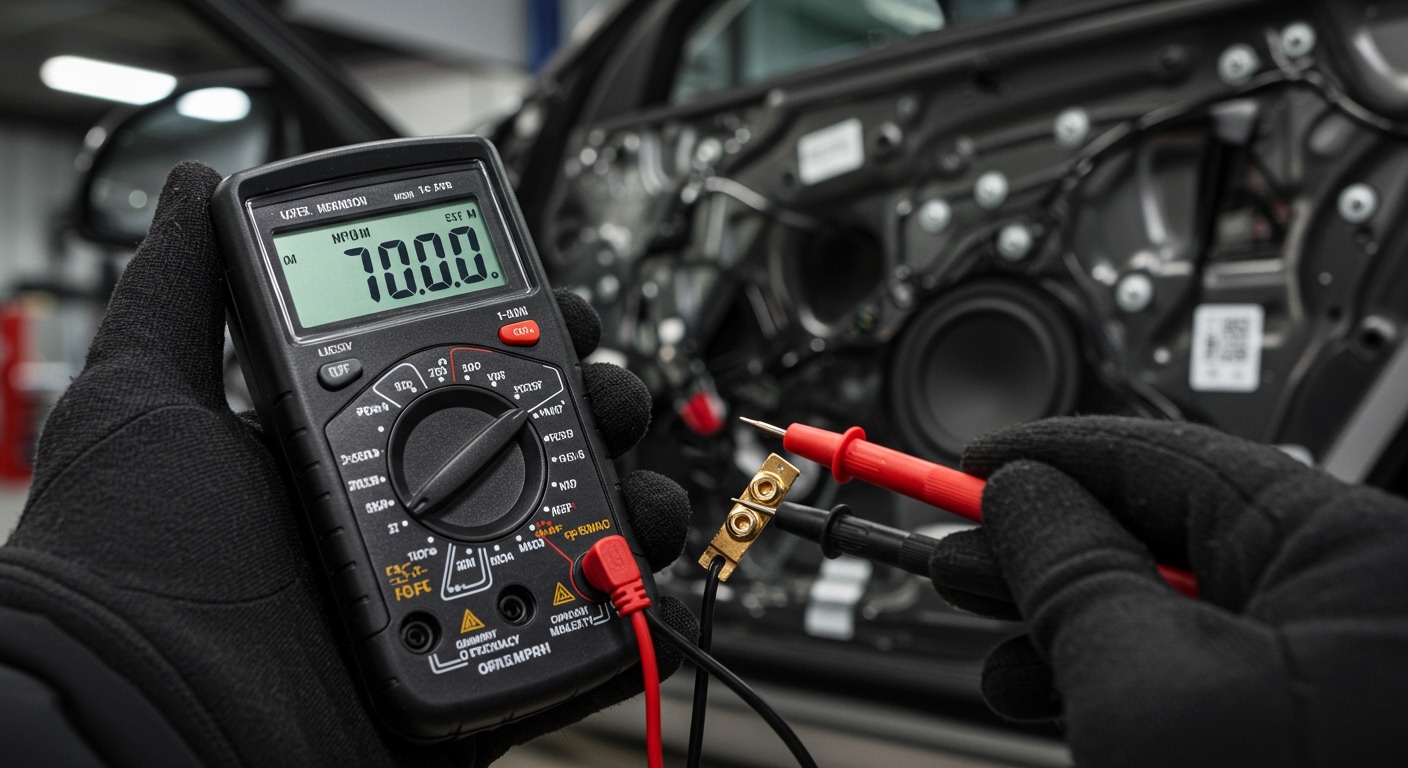
If you are unsure whether your speakers are 4 ohm or 8 ohm, don’t guess. Doing so can fry your amplifier. Follow this process using a Digital Multimeter (DMM).
Set Your Multimeter to Ohms (Ω)**
Turn the dial to the lowest resistance setting (usually 200 ohms).
Disconnect the Speaker**
CRITICAL: You cannot accurately measure a speaker while it is connected to the amplifier. Disconnect at least one wire from the terminal.
Touch the Probes to the Terminals**
Place the red probe on the positive (+) terminal and the black probe on the negative (-) terminal.
Read the DC Resistance (Re)**
A 4-ohm speaker will typically read between 3.2 and 3.8 ohms on a meter. This is because a multimeter measures DC Resistance, while the “4-ohm” rating is AC Impedance (which changes with frequency).
- If it reads ~3.5Ω, it’s a 4-ohm speaker.
- If it reads ~6.8Ω, it’s an 8-ohm speaker.
- If it reads ~1.8Ω, it’s a 2-ohm speaker.
Wiring Logic: How to Change Your Ohms
One reason people ask why are car speakers 4 ohm is because they want to know if they can change that value. Through wiring, you can. This is most common with Subwoofers.
Series Wiring (Increases Ohms)
If you have two 4-ohm speakers and wire them in Series (Positive of Amp to Pos of Speaker 1 -> Neg of Speaker 1 to Pos of Speaker 2 -> Neg of Speaker 2 to Neg of Amp), you add them together.
- Result: 4 + 4 = 8 Ohms.
Parallel Wiring (Decreases Ohms)
If you wire the same two speakers in Parallel (Both Positives to Amp Pos, both Negatives to Amp Neg), you divide the impedance.
- Result: 4 / 2 = 2 Ohms.
Actionable Advice: Always check your amplifier’s “Minimum Impedance” rating before wiring in parallel. If your amp is only “4-ohm stable” and you wire speakers down to 2 ohms, the amp will eventually enter Thermal Protect Mode or suffer internal failure.
The Role of E-E-A-T in Speaker Selection
When we evaluate speakers at our facility, we look beyond the 4-ohm label. We consider Sensitivity (dB).
A 4-ohm speaker with a low sensitivity (85dB) might actually sound quieter than an 8-ohm speaker with high sensitivity (92dB). When you are looking for replacements, don’t just match the ohms; look for a Sensitivity rating of 90dB or higher if you are running them off a factory radio. This ensures you get the most “bang” for your wattage.
We’ve seen customers buy expensive 4-ohm “Competition” speakers only to be disappointed because their factory radio didn’t have the “juice” to move the heavy voice coils. Always match the RMS Power and Impedance to your source unit.
Frequently Asked Questions (FAQ)
Can I put 8-ohm speakers in my car?
Yes, you can physically install them, and they will work without damaging the radio. However, the volume will be roughly half of what a 4-ohm speaker would produce. This usually results in poor soundstage balance unless you adjust the gain on an external amplifier.
What happens if I put 2-ohm speakers on a 4-ohm radio?
This is dangerous. A 2-ohm speaker has very little resistance, causing the radio to work twice as hard. Most factory head units will overheat, clip the audio signal (causing distortion), or blow a fuse/internal circuit within minutes of high-volume play.
Why do home speakers use 8 ohms instead?
Home speakers use 8 ohms because home amplifiers use high-voltage power supplies. Higher impedance is generally “cleaner” because it requires less current, which generates less heat and allows for thinner speaker wire over long distances (like running wires through walls).
Does 4-ohm vs 8-ohm affect sound quality?
Technically, 8-ohm speakers can have a higher damping factor, leading to tighter control of the woofer. However, in the noisy environment of a car, the difference is virtually imperceptible. The priority in a car is overcoming road noise, which requires the efficiency of 4 ohms.









