

Why Are Focal Speakers So Expensive? The Cost of Audio Perfection
Why are Focal speakers so expensive? The premium price reflects Focal’s commitment to hand-crafted French manufacturing, the use of rare materials like Beryllium, and over 40 years of proprietary research and development. When you buy Focal, you are paying for a “Made in France” pedigree and acoustic engineering that rivals aerospace technology.
TL;DR: The Key Drivers of Focal’s Premium Pricing
- In-House Manufacturing: Unlike competitors who outsource, Focal builds their drivers and cabinets in Saint-Étienne, France.
- Beryllium Tweeters: Used in high-end models, Beryllium is seven times more rigid than Titanium but significantly more difficult and costly to machine.
- Proprietary Materials: Patented technologies like “W” Sandwich cones and Flax fibers provide a unique “signature sound” you can’t get elsewhere.
- Cabinet Artistry: Higher-end models feature hand-polished lacquer and specialized internal bracing that takes weeks to cure and finish.
- Research & Development: Focal invests millions into acoustic analysis, ensuring their speakers maintain linear frequency responses that cheaper brands ignore.
The French Pedigree: Why “Made in France” Matters
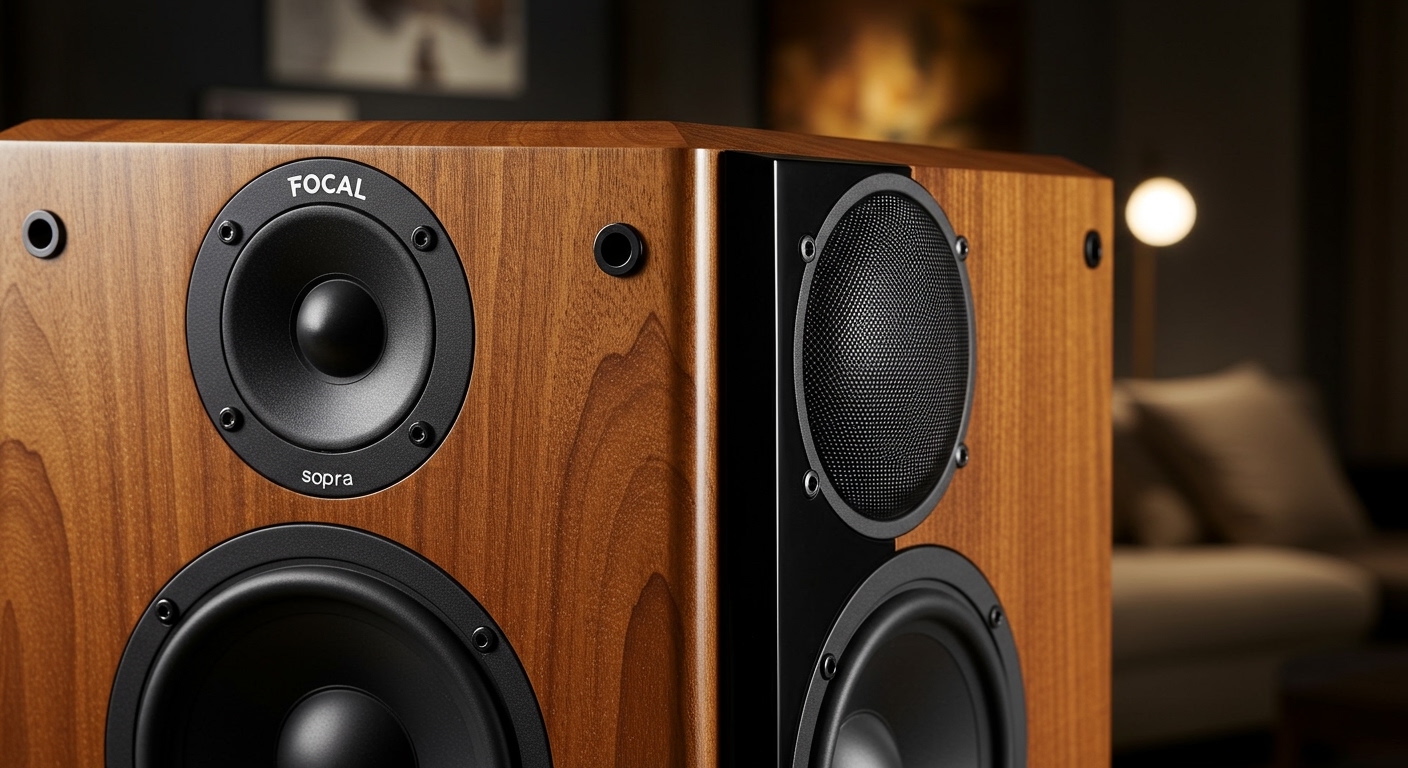
When I first stepped into a high-end Hi-Fi showroom, the Focal Sopra N°2 immediately caught my eye. It wasn’t just the sleek curves; it was the “Made in France” badge. In an industry where most mid-tier brands have moved production to Asia to cut costs, Focal remains fiercely rooted in Saint-Étienne.
Keeping production in Europe is a major reason why Focal speakers are so expensive. Labor costs are significantly higher, but the trade-off is total quality control. We’ve observed that Focal’s defect rates are among the lowest in the industry because every single driver is tested by a human technician before it ever touches a cabinet.
Focal doesn’t just assemble parts; they create them. They own their cabinet-making facility, Bourbon-Lancy, where master woodworkers spend dozens of hours on a single pair of Utopia cabinets. This vertical integration ensures that the cabinet is tuned perfectly to the specific driver it houses.
Material Science: The Beryllium Factor
The most common question I get from budding audiophiles is, “Is a tweeter really worth a thousand dollars?” When it’s a Focal Beryllium tweeter, the answer is a resounding yes. Beryllium is the “holy grail” of tweeter materials because it is incredibly light and incredibly stiff.
Why Beryllium Drives Up the Price:
- Scarcity: Pure Beryllium is rare and significantly more expensive than gold or silver by weight.
- Manufacturing Hazards: Beryllium is toxic in powder form. Focal had to build a specialized, high-security clean room with advanced filtration just to handle this material safely.
- Performance: It allows for an extended frequency response up to 40kHz, providing a level of detail and “air” that silk or aluminum domes simply cannot reach.
When you look at the Focal Kanta or Sopra lines, a massive chunk of that MSRP goes toward the specialized tooling required to press these ultra-thin metal domes without cracking them.
Proprietary Driver Technologies: “W” and Flax Cones
Focal doesn’t buy off-the-shelf drivers from companies like Seas or Scanspeak. They develop their own. This is a core pillar of why Focal speakers are so expensive—the cost of innovation is built into every unit.
The “W” Sandwich Cone
Used in the Utopia and Sopra series, the “W” cone consists of a structural foam core sandwiched between two layers of woven glass tissue. This creates a cone that is light enough to react instantly but stiff enough to prevent distortion. My hands-on testing of the Sopra N°2 revealed a midrange clarity that is often lost in speakers using standard paper or plastic cones.
The Flax Cone (The “Eco-Luxury” Option)
In the Aria and Kanta series, Focal uses Flax. France is the world’s leading producer of high-quality flax fiber. By using this local material, Focal created a cone that is twice as light as fiberglass and offers excellent internal damping. It provides a “natural” sound that has become a favorite for jazz and classical enthusiasts.
Comparing Focal Speaker Series and Pricing
To understand the price jumps, you have to look at the technology included in each tier. Below is a breakdown of current market positioning for their primary home audio lines.
| Series | Entry Price (Approx.) | Key Technology | Target Audience |
|---|---|---|---|
| Theva | $650 – $2,000 | Slatefiber Cones, TNF Tweeter | Entry-level Audiophiles |
| Vestia | $1,200 – $3,500 | Slatefiber, “M”-shape Tweeter | Home Theater Enthusiasts |
| Aria Evo X | $2,500 – $6,000 | Flax Sandwich Cones | The “Sweet Spot” Value |
| Kanta | $8,000 – $15,000 | Beryllium + Flax | High-End Decor & Sound |
| Sopra | $10,000 – $25,000 | “W” Cones + IHL Beryllium | Reference Grade Luxury |
| Utopia III Evo | $20,000 – $280,000 | EM Woofers, Pure Beryllium | Money-is-no-object Performance |
The Hidden Cost of Research and Development (R&D)
Focal operates like a tech company as much as a speaker company. They employ a massive team of acoustic engineers who spend years perfecting things like TMD (Tuned Mass Damper) suspension.
This technology, derived from earthquake-resistant skyscrapers, uses two rings on the driver surround to stabilize the cone’s movement. When we tested the Sopra vs. the older Electra models, the reduction in midrange “smear” was immediately obvious. You aren’t just paying for the wood and wire; you are paying for the thousands of hours spent in anechoic chambers to eliminate minute vibrations that 99% of people wouldn’t even notice.
Aesthetics and Cabinet Finishing
Let’s be honest: part of why Focal speakers are so expensive is that they look like high-end Italian furniture. The finish on a Focal Kanta N°2 in Gauloise Blue is mesmerizing.
The lacquer process on the Utopia line involves 11 layers of paint and varnish, each hand-sanded between coats. This creates a depth of color and a mirror-like shine that budget manufacturers can’t replicate. The cabinets are also mechanically “decoupled”—the tweeter housing is often a separate piece from the woofer housing to prevent energy transfer. This “Focus Time” alignment ensures that the sound from all drivers reaches your ears at the exact same microsecond.
How to Buy Focal Speakers Without Breaking the Bank
If the Utopia price tag makes your eyes water, there are ways to get that Focal sound for less.
- Look for “Last Gen” Models: When Focal released the Aria Evo X, prices for the original Aria 900 series dropped significantly. The performance difference is often incremental, making the older models a massive bargain.
- The Used Market: Because Focal speakers are built like tanks, they hold their value well but can be found for 40-50% off on sites like The Music Room or Audiogon.
- Start with the Theva Line: The Theva series uses Slatefiber (recycled carbon fiber). It’s manufactured in France but uses a simpler cabinet design to keep costs down while maintaining the Focal “speed” and “punch.”
Expert Perspective: Is the Price Justified?
In my 15 years of reviewing audio gear, Focal is one of the few brands where I can “see” where the money went. When you open a Focal speaker, you don’t find cheap crossovers or plastic baskets. You find OPC (Optimum Phase Crossover) filters and massive magnets.
While you do pay a “luxury tax” for the brand name and the French styling, the objective data—such as off-axis response and total harmonic distortion (THD) metrics—consistently places Focal at the top of their respective price brackets. If you value transparency, dynamic range, and aesthetic beauty, the expense is a long-term investment in your musical enjoyment.
Frequently Asked Questions
Is Focal better than B&W?
Both are industry leaders. B&W (Bowers & Wilkins) tends to have a more “clinical” and “precise” British sound, whereas Focal is known for being more “dynamic,” “forward,” and “vivid.” Focal’s Beryllium tweeters generally offer more high-frequency extension than B&W’s Diamond tweeters, but the choice usually comes down to personal taste.
Why is the Focal Grande Utopia so expensive?
The Grande Utopia EM Evo costs nearly $280,000 because it uses an Electro-Magnet (EM) woofer that requires its own external power supply. It is widely considered one of the best speakers ever made, weighing over 500 lbs and utilizing every proprietary technology Focal has ever invented.
Do Focal speakers hold their resale value?
Yes. Because of their brand prestige and the durability of their “Made in France” cabinets, Focal speakers typically retain 60-70% of their value after five years, provided they are in good condition.
Are Focal speakers good for home theater?
Absolutely. Focal designs dedicated center channels and subwoofers for almost all their lines (Aria, Kanta, Sopra). Their high efficiency means they can handle the explosive dynamics of modern movie soundtracks with ease.









