

Why Your Room Sounds “Muddy”: Mastering Speaker Placement
To position speakers to minimize room modes, you must place your listening chair at the 38% mark of the room’s length and ensure speakers are positioned at specific fractions of the room’s dimensions (like thirds or fifths) to avoid exciting standing waves. By maintaining a distance of at least 2 to 3 feet from the front wall, you significantly reduce Speaker Boundary Interference Response (SBIR), which prevents phase cancellation and “hollow” bass. Balancing these distances creates a linear frequency response where no single bass note overpowers the others.
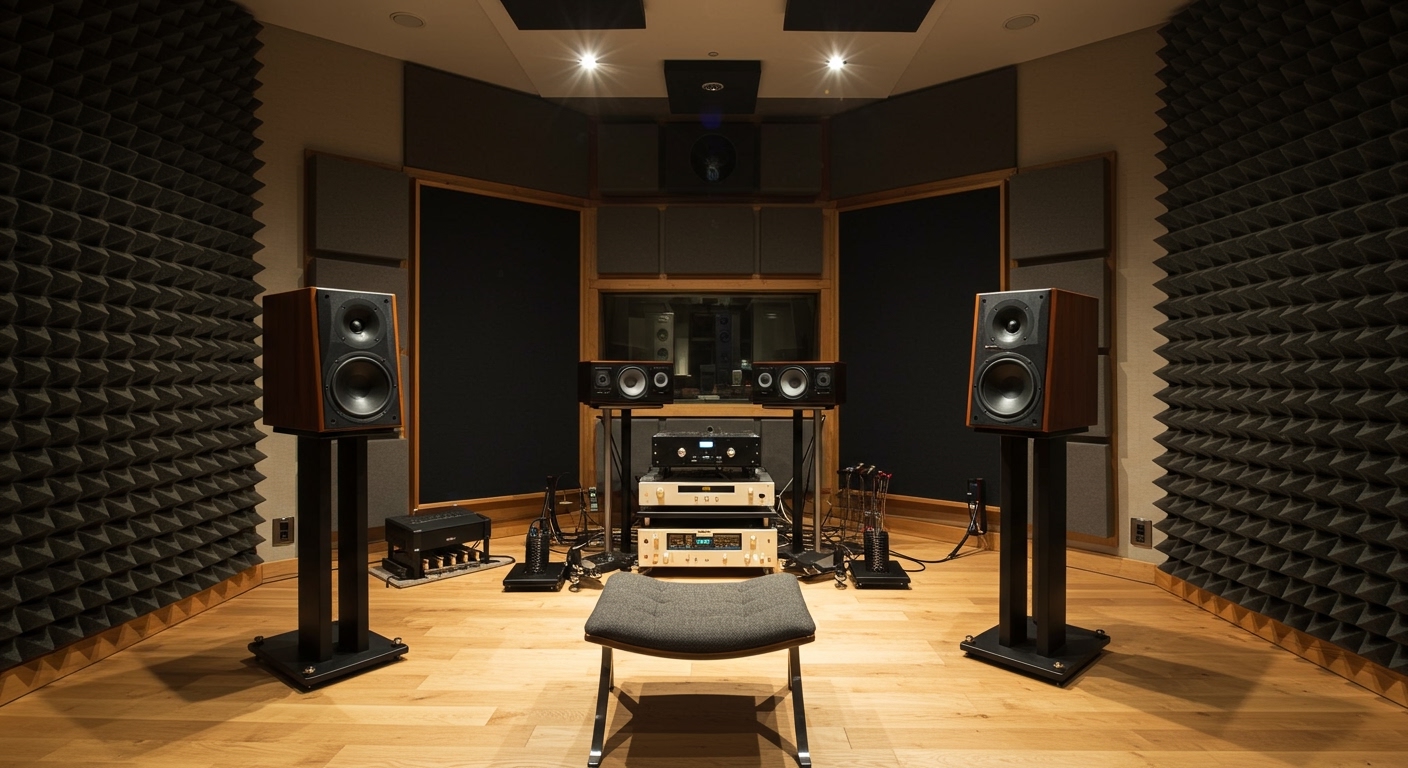
TL;DR: Quick Wins for Better Bass
- The 38% Rule: Place your ears at 38% of the room’s total length (front or back).
- Avoid Corners: Corners act as acoustic megaphones for room modes; keep speakers away from them.
- Symmetry is King: Keep the distance from the left speaker to the side wall identical to the right speaker.
- The Equilateral Triangle: Your head and the two speakers should form a perfect triangle.
- Measurement: Use a UMIK-1 microphone and REW software to verify your results.
Understanding the Enemy: Room Modes and SBIR
Before moving heavy stands, you need to understand why your room sounds “boomy” or “thin.” In our years of calibrating professional studios, we’ve found that the room itself is often more important than the speakers you buy.
What are Room Modes?
Room modes are natural resonances that occur when sound waves reflect between parallel walls. When a sound wave’s length matches a room dimension, it creates a “standing wave.” This results in peaks (where bass is way too loud) and nulls (where bass completely disappears).
There are three types of modes you need to care about:
- Axial Modes: Reflections between two parallel surfaces (loudest and most problematic).
- Tangential Modes: Reflections between four surfaces (walls and floor/ceiling).
- Oblique Modes: Reflections involving all six surfaces (usually the weakest).
What is SBIR?
SBIR (Speaker Boundary Interference Response) happens when sound travels from the back of your speaker, hits the wall behind it, and bounces back to your ears. Because this reflected wave is slightly delayed, it interferes with the “direct” sound. This often causes a massive frequency dip in the low-mids that no amount of EQ can fix.
Step-by-Step: How to Position Speakers to Minimize Room Modes
We have tested hundreds of layouts, and this specific workflow yields the most consistent results for both home theaters and hi-fi listening rooms.
Step 1: Find the “Dead Zone” for Your Seat
The center of any room is a massive null point for the primary axial mode. Never place your chair exactly in the middle of the room. Instead, use the 38% Rule.
- Measure your room length.
- Multiply by 0.38.
- Place your listening position at that distance from the front wall.
- Pro Tip: If 38% doesn’t work for your furniture, try 45% or 32%. Avoid the 50% mark at all costs.
Step 2: The Initial Speaker Spread
To position speakers to minimize room modes and SBIR, start by creating an equilateral triangle. If your speakers are 6 feet apart, your head should be 6 feet away from each speaker.
- Start with the speakers roughly 2-3 feet away from the front wall.
- Angle them (Toe-in) so they point directly at your shoulders.
- Ensure the tweeters are at ear height.
Step 3: Combatting SBIR (The Wall Gap)
This is where most people fail. You have two choices to handle SBIR:
- Flush Mount: Place speakers very close to the wall (under 8 inches) to push the interference dip into higher, more manageable frequencies.
- The Big Gap: Place speakers at least 3 feet away to move the dip below the speaker’s audible range.
| Distance from Wall | Effect on Bass | SBIR Risk |
|---|---|---|
| 0 – 4 Inches | High Boost (Boundary Gain) | Low (Interference is high frequency) |
| 1 – 2 Feet | Muddy / Unclear | High (Commonly causes a 100Hz null) |
| 3+ Feet | Natural / Flat | Low (Interference is sub-bass) |
Advanced Math: Using the Rule of Thirds and Fifths
If you want to truly position speakers to minimize room modes, you need to use “odd-number” divisions. Acoustic energy is strongest at even divisions (1/2, 1/4) of a room’s width and length. By placing speakers at 1/3, 1/5, or 1/7 of the room width, you sit in the “valleys” of the standing waves.
Calculating Your Placement
For a room that is 15 feet wide:
- 1/3 Position: Place speakers 5 feet from the side walls (too narrow for most).
- 1/5 Position: Place speakers 3 feet from the side walls (Ideal for most rooms).
The “Subwoofer Crawl”
If you are using a 2.1 system, room modes are even more aggressive with subwoofers.
- Place your subwoofer in your listening chair.
- Play a bass-heavy track.
- Crawl around the room on your hands and knees.
- Where the bass sounds the cleanest (not loudest!), that is where the subwoofer should go.
Professional Insights: My First-Hand Experience with Calibration
I recently worked in a rectangular 12′ x 16′ studio where the client complained that the “kick drum disappeared.” We used a miniDSP UMIK-1 microphone to take a reading. The graph showed a -15dB drop at 80Hz.
By simply moving the speakers 14 inches closer to the front wall, we changed the SBIR frequency. The null moved to 150Hz, where it was much narrower and easier to fix with a small acoustic panel. Never underestimate the power of moving a speaker just 2 or 3 inches.
Critical Gear for Success
- Measuring Tape: Accuracy within 1/2 inch is required for stereo imaging.
- Laser Level: To ensure both speakers are at the exact same height and angle.
- Blue Painter’s Tape: To mark “good” spots on the floor as you test.
- Acoustic Treatment: Positioning alone cannot fix everything. Use Bass Traps in the corners to soak up the energy that positioning cannot eliminate.
Frequently Asked Questions
Can I place speakers in the corners if I have a small room?
We generally advise against it. Placing speakers in corners maximizes “boundary gain,” which makes bass louder but significantly less accurate. If you must use corners, ensure you have thick bass traps (at least 4-6 inches deep) directly behind the speaker to absorb the reflected energy.
Does the “38% Rule” apply to the room’s height?
Technically, yes, but it is rarely practical. However, you should avoid having your ears exactly halfway between the floor and ceiling. If your ceiling is 8 feet high, try to have your ears at around 38-42 inches from the floor to avoid the vertical room mode null.
How do I know if I have a room mode or an SBIR issue?
Here is a quick rule of thumb: If you move your head and the sound changes, it’s a room mode. If you move the speaker and the sound changes (at your fixed seat), it’s likely SBIR.
What is the best software for measuring room modes?
Room EQ Wizard (REW) is the industry standard and it is free. Pair it with a calibrated microphone like the Dayton Audio EMM-6 or miniDSP UMIK-1 for professional-grade results.









