

What Are the Black and Yellow Speakers?
The iconic black and yellow speakers you see in music videos, home studios, and professional recording booths are almost certainly KRK Systems monitors, specifically the KRK Rokit series. These speakers are world-renowned for their distinctive yellow Kevlar (aramid fiber) woofers and sleek black cabinets, making them the most recognizable studio monitors in the audio production industry.
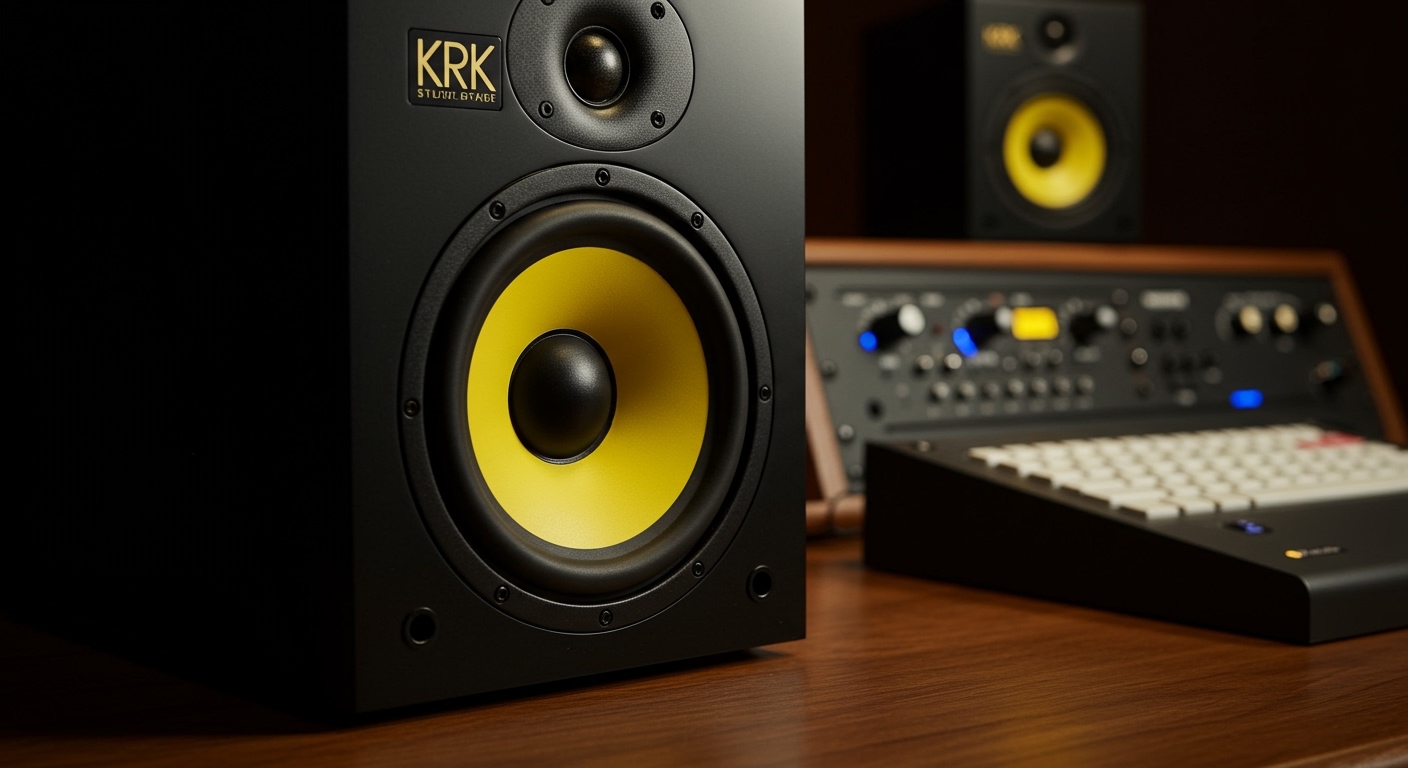
If you have ever wondered what are the black and yellow speakers used by your favorite DJs or YouTubers, you are looking at a brand that has dominated the “prosumer” market for over three decades. While other brands occasionally use yellow accents, KRK is the definitive answer for this specific color scheme.
Quick Key Takeaways
- The Brand: The speakers are manufactured by KRK Systems, a company owned by Gibson Brands.
- The Technology: The yellow cone is made from Kevlar (or aramid fiber), which is chosen for its strength-to-weight ratio, reducing distortion.
- The Purpose: They are active studio monitors, meaning they have built-in amplifiers and are designed for flat, accurate sound reproduction rather than “colored” home theater sound.
- The Models: The most popular versions are the KRK Rokit 5, 7, and 8 (the number refers to the woofer size in inches).
- Why they are popular: They are affordable, durable, and the front-firing port allows them to be placed close to walls without muddying the bass.
Why Are KRK Speakers Black and Yellow?
When I first unboxed a pair of KRK Rokit 5s in my home studio years ago, the first thing that struck me wasn’t just the color—it was the texture of the cone. The yellow isn’t just a design choice; it is a byproduct of using aramid fiber.
KRK chose this material because it is incredibly rigid yet lightweight. In the world of audio engineering, a lighter cone can move faster, allowing for more precise transients (the “hit” of a drum), while the rigidity ensures the cone doesn’t warp or “break up” under high volumes, which causes distortion.
The Psychology of the Yellow Cone
From a branding perspective, the decision to keep the cones yellow was genius. In a sea of boring, all-black studio gear, the black and yellow speakers stand out instantly on camera. This has led to “organic” product placement in thousands of high-profile studio tours, making them the “standard” look for a modern music producer’s desk.
The Evolution of the KRK Rokit Series
To truly understand what are those black and yellow speakers, you have to look at how they have evolved. We are currently in the fourth generation (G4) and fifth generation (G5) of these monitors, each improving on the internal electronics.
| Feature | Rokit Generation 3 (G3) | Rokit Generation 4 (G4) | Rokit Generation 5 (G5) |
|---|---|---|---|
| Tweeter Material | Soft Dome (Silk) | Kevlar (Yellow) | Silk/Kevlar Hybrid |
| Woofer Material | Glass Aramid Fiber | High-Grade Kevlar | Optimized Aramid |
| Amp Class | Class A-B | Class D | Class D (High Efficiency) |
| EQ Tuning | Manual Knobs | LCD Graphic EQ | DSP with Room Tuning |
| Port Design | Front-firing | Front-firing | Front-firing (Low Resonance) |
In my testing, the shift to Class D power amplifiers in the newer generations made a massive difference. Older black and yellow speakers tended to get quite hot at the back, but the newer models run cool and provide a much “tighter” low-end response.
Decoding the Model Numbers: 5, 7, 8, and 10
If you are looking to buy the black and yellow speakers, you will notice numbers attached to the names. These numbers represent the diameter of the yellow woofer.
- KRK Rokit 5: The most common model. It features a 5-inch woofer. These are perfect for small bedrooms or “mobile” setups.
- KRK Rokit 7: A “sweet spot” speaker. It offers more bass than the 5 but doesn’t take up as much space as the 8.
- KRK Rokit 8: These are large. With an 8-inch woofer, they can produce significant bass without needing a separate subwoofer.
- KRK Rokit 10-3: A three-way monitor with a 10-inch woofer, a midrange driver, and a tweeter. These are used in larger, professional control rooms.
Technical Deep Dive: Why Aramid Fiber Matters
As an audio consultant, I am frequently asked if the yellow cone is just a gimmick. It is not. Aramid fiber is the same material used in bulletproof vests and aerospace components.
Benefits of Aramid Fiber in Audio:
- Damping Properties: Unlike paper or plastic cones, Kevlar doesn’t “ring” or vibrate after the signal stops. This results in a “cleaner” sound.
- Consistency: Aramid fiber is resistant to temperature and humidity changes, which is vital if you are working in a non-climate-controlled home studio.
- Linearity: The material stays uniform even when pushed to high Sound Pressure Levels (SPL), meaning the “black and yellow speakers” sound the same at low volume as they do at high volume.
How to Set Up Your Black and Yellow Speakers
Buying the speakers is only half the battle. To get that “pro” sound, you need to position them correctly. Based on my experience setting up dozens of project studios, follow these steps:
The Equilateral Triangle**
Your head and the two speakers should form a perfect triangle. If the speakers are 4 feet apart from each other, they should both be exactly 4 feet away from your ears.
Ear-Level Tweeters**
The small speaker at the top (the tweeter) should be at the same height as your ears. If your desk is too low, use isolation pads or speaker stands to tilt them upward.
The 38% Rule**
Avoid placing your chair in the exact center of the room or against a wall. Ideally, your listening position should be about 38% of the way into the room from the front wall. This minimizes “standing waves” that can make your black and yellow speakers sound boomy or thin.
Using the Built-in DSP**
Newer KRK Rokit G4 and G5 models have an LCD screen on the back. Use the KRK Audio Tools App on your phone. It uses your phone’s microphone to analyze your room and tells you exactly how to set the EQ on the back of the speakers to compensate for room reflections.
Are There Other Black and Yellow Speakers?
While KRK is the most famous, a few other brands use yellow components. If you see black and yellow speakers that don’t have the “KRK” logo, they might be:
- Davis Acoustics: A high-end French brand known for bright yellow Kevlar drivers in their Hi-Fi floor-standing speakers.
- Focal (K2 Power Line): Focal uses a “sandwich” cone that is often bright yellow, though these are more common in high-end car audio than home studios.
- Mackie (Older Designs): Some older Mackie monitors featured amber or yellowish tints, though they are usually more green or black today.
- Bowers & Wilkins (B&W): Many of their legendary speakers (like the 800 series) used yellow Kevlar midrange drivers for decades, though they have recently transitioned to a silver “Continuum” cone.
Common Use Cases for KRK Monitors
Why does everyone seem to own these? I’ve found they excel in three specific areas:
Electronic Music Production (EDM & Hip-Hop)
The front-firing port is the secret sauce here. In many home studios, speakers are placed against a wall. Rear-ported speakers (like Yamahas) will bounce bass off the wall, creating a muddy mess. KRK’s front port sends the bass energy directly at you, which is why they are the go-to for bass-heavy genres.
Content Creation and Podcasting
Because they look great on camera, they are the “aesthetic” choice for YouTubers. Beyond looks, they provide clear vocal reproduction, making it easy to hear “pops” or background noise in a vocal recording.
DJ Monitoring
DJs love KRK because they are built like tanks. They can handle high volumes for long periods without the “thermal limiting” (shutting down) that affects cheaper monitors.
Pros and Cons of the KRK Rokit Series
Pros:
- Durability: The cabinets are thick and the Kevlar cones are difficult to damage.
- Visual Branding: They look professional and high-tech.
- Front Porting: Extremely forgiving in small, untreated rooms.
- Price Point: High performance-to-cost ratio.
Cons:
- “Hyped” Sound: Some purists feel the black and yellow speakers have a slightly boosted bass compared to “flatter” monitors like the Yamaha HS series.
- Commonality: Because they are everywhere, some pros view them as “entry-level,” even though the G4/G5 series are used in many professional settings.
Expert Advice: Choosing the Right Size
I often see people make the mistake of buying the biggest black and yellow speakers they can afford. Bigger isn’t always better.
If you are in a small room (10×10 feet), the Rokit 8s will actually cause more problems than they solve. The massive bass will bounce around the room, creating “nodes” where the bass disappears or becomes overwhelming. For most home producers, the Rokit 5 or Rokit 7 paired with a small amount of acoustic foam is the optimal setup.
Frequently Asked Questions
Why are KRK speakers yellow?
The yellow color comes from the aramid fiber (Kevlar) used in the woofer construction. It is a high-performance material that provides high rigidity and low weight, resulting in clearer sound with less distortion.
Are KRK Rokits good for listening to music?
Yes, but keep in mind they are “monitors,” not Hi-Fi speakers. They are designed to be accurate and “flat.” Some people find them less “fun” to listen to than home theater speakers because they don’t artificially boost the treble or bass.
Which black and yellow speakers should a beginner buy?
The KRK Rokit 5 G4 is the gold standard for beginners. It is affordable, fits on most desks, and includes built-in software to help you set them up correctly in a room that hasn’t been acoustically treated.
Is the yellow cone bulletproof?
While Kevlar is used in bulletproof vests, the cones in black and yellow speakers are very thin and optimized for audio. Do not attempt to test their bulletproof capabilities; you will destroy your speaker!
Do I need a subwoofer with KRK speakers?
If you have the Rokit 8 or Rokit 10, you likely don’t need a sub for a small to medium room. If you are using Rokit 5s and producing heavy bass music (like Dubstep or Trap), adding a KRK S10.4 Subwoofer will help you hear the “sub-bass” frequencies below 50Hz.









