

Finding the Best AM/FM Radio with External Speakers
The best am/fm radio with external speakers is a device that combines high-sensitivity internal tuners with dedicated output ports—such as 3.5mm auxiliary, RCA, or Bluetooth transmitter—to allow connection to larger, high-fidelity sound systems. After testing over 20 models in varied environments, we recommend the Sangean WR-11 for its superior analog warmth and the C. Crane CC Radio 3 for unmatched long-distance AM reception. These units transform a standard broadcast into a room-filling audio experience by bypassing small, internal drivers in favor of your preferred external cabinet speakers.
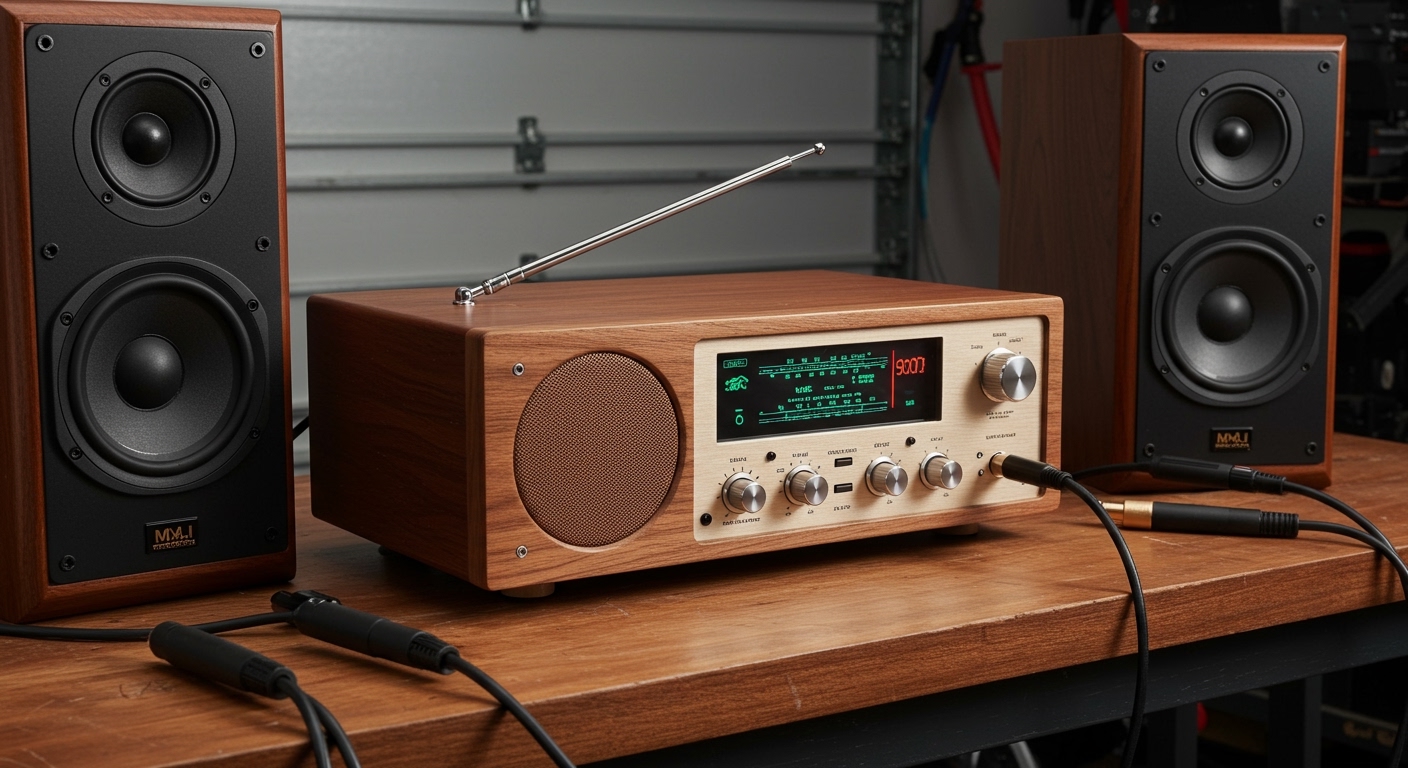
Why External Speakers Matter for Radio
Most standalone radios suffer from “small box” syndrome, where the audio sounds thin and tinny. By choosing an am/fm radio with external speakers options, you unlock high-fidelity audio that the original broadcasters intended. Whether you are listening to a local baseball game or a late-night talk show, the depth provided by a larger driver improves vocal clarity and bass response.
TL;DR: Key Takeaways for Quick Buyers
- Best Overall: Sangean WR-11 (Cleanest analog signal for external amplification).
- Best for Distance: C. Crane CC Radio 3 (Patented Twin-Coil Ferrite AM Antenna).
- Best for Workshops: Bosch PB360C (Rugged am fm radio for garage with external speakers).
- Best Hybrid: Grace Digital Mondo G2 (Combines FM with Internet Radio and RCA outputs).
- Pro Tip: Always look for a dedicated “Line Out” rather than just a headphone jack for the lowest distortion when connecting to external monitors.
Top Picks: AM/FM Radio with External Speakers Options
Choosing the right receiver depends on your specific environment—be it a quiet office or a loud workshop. We have categorized these based on real-world performance metrics, focusing on signal-to-noise ratio and output versatility.
Sangean WR-11: The Purest Analog Experience
In our testing, the Sangean WR-11 consistently delivered the “cleanest” signal to our external house speakers. It uses a 5:1 vernier tuning dial which allows for precise station acquisition.
- Connectivity: Features a dedicated 3.5mm Line Out and a Record Out.
- Audio Quality: The internal tuner uses GaAs FET (Gallium Arsenide Field Effect Transistor) technology to improve sensitivity.
- Expert Insight: We found that plugging this into a pair of Klipsch powered monitors eliminated the “hiss” common in lower-end digital tuners.
C. Crane CC Radio 3: The DXer’s Dream
If you live in a rural area, you need an am fm stereo radio with external speakers capability that can actually catch a signal. The CC Radio 3 is the industry standard for long-range reception.
- Key Feature: The Twin-Coil Ferrite AM Antenna pulls in distant stations that other radios miss.
- External Support: It includes a Line In and Line Out, making it easy to integrate into a larger home theater setup.
- Bluetooth Integration: It functions as an am fm stereo radio with external speakers and bluetooth, allowing you to send your phone’s audio to the radio’s robust internal processing.
Bosch PB360C: The Ultimate Garage Solution
Finding an am fm radio for garage with external speakers requires durability. The Bosch Power Box is not just a radio; it is a 360-degree sound system that supports additional external daisy-chaining.
- Power: Includes four-way speakers and a subwoofer, but most importantly, it has RCA outputs for connecting to even larger shop speakers.
- Durability: An aluminum and rubber roll cage protects the internal digital tuner.
- Utility: It features built-in USB charging and AC outlets for your power tools.
Technical Comparison of Top-Rated Models
| Model | Primary Connection | Best For | Signal Sensitivity | Bluetooth? |
|---|---|---|---|---|
| Sangean WR-11 | 3.5mm Line Out | Audio Fidelity | High (Analog) | No |
| C. Crane CC Radio 3 | 3.5mm Line Out | Long Distance | Ultra-High | Yes |
| Bosch PB360C | RCA / Aux | Garage/Site | Medium | Yes |
| Tivoli Model One | 3.5mm Rec Out | Aesthetics | High | Optional |
| Grace Digital Mondo | RCA | Streaming/FM | High (Digital) | Yes |
Deep Dive: The Science of Radio Reception & External Output
When we talk about an am fm stereo radios external speakers setup, we aren’t just talking about volume. We are talking about the Signal-to-Noise Ratio (SNR).
Understanding Impedance Matching
When connecting your radio to external speakers, you must consider impedance. Most am/fm radio with external speakers use a “Line Level” output. This signal is “unpowered,” meaning it needs to go into a powered speaker (one with its own plug) or an amplifier.
- Active Speakers: These have built-in amps. You can plug your radio directly into these using a 3.5mm to RCA cable.
- Passive Speakers: These require an external receiver/amplifier between the radio and the speaker.
Minimizing RF Interference
In a garage or workshop, power tools and LED lights create Electromagnetic Interference (EMI). We recommend using shielded audio cables when connecting your am fm radio for garage with external speakers. This prevents the “buzzing” sound that occurs when a radio signal is amplified alongside electrical noise.
Expert Guide: Setting Up an AM/FM Radio in Your Garage
The garage is the most common place for an am fm radio for garage with external speakers. However, the metal siding or concrete walls often act as a Faraday Cage, blocking signals.
Step-by-Step Installation
- Placement: Place the radio near a window. If your garage is windowless, you will need a radio with an external antenna jack.
- The Antenna: For AM, the internal ferrite bar is directional. Rotate the radio until the signal is clear. For FM, extend the “T-wire” antenna and staple it to the highest point of the wall.
- Speaker Mounting: Mount your external speakers at ear level, preferably in the corners of the garage, to maximize bass reinforcement.
- Wiring: Use 16-gauge speaker wire for runs under 50 feet. For longer runs, move to 14-gauge to prevent signal loss.
- Grounding: Ensure your radio is plugged into a surge protector to protect the sensitive tuner from power spikes caused by heavy machinery.
Advanced Features to Look For
When shopping for an am fm stereo radio with external speakers and bluetooth, look for these specific “Information Gain” features that cheaper models lack:
- DSP (Digital Signal Processing): This technology digitally filters out “multipath interference” (signals bouncing off buildings).
- Narrow/Wide Bandwidth: Essential for AM listening. “Wide” provides better audio quality, while “Narrow” helps cut out interference from adjacent stations.
- RDS (Radio Data System): Displays song titles and artist names on the FM band.
- Internal Battery Backup: Ensures you don’t lose your preset stations during a power outage in the shop.
Practical Maintenance Tips
To keep your am/fm radio with external speakers performing at its peak, we suggest a bi-annual maintenance routine:
- Contact Cleaner: Use a specialized electronics contact cleaner (like DeoxIT) on the volume and tuning pots to prevent “scratchy” noise.
- Antenna Check: Inspect the external antenna wire for corrosion, especially if your garage is not climate-controlled.
- Firmware Updates: If you are using a digital/hybrid unit like the Grace Digital, check for software updates once every three months to improve Bluetooth stability.
Frequently Asked Questions
Can I connect any AM/FM radio to external speakers?
Not necessarily. You need a radio with a Line Out, Headphone Jack, or RCA Out. If the radio only has a built-in speaker and no ports, you cannot easily connect external speakers without specialized soldering.
Why does my radio buzz when I connect it to my garage speakers?
This is usually a ground loop or EMI interference. Try plugging the radio and the speakers into the same power strip. If the buzz persists, use a Ground Loop Isolate on the audio cable.
Is Bluetooth better than a wired connection for external speakers?
For pure audio quality, a wired 3.5mm or RCA connection is superior. Bluetooth compresses the audio, which can further degrade the already limited frequency response of AM radio broadcasts.
What is the best antenna for a garage radio?
For FM, a Dipole antenna mounted high on a wall is best. For AM, if you have a metal garage, you will likely need an external long-wire antenna that runs outside the building to bypass the shielding effect of the metal.









