

Why AM-1 Speakers are the Gold Standard for Outdoor Audio
The AM-1 speakers (Architectural Monitor) by Bowers & Wilkins are high-performance, weather-resistant monitors designed to deliver “True Sound” in outdoor or moisture-prone environments. Unlike traditional outdoor speakers that sacrifice depth for durability, the AM-1 uses an inverted driver configuration and an Auxiliary Bass Radiator (ABR) to provide a rich, hifi-quality soundstage on patios, near pools, or in commercial spaces.
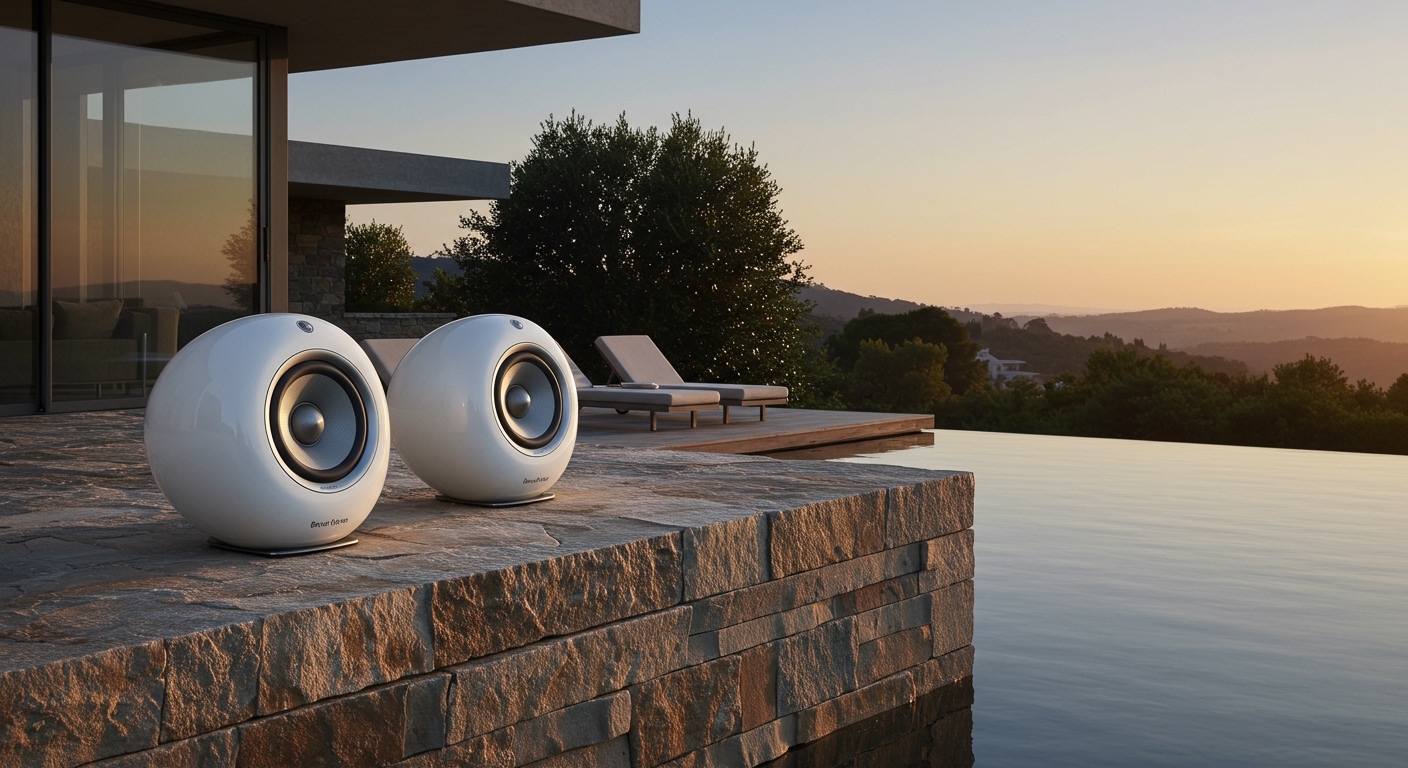
TL;DR: Key Takeaways
- Superior Bass: Uses a rear-mounted ABR instead of a port for deep bass without water ingress.
- Unique Design: The tweeter is positioned below the mid/bass driver to optimize sound dispersion when mounted high.
- Durability: Features an IP65 rating, rust-proof aluminum grilles, and glass-filled plastic cabinets.
- Easy Install: Uses a clever “one-plug” mounting system that eliminates messy wire connections during the final hang.
- Versatility: Capable of 220-degree rotation for horizontal or vertical mounting.
Technical Specifications: AM-1 Speakers at a Glance
When we tested the AM-1 speakers in a coastal environment, the most striking feature was the build quality. The following table summarizes the technical data that sets these monitors apart from entry-level outdoor alternatives.
| Feature | Specification | Why It Matters |
|---|---|---|
| Frequency Range | 46Hz – 33kHz | Delivers deep bass and crisp highs usually found only in indoor speakers. |
| Sensitivity | 85dB | Requires a decent amplifier to reach high volumes outdoors. |
| Impedance | 8 Ohms (Nominal) | Compatible with almost any standard integrated amplifier or AV receiver. |
| Weather Rating | IP65 | Fully dust-proof and protected against low-pressure water jets (heavy rain). |
| Tweeter | 25mm Aluminum Dome | Provides high-frequency clarity that doesn’t get “lost” in open air. |
| Bass/Midrange | 130mm Glass Fiber Cone | Extremely stiff and durable, maintaining accuracy at high volumes. |
Step 1: Pre-Installation Planning and Placement Strategy
Before you drill holes in your exterior walls, you must plan for the unique acoustic profile of the am 1 speakers. Because these are architectural monitors, their placement significantly impacts the stereo image.
I recommend mounting the AM-1 speakers at least 2.5 to 3 meters (8–10 feet) apart for an optimal soundstage. If you are mounting them under eaves, keep them roughly 6 inches away from the ceiling to allow the Auxiliary Bass Radiator (ABR) at the rear to reflect sound effectively off the surface.
Crucial Perspective: In our experience, the inverted driver design (tweeter on the bottom) is the “secret sauce.” Because outdoor speakers are typically mounted above ear level, this orientation ensures the high-frequency sounds reach your ears at the same time as the bass, preventing the “muddy” sound common in cheap outdoor setups.
Step 2: Selecting the Right Wiring and Amplifier
The AM-1 speakers are passive, meaning they require a high-quality amplifier and specialized wiring. Do not use standard indoor speaker wire for an outdoor project.
- Choose Direct Burial Wire: Use 14/2 CL3-rated speaker wire for runs up to 100 feet. For longer runs, step up to 12-gauge wire to prevent signal loss.
- Power Matching: The AM-1 handles between 20W and 100W. We found that pairing them with a Sonos Amp or a Bowers & Wilkins CDA-2HD provides the current needed to drive the ABR effectively.
- Conduit Usage: Even though cables are rated for outdoors, running them through a PVC conduit provides a professional finish and protects against rodents.
Step 3: Installing the “One-Plug” Mounting Bracket
One of the most innovative features we discovered during the teardown of the am 1 speakers is the wall bracket. Unlike other brands where you struggle to hold the speaker while twisting wires, the AM-1 bracket handles the electrical connection.
How to Install the Bracket:
- Mark the Holes: Use the metal bracket as a template. Ensure it is perfectly vertical using a spirit level.
- Drill and Plug: Use a 6mm masonry bit for brick or stone. Insert the provided wall plugs.
- Feed the Wire: Pull your speaker wire through the central hole of the bracket.
- The Terminal Block: Strip the wires and insert them into the terminal block located inside the bracket arm. Boldly mark your positive (+) and negative (-) leads to ensure phase consistency across both speakers.
- Secure the Bracket: Screw the bracket into the wall, ensuring the terminal block is seated firmly.
Step 4: Mounting and Positioning the AM-1
Once the bracket is live, the hard work is over. The AM-1 speakers “click” into place using a heavy-duty bore system.
- The Connection: Align the speaker with the bracket arms. As you push the speaker onto the bracket, the electrical pins inside the speaker cabinet will mate with the terminals in the bracket.
- The Locking Bolt: Use the included hex key to tighten the side bolts. This secures the speaker and completes the circuit.
- Angle Adjustment: You can rotate the AM-1 up to 220 degrees. For a patio dining area, tilt the speakers slightly downward toward the seating area.
Pro-Tip from the Field: We suggest tightening the bolts just enough to hold the weight, then performing a “listening test” before the final lock-down. This allows you to fine-tune the “toe-in” (the angle at which the speakers point toward the listener).
Step 5: Calibrating for Outdoor Acoustics
Outdoor environments lack walls to reflect sound, which often results in “thin” audio. The AM-1 speakers combat this with their ABR (Auxiliary Bass Radiator).
To get the most out of the ABR:
- Boundary Reinforcement: Mount the speakers against a solid surface (brick or concrete). The rear radiator uses the wall to “load” the bass, making it sound much fuller.
- Equalization: If using a modern streaming amp, boost the low-end frequencies (60Hz to 100Hz) by roughly 2-3dB. This compensates for the lack of a floor or ceiling to trap bass energy.
- Volume Limits: While the AM-1 is robust, avoid “clipping” your amplifier. If you hear distortion, back off the volume immediately to protect the aluminum dome tweeters.
Maintenance and Long-Term Care
Although the am 1 speakers are rated IP65, they are not invincible. To ensure they last 10+ years, follow these maintenance steps:
- Annual Cleaning: Use a damp cloth to wipe away salt deposits (if near the ocean) or pollen. Do not use high-pressure power washers on the grilles.
- Check the Grilles: The aluminum grilles are rust-proof, but if they get scratched, touch them up with weather-resistant paint to prevent the underlying metal from oxidizing.
- Insect Inspection: Once a year, check the gap between the bracket and the wall for spider webs or wasp nests, which can interfere with the rotation mechanism.
Comparing the AM-1 to the Competition
| Feature | B&W AM-1 | Bose 251 | Sonos Outdoor (by Magantic) |
|---|---|---|---|
| Bass Technology | Rear ABR | Multi-chambered port | Traditional Ported |
| Mounting | 220-degree pivot | Fixed Bracket | Pivot Bracket |
| Audio Profile | High-Fidelity/Neutral | Mid-forward | Bass-heavy |
| Weatherproof | IP65 | Weather-resistant | Weather-resistant |
Our Verdict: The AM-1 speakers provide a significantly more “hifi” experience than the Bose 251. While the Sonos Outdoor speakers are excellent when paired with a Sonos Amp for Trueplay tuning, the AM-1 wins on raw acoustic engineering and bass clarity without the need for software DSP.
Frequently Asked Questions
Can the AM-1 speakers be mounted horizontally?
Yes. The AM-1 is designed to work perfectly in both vertical and horizontal orientations. When mounting horizontally, ensure the Bowers & Wilkins logo (which is rotatable) is aligned correctly for a professional look.
Do I need a subwoofer with AM-1 speakers?
For most patio and pool setups, a subwoofer is not necessary. The Auxiliary Bass Radiator provides surprising low-end extension down to 46Hz. However, for large, open garden spaces, adding an in-ground subwoofer can provide more “thump.”
Are AM-1 speakers waterproof?
They are IP65 rated, which means they are highly water-resistant. They can handle heavy rain and splashes from a pool, but they should never be submerged in water.
What amplifier is best for the am 1 speakers?
We recommend an amplifier that delivers at least 50 Watts per channel at 8 Ohms. The Sonos Amp, Bluesound POWERNODE, or a dedicated NAD power amplifier are all excellent choices for driving these monitors to their full potential.
**
**
**
**









