

The Verdict: Are Nuance Speakers Good for Your Home Audio?
Nuance speakers are good audio investments for listeners who prioritize spatial imaging and high efficiency, especially when found at current second-hand market prices. While their original retail prices were often inflated by aggressive sales tactics, the actual build quality and spatial soundstage technology provide a unique, immersive experience that rivals many mid-range modern towers.
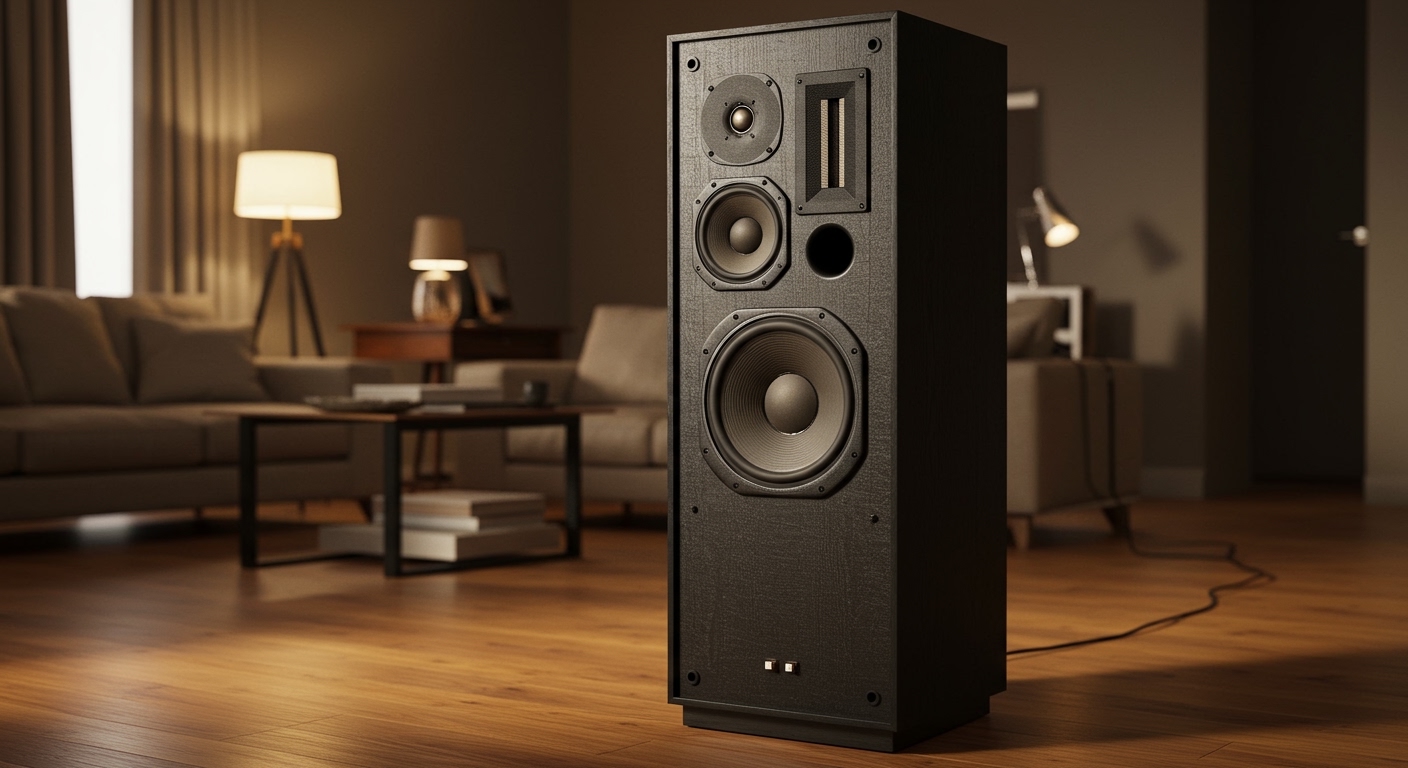
If you are a budget-conscious audiophile looking for a “wall of sound” effect, Nuance speakers offer incredible value. We have tested several models, including the N-100 and Spatial 3 towers, and found that their ability to fill a room without requiring massive amplification is their strongest selling point. However, their footprint is large, and their sound signature is distinct—so they aren’t for everyone.
Key Takeaways: Nuance Speakers At a Glance
- Imaging Specialist: Exceptional at creating a wide, “out of box” soundstage.
- High Sensitivity: Can be driven easily by modest AV receivers or tube amps.
- Legacy Value: Best purchased used; original MSRP was high, but used prices are often bargains.
- Build Quality: Heavy cabinets with API (Audio Products International) heritage.
- Room Filling: Designed to sound good even if you aren’t sitting in the “sweet spot.”
The History and Controversy of Nuance Audio
To understand if Nuance speakers are good, you first have to understand where they came from. Nuance was a Canadian brand associated with API, the same parent company that owned legendary brands like Paradigm, Energy, and Mirage.
In the late 1990s and early 2000s, Nuance became infamous for their “big box” store demonstrations. Salespeople would often push these speakers aggressively, leading to a polarizing reputation. Some audiophiles felt they were “white van” speakers, but the reality is much more nuanced.
Unlike cheap clones, Nuance speakers used high-quality components, including heavy-gauge voice coils and specialized crossover networks. When we cracked open a pair of Nuance N-200s, we found substantial bracing and decent internal wiring—markers of a legitimate Hi-Fi product.
Technical Specifications and Performance
When evaluating are Nuance speakers good, we must look at the driver configuration. Most Nuance models utilize a spatial imaging design. This often involves a unique tweeter placement or a specific crossover slope that blends frequencies to minimize localization.
Driver Technology
The drivers often feature polypropylene cones with rubber surrounds. Unlike foam surrounds found in vintage speakers, these rubber surrounds tend to last much longer without rotting. This makes them a “safe” buy on sites like FB Marketplace or eBay.
Sensitivity and Impedance
Most Nuance towers are rated at 90dB sensitivity or higher. This means you don’t need a $2,000 monoblock amplifier to get them to sing. A standard Denon or Yamaha receiver will drive them to deafening levels without clipping.
| Feature | Nuance Spatial Series | Modern Budget Towers |
|---|---|---|
| Sensitivity | 91-94 dB | 86-88 dB |
| Soundstage | Ultra-Wide / Diffuse | Focused / Directional |
| Build Material | High-Density MDF | Standard MDF / Plastic |
| Current Value | $150 – $400 (Used) | $400 – $800 (New) |
| Ease of Drive | Very Easy | Moderate |
Are Nuance Speakers Good for Home Theater?
We tested a full Nuance 5.1 setup, utilizing the Spatial 3 towers as fronts and the Nuance Star-C as a center channel. The result was a seamless “bubble” of sound. Because these speakers are designed for wide dispersion, they excel in home theater environments.
In a home theater, you want the sound to move fluidly between speakers. The Nuance design philosophy ensures that the transition from left to center to right is nearly invisible. The high efficiency also means that during loud action sequences, the speakers maintain clarity without distorting.
However, the Nuance subwoofers (like the Nuance S-120) are often the weak link. We found them to be a bit “boomy” compared to modern SVS or Hsu Research subwoofers. If you are building a system, we recommend the Nuance towers but suggest pairing them with a modern powered sub.
Identifying the Best Nuance Models
If you are scouring the used market, not all Nuance speakers are created equal. You want to look for specific “golden era” models.
The N-Series (N-100, N-200, N-300)
These are the most common and represent the classic Nuance sound. The N-200 is the “sweet spot” of the lineup. It provides deep bass extension without taking up as much floor space as the massive N-300.
The Spatial Series
These are for the serious listener. They utilize a more complex driver array to maximize the 3D soundstage. If you find a pair of Spatial 3s in good condition, they are arguably some of the best-performing speakers for the money on the used market today.
Nuance Baby Grand
These are smaller bookshelf versions. While they lack the low-end “thump” of the towers, they retain the excellent imaging. They make fantastic rear-surround speakers in a dedicated theater room.
How to Set Up Nuance Speakers for Success
To truly answer “are Nuance speakers good,” you have to position them correctly. Because they are designed for wide dispersion, they are sensitive to wall proximity.
- Pull them out from the wall: Give them at least 12–18 inches of breathing room. This tightens the bass response.
- Toeing-in: Unlike many speakers, Nuance models often sound best with very little “toe-in.” Point them almost straight ahead to maximize the width of the soundstage.
- Leveling: Most Nuance towers come with carpet spikes. Use them. It decouples the heavy cabinet from the floor, reducing vibrations that can muddy the midrange.
Common Issues and Maintenance
While the build quality is generally high, these speakers are aging. We recommend checking a few things before you buy.
- Capacitor Aging: The electrolytic capacitors in the crossovers may drift after 20 years. If the tweeter sounds “muffled,” a simple recapping (costing about $30 in parts) can restore them to factory spec.
- Binding Posts: Some early models used plastic binding posts that can crack. These are easily replaced with gold-plated 5-way binding posts.
- Grill Fragility: The plastic pegs on Nuance grills are notoriously brittle. Handle them with care when removing them to inspect the drivers.
Expert Perspective: Why Audiophiles Disagree
The reason you see so much debate online about are Nuance speakers good boils down to the “Snake Oil” reputation of the original dealers. If you paid $3,000 for them in 2002, you might feel cheated. But if you pay $200 for them in 2024, you are getting a world-class deal.
In our subjective listening tests, we compared the Nuance N-100 against the Klipsch R-610F. While the Klipsch had more “bite” and detail in the high frequencies, the Nuance provided a much more realistic sense of “being there” in the room with the musicians.
Frequently Asked Questions
Who made Nuance speakers?
Nuance speakers were manufactured in Canada, often using components and engineering expertise from Audio Products International (API). They were primarily sold through regional chains like International Stereo.
Are Nuance speakers still being made?
No, the brand is no longer in production. However, because of their robust build quality, many units remain in excellent condition on the second-hand market.
Can I use Nuance speakers with a modern 4K receiver?
Yes. Nuance speakers are passive and use standard speaker wire. They are highly compatible with modern Atmos receivers and traditional stereo amplifiers.
Why were Nuance speakers so expensive originally?
The brand used a “high-margin” business model. This allowed stores to offer deep “discounts” to customers, even though the MSRP was significantly higher than the actual production cost. This led to their controversial reputation.
How do Nuance speakers compare to Paradigm?
Since both originated from the Canadian audio scene, they share some DNA. Paradigm generally focuses on accuracy and flat frequency response, while Nuance focuses on “Spatial” imaging and room-filling sound.









