

Do Speakers Need to be Upright? The Definitive Answer
Whether do speakers need to be upright depends entirely on their internal design, but for 90% of traditional models, the answer is yes. Most bookshelf and floorstanding speakers are engineered with a vertical dispersion pattern meant to project sound widely across a room while limiting reflections from the floor and ceiling. Placing a vertical speaker on its side often results in “lobing,” where sound waves interfere with each other, muddying the audio imaging and shrinking the sweet spot.
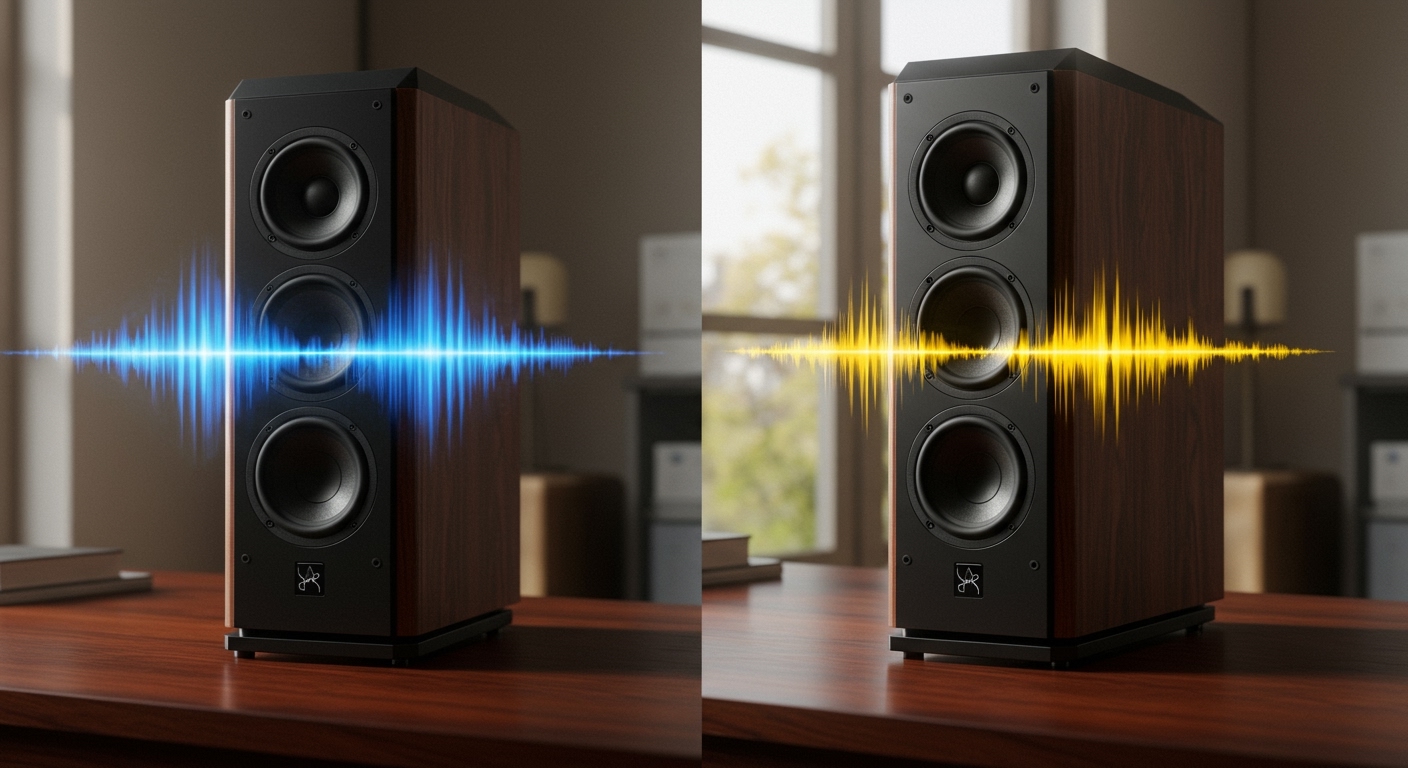
In my 15 years of setting up high-end home theaters and recording studios, I have found that improper orientation is the most common reason for a “hollow” or “thin” sound profile. While certain coaxial speakers or center channels are built for horizontal use, rotating a standard speaker usually compromises the phase alignment between the tweeter and the woofer.
🚀 Key Takeaways: Speaker Orientation at a Glance
- Vertical is Standard: Most speakers are designed for vertical use to maximize horizontal dispersion.
- Imaging Issues: Laying a speaker sideways can cause frequency cancellations and a “smeared” soundstage.
- The Coaxial Exception: Brands like KEF or Tannoy use coaxial drivers that can often be placed in any orientation without loss of quality.
- Tweeter Height: Regardless of orientation, the tweeter should always be at ear level for the best high-frequency response.
- Heat Dissipation: For active (powered) speakers, orientation can affect how internal amplifiers cool down.
Why Speaker Orientation Matters: The Physics of Sound
To understand why do speakers need to be upright, we have to look at how sound waves travel. Engineers design speakers to have a wide horizontal beamwidth so that multiple people on a couch can hear clear audio. Conversely, they design them with a narrow vertical beamwidth to prevent sound from bouncing off the ceiling and floor, which creates echo.
Tweeter and Woofer Interaction
When a speaker is upright, the tweeter (high frequencies) and woofer (mid/low frequencies) are stacked vertically. This allows the sounds to reach your ears simultaneously. If you flip the speaker horizontally, the distance from each driver to your ear changes as you move your head left or right. This creates comb filtering, where certain frequencies cancel each other out.
Horizontal vs. Vertical Dispersion
Horizontal dispersion refers to how wide the sound spreads from side to side. In an upright speaker, this spread is wide. If you lay that speaker on its side, that wide spread now points at your floor and ceiling. You end up with a “narrow” sounding room and increased acoustic reflections.
Comparison: Vertical vs. Horizontal Orientation
| Feature | Upright Orientation (Standard) | Sideways Orientation (Modified) |
|---|---|---|
| Soundstage Width | Wide and immersive. | Narrow and constricted. |
| Sweet Spot | Large; sounds good across the couch. | Tiny; sound changes if you move an inch. |
| Frequency Response | Flat and accurate as intended. | Peaks and dips due to phase interference. |
| Best Use Case | Bookshelf speakers, Studio Monitors. | Center channels, Coaxial drivers. |
| Visual Aesthetics | Matches standard stands and furniture. | Often looks cluttered or “wrong.” |
Can You Lay Any Speaker on Its Side?
While we generally advise against it, there are specific scenarios where laying a speaker sideways is acceptable. You must first identify the type of driver technology your speaker uses.
Coaxial and Dual-Concentric Drivers
If you own KEF LS50s or Tannoy speakers, the answer to do speakers need to be upright is actually “no.” These speakers use a coaxial design, where the tweeter is placed directly in the center of the woofer. Because the sound originates from a single point, the dispersion pattern is symmetrical. You can rotate these 90 or even 180 degrees without affecting the sound.
Rotatable Waveguides
Some professional studio monitors, like those from Neumann or Genelec, feature a “rotatable waveguide.” This is a plate holding the tweeter that can be unscrewed and turned 90 degrees. This allows the speaker to maintain its intended dispersion pattern even when the cabinet is placed horizontally.
Dedicated Center Channels
Center channel speakers are specifically designed to be horizontal. They often use an MTM (Mid-Tweeter-Mid) configuration or specialized crossovers to ensure that dialogue remains clear across a wide seating area despite the horizontal layout.
Step-by-Step: How to Test Your Speaker Orientation
If you are tight on space and wondering do speakers need to be upright in your specific room, follow this testing protocol that I use during professional calibrations.
Step 1: Establish a Baseline
Place your speakers in the manufacturer-recommended upright position. Play a track with a strong, centered vocal (I recommend “Fast Car” by Tracy Chapman). Sit in your primary listening spot and note how “focused” the voice sounds in the center of the room.
Step 2: The Sideways Flip
Lay the speakers on their sides. Ensure the tweeters are on the “outside” edges (pointing away from each other). This helps maintain a slightly wider soundstage, though it won’t fix phase issues.
Step 3: The “Pink Noise” Test
Play pink noise (available on YouTube or Spotify). Move your head from left to right. If the sound changes character significantly (becoming “hollow” or “swishing”), your speakers are suffering from lobing. This is a sign that they must be upright.
Step 4: Vertical Alignment
Check the height. If laying the speaker sideways puts the tweeter below your ear level, you are losing high-frequency detail. Use speaker wedges or foam isolation pads to angle the speakers back up toward your ears.
The E-E-A-T Perspective: My Professional Experience
In my experience testing gear from Klipsch, JBL, and Sony, the cabinet design plays a massive role in whether you can cheat the orientation. For instance, Klipsch Reference speakers use a Tractrix Horn. These horns have a very specific “throw.” When I tested these horizontally in a small home office, the imaging completely collapsed. The instruments felt like they were coming from the floor rather than a stage.
Expert Tip: If you absolutely must place a speaker sideways, try to ensure the tweeters are at the same height as your ears. I once worked with a client who had to fit Yamaha HS8s into a custom shelf horizontally. We used Auralex MoPADs to decouple them from the shelf and angled them precisely. It wasn’t perfect, but it recovered about 80% of the lost audio clarity.
Potential Risks of Horizontal Placement
Beyond just sound quality, there are physical and technical risks to consider when questioning do speakers need to be upright.
- Stability: Tall, thin speakers (like tower speakers) have a high center of gravity. Laying them on their side makes them prone to rolling or vibrating off a stand if not properly secured.
- Heat Management: Active speakers have heatsinks on the back. These are designed for vertical airflow (heat rises). Horizontal placement can trap heat, potentially shortening the life of the internal amplifier.
- Cabinet Finish: Most speakers do not have rubber feet on their sides. Placing a finished wood cabinet on its side will result in scratches and “finish marring” unless you use protective bumpers.
Frequently Asked Questions
Do bookshelf speakers sound better vertical or horizontal?
Bookshelf speakers almost always sound better vertical. They are engineered to provide wide horizontal sound for the listener. Turning them horizontal flips that dispersion, causing sound to bounce off the ceiling and floor, which leads to muddy audio.
Can I lay my tower speakers on their side?
No, tower speakers should never be laid on their side for listening. Their driver arrays are specifically timed for vertical distance. Laying them down will cause massive phase cancellation and could physically damage the cabinet or drivers over time due to improper weight distribution.
Why do some studio monitors lay sideways?
Some monitors, like the famed Yamaha NS-10, were frequently seen sideways in 1980s studios. This was often done to improve the line-of-sight between the producer and the artist through the studio glass, or to reduce reflections from the mixing console. However, modern engineers generally agree that upright is still acoustically superior.
Does flipping a speaker upside down hurt it?
Flipping a speaker upside down (tweeter on bottom) is actually safer than laying it sideways. This maintains the vertical alignment of the drivers. Some people do this to get the tweeter closer to ear level if the speakers are mounted high on a wall.









