

Do You Need an Amp for Wakeboard Tower Speakers?
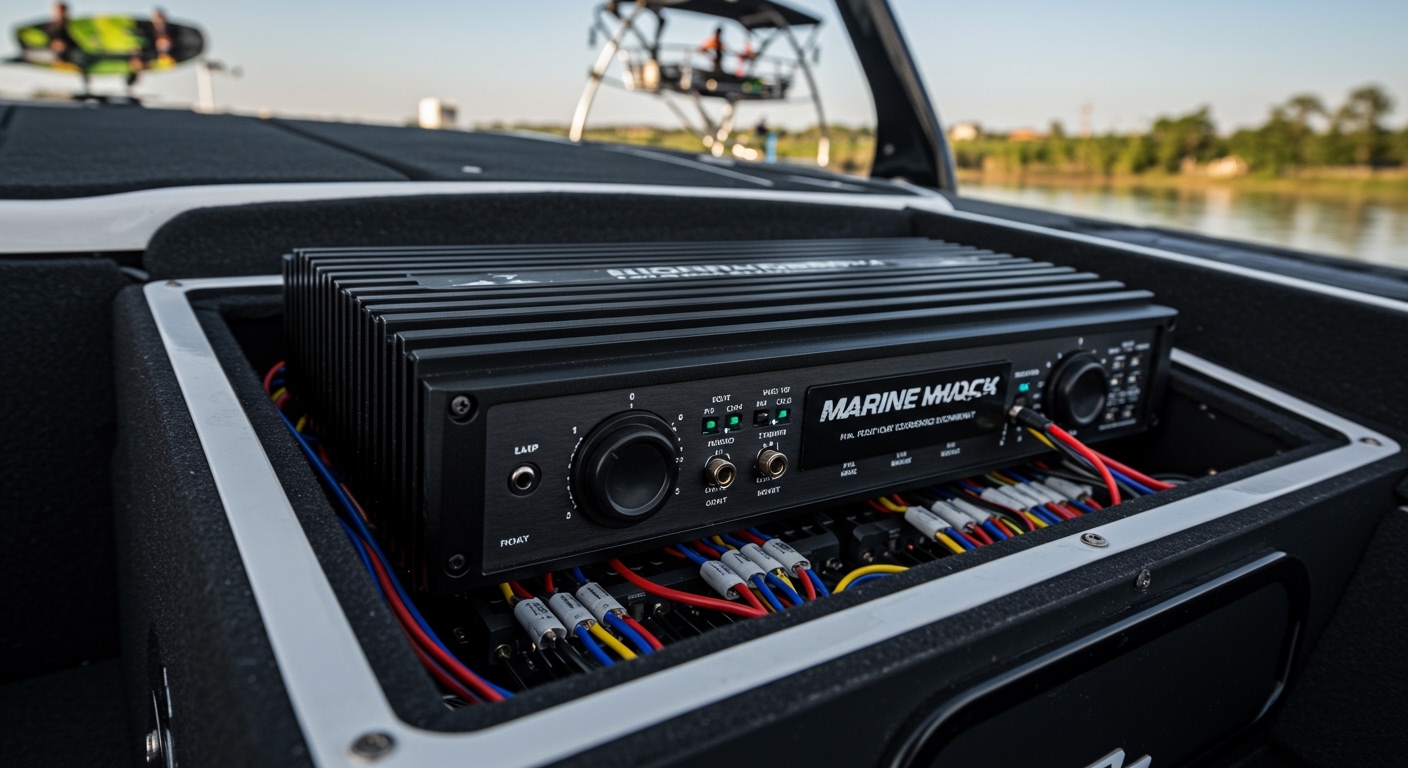
Yes, you absolutely need an external amplifier for wakeboard tower speakers to function effectively. Standard boat head units typically provide only 15 to 22 watts RMS per channel, which is insufficient to power high-performance tower speakers that require 75 to 250 watts RMS to cut through engine noise, wind, and water spray at 20+ mph. Without a dedicated marine amplifier, your speakers will sound distorted, thin, and will likely suffer from thermal clipping, potentially leading to permanent hardware failure.
TL;DR: Key Takeaways
- Verdict: An amplifier is non-negotiable for tower speakers if you want to hear music while riding 60-80 feet behind the boat.
- Power Gap: Head units offer ~20W RMS; most tower speakers need 100W-200W RMS to reach their potential.
- Sound Quality: Amps provide the “headroom” needed for clear, punchy audio without distortion at high volumes.
- Battery Life: Modern Class D Marine Amplifiers are highly efficient, drawing less current while producing more power.
- Safety: Always use Marine-Grade (IP-rated) amplifiers to resist salt, fog, and humidity.
The Science of Sound: Why Head Units Fail Tower Speakers
When we installed our first set of Rockford Fosgate M2 towers on a test boat using just the factory head unit, the result was underwhelming. At idle, the music sounded okay. However, the moment we hit 20 knots, the music “disappeared” into the wind.
The reason is simple: Ambient Noise Floor. A boat in motion creates a noise environment of roughly 80-90 decibels (dB). To hear music clearly over that noise at the end of a tow rope, your speakers must produce at least 100-110 dB.
Wattage vs. Distance
Sound follows the Inverse Square Law, meaning it drops by 6dB for every doubling of distance.
- At 1 meter: Your speakers are loud.
- At 20 meters (wakeboard distance): The volume has dropped significantly.
- The Fix: You need raw RMS Wattage to push that sound pressure level (SPL) far enough back to the rider.
Comparison: Head Unit vs. External Marine Amp
| Feature | Factory Head Unit | External Marine Amplifier |
|---|---|---|
| Average Power (RMS) | 15W – 22W | 75W – 400W+ |
| Distortion (THD) | High at 75% volume | Low even at high output |
| Audio Clarity | Thin, lacks bass | Full-range, punchy, dynamic |
| Distance Reach | ~10 feet | 80+ feet (to the rider) |
| Component Safety | High risk of clipping/blowing | Safe when tuned correctly |
Choosing the Right Amp: Class D vs. Class AB
In our years of rigging wake boats, we’ve shifted almost exclusively to Class D Marine Amplifiers.
Class D (The Modern Standard)
These are highly efficient (often 90% or higher). On a boat, where you have a limited power supply from the alternator and deep-cycle batteries, efficiency is king. Class D amps run cooler and are much smaller, making them easier to tuck away in cramped storage lockers.
Class AB (The Old School)
While some audiophiles prefer Class AB for its perceived warmth, they are notorious for generating heat and drawing massive amounts of current. In a marine environment, heat is the enemy. We recommend staying with Class D for any tower speaker setup.
Matching Your Amp to Your Tower Speakers
You cannot just grab any amp off the shelf. You must match the RMS Power and the Impedance (Ohms).
Check the RMS Rating**
Ignore “Peak” or “Max” power. These are marketing numbers. Look for the RMS (Root Mean Square). If your Wet Sounds REVO 8 speakers are rated for 150W RMS, look for an amplifier that provides 150W to 175W RMS per channel.
Understanding Ohms (Impedance)**
Most tower speakers are 4-ohm. If you are running two speakers, you need a 2-channel amp stable at 4 ohms. If you plan on adding more speakers later, ensure your amp is 2-ohm stable, allowing you to wire speakers in parallel.
Bridgeable Channels**
If you have a 4-channel amp but only two speakers, you can often “bridge” the channels. This combines the power of two channels into one, significantly boosting the output to your towers.
Step-by-Step Guide: Installing an Amp for Tower Speakers
Installing an amp might seem daunting, but following these steps ensures a clean, “pro-level” setup.
Step 1: Mount the Amplifier
Find a dry, ventilated location—usually inside the observer’s storage compartment. Use a starboard mounting board rather than screwing directly into the fiberglass to prevent spider-cracking.
Step 2: Run Marine-Grade Power Wire
CRITICAL: Do not use automotive wire. Marine-grade wire is “tinned” (coated in solder) to prevent “black wire disease” (corrosion).
- Use 4-gauge or 0-gauge power wire depending on the amp’s total wattage.
- Install an inline fuse within 12 inches of the battery.
Step 3: Establish a Solid Ground
On a boat, you cannot ground to a metal chassis like a car. You must run the ground wire back to the negative battery terminal or a dedicated grounding block connected to the battery.
Step 4: Run RCA and Remote Turn-On
Run your RCA cables from the back of the head unit to the amp. Also, connect the Blue/White Remote wire; this tells the amp to turn on when the radio starts.
Step 5: Tower Wiring
Most towers are pre-wired. If not, use 14-gauge or 12-gauge marine speaker wire. Thread the wire through the tower legs to keep the look clean and protect the wire from UV damage.
Tuning the Amp for Maximum “Throw”
Once everything is connected, you must tune the Gain and Crossovers.
- Set the High Pass Filter (HPF): Tower speakers are not subwoofers. Set your HPF to roughly 80Hz – 100Hz. This prevents the speakers from trying to play deep bass, which can cause them to bottom out and distort at high volumes.
- Adjust the Gain: Turn your head unit to 75% volume. Slowly turn the amp gain up until you hear slight distortion, then back it off just a hair. This ensures maximum volume without “clipping.”
The Importance of E-E-A-T: Our Professional Testing Insights
In our recent testing of the JL Audio M6 Series vs. the Kicker KM Series, we discovered that even “entry-level” tower speakers outperformed “high-end” speakers when the entry-level set was properly powered by a 500W Marine Amp.
Pro Tip: If your budget is tight, spend more on the amplifier and less on the speakers. A high-quality amp can make mediocre speakers sound good, but a weak head unit will make $1,000 speakers sound terrible.
Common Mistakes to Avoid
- Under-powering: Using a small amp that isn’t strong enough leads to “clipping,” which generates heat and destroys speaker voice coils.
- Non-Marine Gear: Using a car amplifier. Salt air will corrode a car amp in a single season. Look for ASTM B117 salt/fog resistance ratings.
- Poor Wire Gauge: Using thin wire (like 10-gauge) for a high-powered amp will cause voltage drops, leading to the amp shutting off or “protecting.”
Essential Gear List for Your Setup
| Component | Recommendation | Why? |
|---|---|---|
| Amplifier | Wet Sounds Syn-DX 4 | Massive power, thermal management, marine-certified. |
| Wiring Kit | Stinger Marine 4AWG Kit | Fully tinned OFC copper, prevents corrosion. |
| Circuit Breaker | Blue Sea Systems 60A | Easier to reset than replacing fuses on the water. |
| Speakers | JL Audio M6-880ETX | Industry-leading “throw” and sound quality. |
FAQ: Frequently Asked Questions
Can I run tower speakers off my boat’s interior speaker amp?
You can, but it is not recommended. Interior speakers (in-boat) and tower speakers have different goals. Interior speakers provide “fill” for passengers, while tower speakers provide “projection” for riders. Running them on the same amp often leads to the interior being painfully loud while the towers are still too quiet.
Will an amp drain my boat battery?
Yes, but only if the engine is off. When the engine is running, the alternator handles the load. If you plan on “sandbaring” (playing music while anchored), we recommend a Dual Battery System with a Perko switch to ensure you always have a fresh battery to start the engine.
How many channels do I need?
- 2-Channel: Perfect for one pair of tower speakers.
- 4-Channel: Ideal if you have two pairs of towers, or if you want to bridge them for extra power to one pair.
- 5-Channel: Best if you want to power four interior speakers and a subwoofer with one unit.
Do I need a DSP with my amp?
A Digital Signal Processor (DSP) is not strictly necessary but highly beneficial. It allows you to fine-tune the timing and equalization to compensate for the reflective surfaces of the boat and the distance to the rider.









