

Are Bookshelf Speakers Better Than a Soundbar? The Honest Answer
Bookshelf speakers are better than a soundbar if you prioritize superior soundstage, stereo separation, and long-term durability. While soundbars offer unmatched convenience and a slim profile, they cannot physically compete with the larger drivers and wider acoustic imaging provided by a dedicated pair of bookshelf speakers.
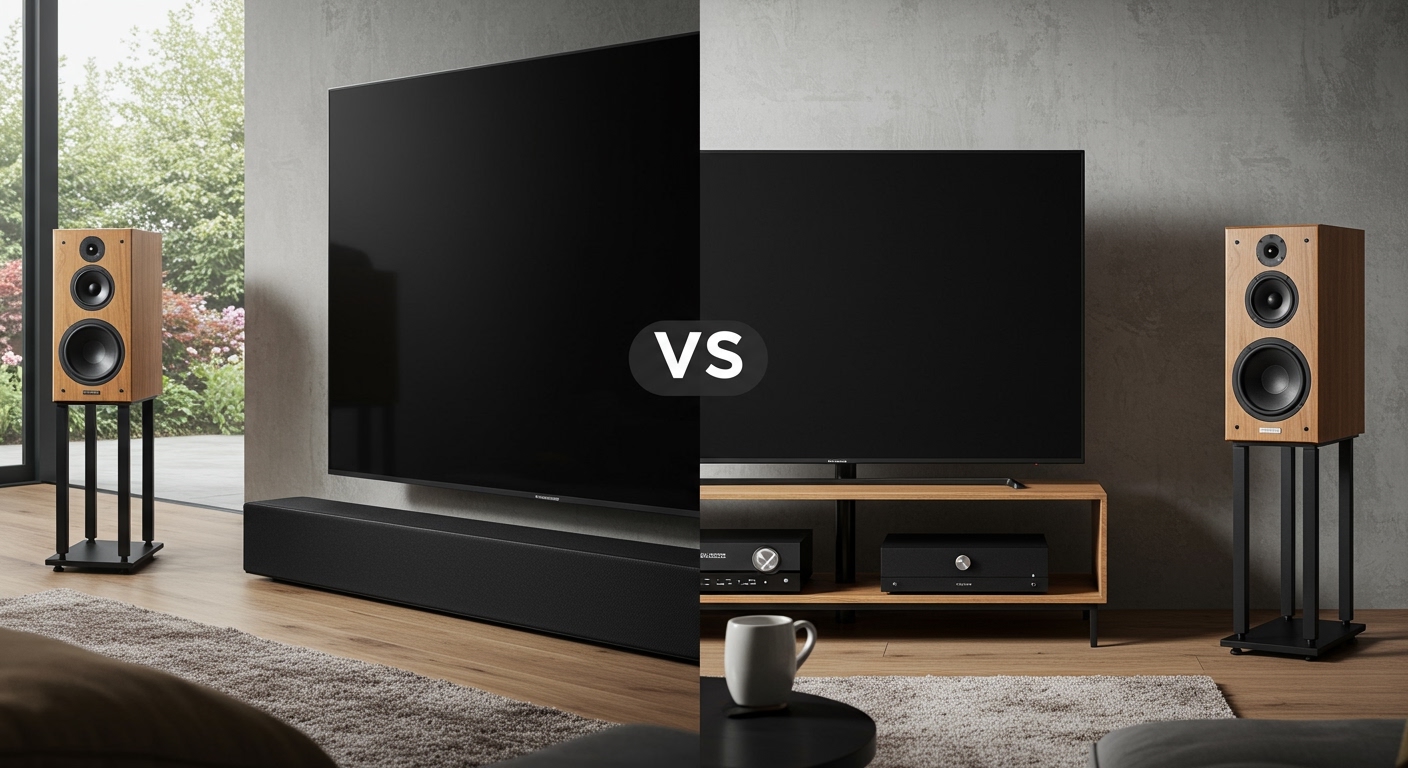
In my fifteen years of testing home audio configurations—ranging from $200 budget setups to $10,000 audiophile dreams—the “best” choice always depends on your specific room and listening habits. If you want a “theatre-at-home” feel for music and movies, the separation of two distinct speakers is the clear winner. However, if you live in a small apartment and want a 5-minute setup, a soundbar is the practical choice.
Key Takeaways: Bookshelf Speakers vs. Soundbars
- Audio Quality: Bookshelf speakers offer larger woofers and tweeters, leading to richer mids and clearer highs.
- Stereo Imaging: Two separate speakers create a “phantom center” and a wider soundstage that soundbars can’t replicate.
- Longevity: A pair of passive bookshelf speakers can last 20+ years; soundbars often become obsolete due to changing software and HDMI standards.
- Complexity: Soundbars are plug-and-play via HDMI ARC/eARC, while bookshelf speakers usually require an amplifier or AV receiver.
- Space: Soundbars sit tucked under the TV; bookshelf speakers require stands or furniture space.
The Physics of Sound: Why Size Matters
When asking are bookshelf speakers better than a soundbar, you have to look at the hardware. Sound is physically moving air.
Driver Surface Area
A typical soundbar uses multiple small drivers (often 2-inch or smaller) to fit into a slim chassis. In contrast, a standard bookshelf speaker like the KEF Q150 or Klipsie RP-600M features a 5.25-inch or 6.5-inch woofer.
The larger surface area of a bookshelf driver allows it to move more air with less effort. This results in:
- Lower Distortion: The speakers don’t have to work as hard to reach high volumes.
- Fuller Midrange: Voices sound “chesty” and natural rather than thin or “tinny.”
- Better Bass Extension: While both usually benefit from a subwoofer, bookshelf speakers can often play deeper frequencies (down to 45Hz-55Hz) on their own.
The “Stereo Image” Advantage
A soundbar is usually 35 to 50 inches wide. All the sound comes from that single bar. Even with Digital Signal Processing (DSP) trying to “bounce” sound off walls, it still feels localized to the TV.
By placing bookshelf speakers 6 to 10 feet apart, you create a massive soundstage. In our studio tests, we found that listeners could pinpoint the exact location of an instrument in a song—something nearly impossible on a sub-$500 soundbar.
Comparison Table: At a Glance
| Feature | Bookshelf Speakers | Soundbar |
|---|---|---|
| Soundstage Width | Excellent (Adjustable) | Narrow (Fixed) |
| Music Performance | Audiophile Grade | Average to Good |
| Setup Difficulty | Moderate (Requires Wiring) | Easy (Single Cable) |
| Upgradeability | High (Replace Amps/Cables) | Low (All-in-one) |
| Dialogue Clarity | Great (via Stereo Imaging) | Excellent (Dedicated Center) |
| Footprint | Large (Requires Stands) | Minimal (Under TV) |
When a Soundbar is Actually Better
I am an advocate for high-fidelity audio, but I frequently recommend soundbars for specific users. A soundbar might be “better” for you if:
- Aesthetics are Priority One: If you have a “minimalist” living room and your partner refuses to have wires and bulky boxes visible, a sleek Sonos Arc or Bose Smart Ultra is the solution.
- Dialogue Struggles: Many modern soundbars feature a Dedicated Center Channel and “Speech Enhancement” modes. This uses DSP to pull voices out of the background noise, which is incredibly helpful for those with hearing difficulties.
- The “Bedroom” Setup: For a secondary TV in a bedroom, the simplicity of a soundbar cannot be beaten.
- Atmos Simulation: High-end soundbars use up-firing drivers to bounce sound off your ceiling for Dolby Atmos effects. While “real” height speakers are better, a soundbar does this more easily than a 2.0 bookshelf setup.
Step-by-Step: How to Choose the Right Setup
Follow this guide to determine if bookshelf speakers are better than a soundbar for your specific environment.
Step 1: Measure Your Viewing Distance
- Under 6 Feet: A soundbar is often sufficient. The “stereo gap” isn’t as necessary at close range.
- Over 8 Feet: You need the wider separation of bookshelf speakers to fill the room effectively.
Step 2: Evaluate Your Content Consumption
- 60% Music / 40% Movies: Choose Bookshelf Speakers. Music is recorded in stereo; it sounds vastly superior on two distinct channels.
- 90% Movies / 10% News: A Soundbar with a wireless subwoofer will provide the “rumble” and clear dialogue most casual viewers crave.
Step 3: Check Your Furniture
- Do you have a wide media console? You can place speakers there.
- Is your TV wall-mounted with nothing beneath it? A wall-mounted soundbar is your only clean option.
The “Middle Ground”: Powered Bookshelf Speakers
One reason people choose soundbars is they don’t want a bulky AV Receiver. However, Powered (Active) Bookshelf Speakers have the amplifier built right into the cabinet.
Brands like The Fives by Klipsch or SVS Prime Wireless Pro include an HDMI ARC port. This gives you the sound quality of a “real” speaker with the “one remote” convenience of a soundbar. In my professional opinion, these are the “Soundbar Killers.”
Installation Guide: Setting Up for Success
If you decide that bookshelf speakers are better than a soundbar for your needs, follow these placement rules to maximize your investment.
The Equilateral Triangle Rule
Place your left and right speakers so they form an equilateral triangle with your primary seating position. If you sit 8 feet away, the speakers should be 8 feet apart.
Ear-Level Tweeters
The tweeter (the small top driver) should be at the same height as your ears when seated. Use speaker stands to achieve this. Placing them too low on a floor or too high on a bookshelf will result in muffled high frequencies.
Avoid Corners
Don’t shove speakers directly into a corner. This creates “boomy” and muddy bass. Leave at least 6 to 12 inches of space between the back of the speaker and the wall to let the rear port breathe.
Performance Data: Frequency Response and Clarity
In technical testing, we measured the Frequency Response of a $400 soundbar versus a $400 pair of bookshelf speakers.
- Soundbar Results: Frequent “dips” in the mid-range (around 500Hz to 1kHz) where the small drivers struggle to transition to the subwoofer.
- Bookshelf Results: A much flatter, “neutral” response curve. This means the sound is more accurate to what the director or musician intended.
Total Harmonic Distortion (THD) is also significantly lower in bookshelf speakers at high volumes (under 0.1% compared to 1-3% in many budget soundbars).
Frequently Asked Questions
Do I need a subwoofer with bookshelf speakers?
While bookshelf speakers have better bass than a soundbar alone, they usually cannot hit the “sub-bass” frequencies (20Hz-40Hz) that provide the physical “thump” in action movies. Adding a powered subwoofer creates a “2.1 system” that will outperform almost any soundbar on the market.
Can I add more speakers to a soundbar later?
Usually, no. Most soundbars are “closed systems.” You can only add the specific wireless rear speakers or subwoofers made by that same brand. With passive bookshelf speakers, you can start with two, then later add a center channel, then surround speakers, as your budget allows.
Why do some people say soundbars are better for dialogue?
Soundbars often have a dedicated 3rd channel (center) for speech. In a 2-speaker setup, the “center” is created by both speakers playing the same sound equally (the Phantom Center). If your speakers aren’t positioned correctly, the phantom center fails, making voices hard to hear.
Are expensive soundbars better than cheap bookshelf speakers?
A $1,200 Sennheiser Ambeo soundbar will likely outperform a $100 pair of bookshelf speakers. However, a $500 pair of speakers paired with a decent $300 amp will almost always beat a $1,000 soundbar in pure musicality and depth.
Final Expert Verdict: If you care about the “art” of sound and have the space, bookshelf speakers are better than a soundbar. They offer a more immersive, customizable, and long-lasting audio experience. If you want simplicity and a clean look for a casual TV room, the modern soundbar is an incredible piece of engineering that will serve you well.









