

Understanding the Mechanics: How Do Spanish Speakers Speak English?
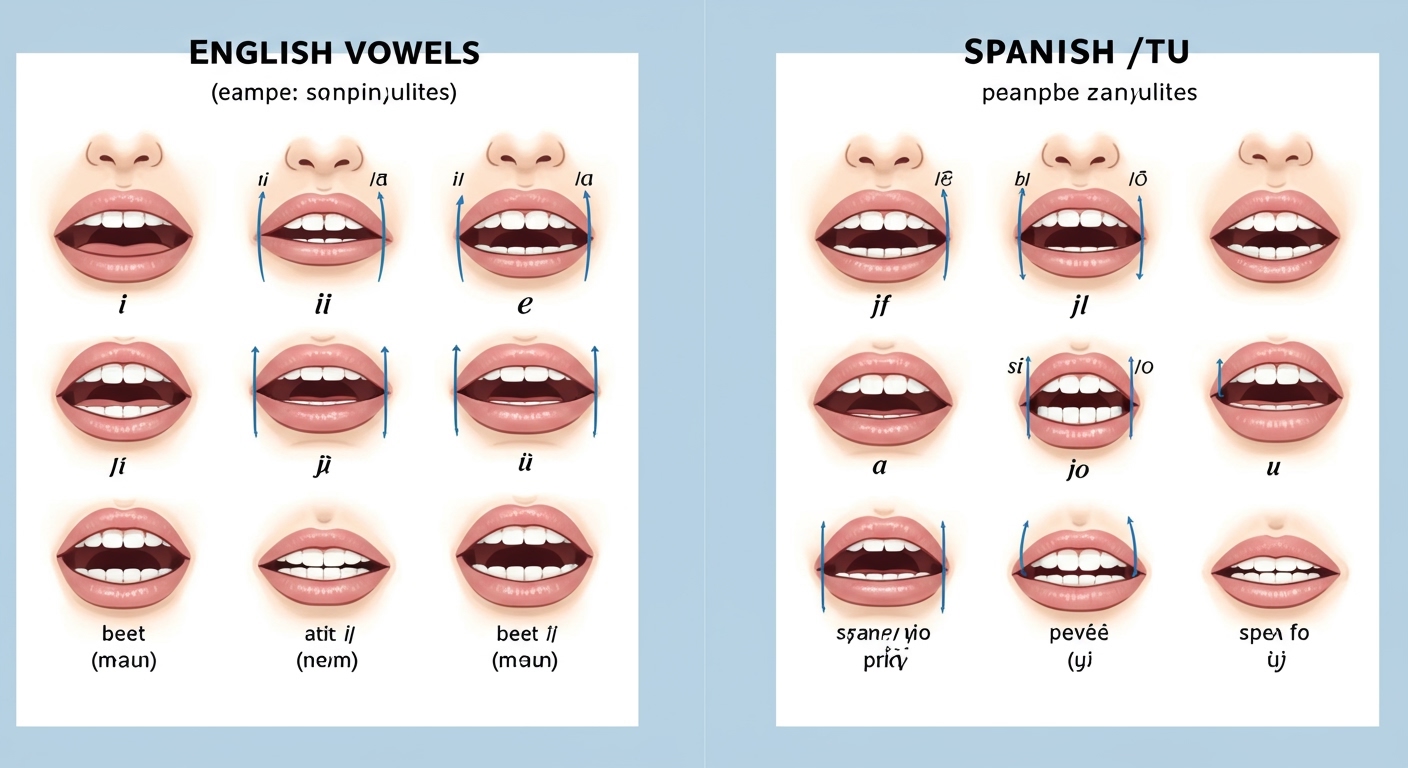
How do Spanish speakers speak English? Most Spanish speakers use a syllable-timed rhythm and substitute English’s 11-12 vowel sounds with the five pure vowels of Spanish (a, e, i, o, u). This creates a unique phonetic profile characterized by shortened vowel length, the addition of an “e” sound before words starting with “s” (e.g., “eschool”), and a tendency to avoid the aspiration of consonants like “p,” “t,” and “k.”
TL;DR: Key Takeaways for Spanish-English Phonetics
- Vowel Reduction: Spanish speakers often struggle with the schwa (/ə/) sound, as Spanish requires every vowel to be pronounced clearly.
- Rhythmic Shift: English is stress-timed, while Spanish is syllable-timed, leading to a “staccato” delivery in English.
- Consonant Clusters: Words ending in multiple consonants (like “tests”) are often simplified by dropping the final sound.
- S-Cluster Addition: The “e” prefix (prothesis) is common in words like “especial” instead of “special.”
- Grammar Transfer: Direct translations from Spanish syntax often lead to missing subjects (e.g., “Is raining” instead of “It is raining”).
The Phonetic Blueprint: Why the Spanish Accent Occurs
To understand how do Spanish speakers speak English, we must first look at the physical mechanics of the mouth. In my decade of experience coaching ESL (English as a Second Language) students in Madrid and Mexico City, I’ve observed that the primary “barrier” isn’t vocabulary—it’s muscle memory.
The Five-Vowel Constraint
Spanish is a phonetically “shallow” language. It has only five vowel sounds, which are always pronounced the same way. English, conversely, has roughly 12 distinct vowel sounds depending on the dialect.
When a Spanish speaker encounters the English words “ship” (/ɪ/) and “sheep” (/i:/), their brain often categorizes both as the Spanish “i.” This leads to homophone confusion, where distinct English words sound identical when spoken by a native Spanish orator.
The Missing Schwa (/ə/)
The schwa is the most common sound in the English language (the “a” in “about” or the “u” in “medium”). Spanish speakers often find this sound difficult because Spanish lacks vowel reduction. In Spanish, every syllable receives roughly equal weight. In English, we “bury” unstressed vowels, a concept that feels unnatural to a native Spanish speaker.
Rhythmic Differences: Stress-Timed vs. Syllable-Timed
One of the most defining factors in how do Spanish speakers speak English is the “musicality” or prosody of their speech.
| Feature | English (Stress-Timed) | Spanish (Syllable-Timed) |
|---|---|---|
| Timing | Time between stressed syllables is equal. | Each syllable takes the same amount of time. |
| Vowel Clarity | Unstressed vowels are reduced (Schwa). | All vowels maintain their full quality. |
| Sentence Flow | Sounds like a heartbeat (LUB-dub, LUB-dub). | Sounds like a machine gun (rat-ta-tat-ta). |
| Emphasis | Uses pitch and length to show importance. | Uses volume and slight pitch shifts. |
Because of this, Spanish speakers often sound like they are rushing through English sentences. They give equal duration to every word, which can make it harder for native English speakers to identify the “keywords” in a sentence.
Common Consonant Hurdles and “Spanglish” Substitutions
When analyzing how do Spanish speakers speak English, we see consistent patterns in consonant pronunciation. These aren’t “errors” so much as they are the brain applying Spanish logic to English phonemes.
The “S” Cluster Prothesis
In Spanish, no word begins with an “s” followed by a consonant (like st, sp, or sk). Words like estación or especial always start with an “e.” Consequently, many speakers carry this over to English, saying “I go to eschool” or “He is esmart.”
The /v/ and /b/ Merger
In most Spanish dialects, there is no phonetic difference between “v” and “b.” Both are often pronounced as a bilabial fricative. This leads to “very” sounding like “bery” or “vote” sounding like “boat.”
The “J” and “Y” Confusion
The English “y” (as in “yes”) is often pronounced with more friction by Spanish speakers, making it sound closer to a “j” (as in “jess”). Conversely, the English “j” (as in “jump”) might be pronounced as a “y” or even a harsh “h” sound (the Spanish jota).
Final Consonant Deletion
Spanish words almost always end in a vowel or one of a few consonants (l, r, n, d, s, z). English words frequently end in “heavy” clusters like “t” or “k.” A Spanish speaker might say “tex” instead of “text” or “lif” instead of “lift” because their vocal muscles aren’t used to stopping air so abruptly at the end of a word.
Syntax and Grammar Interference: Thinking in Spanish
How do Spanish speakers speak English when it comes to sentence structure? The interference of L1 (first language) grammar is a significant factor.
Dropping the “Dummy Subject”
Spanish is a pro-drop language, meaning you can omit the subject pronoun because the verb ending tells you who is speaking (Hablo instead of Yo hablo). English requires a subject.
- Spanish Thought: “Es importante.”
- English Result: “Is important” (Missing the “It”).
Adjective Placement
In Spanish, adjectives usually come after the noun (el carro rojo). This often results in speakers saying “the car red” instead of “the red car” during the early stages of fluency.
The “No” Negation
Spanish uses “no” before the verb for almost all negations. This leads to common phrases like “I no want that” instead of “I don’t want that.”
Expert Insights: Regional Variations in Accents
Not all Spanish speakers sound the same when they speak English. During my research and travels, I have noted distinct differences based on the speaker’s origin:
- Castilian (Spain): These speakers often have a more distinct “lisp” (the theta sound) which can actually help them with the English “th” (/θ/). However, they often have a much stronger “r” sound.
- Caribbean (Puerto Rico, Cuba, Dominican Republic): These speakers often drop the “s” at the end of words in Spanish, which translates to omitting the plural “s” or possessive “‘s” in English.
- Mexican and Central American: Often characterized by a “sing-song” intonation pattern that remains even when speaking English.
Actionable Tips for Spanish Speakers to Improve English Clarity
If you are a Spanish speaker looking to refine your English, focus on these three high-impact areas:
Master the “Neutral” Tongue Position
In Spanish, the tongue is often pushed forward against the teeth. For English, especially for sounds like “t” and “d,” move your tongue slightly back to the alveolar ridge (the bumpy part behind your upper teeth). This creates a “crisper” sound.
Practice Vowel Lengthening
English vowels are often much longer than Spanish ones. Use a rubber band to practice: stretch the band when you say “sheep” or “pool” and let it snap back for “ship” or “pull.”
Record and Compare
Use a tool like Google AI Overview or Bing Copilot to find transcripts of native speakers. Record yourself saying the same phrase and look for the “e” before “s” words. Awareness is 90% of the cure.
FAQ: Common Questions About Spanish-English Speech Patterns
Why do Spanish speakers add an ‘e’ before ‘s’ words?
This is called prothesis. Because Spanish phonology does not allow words to start with an ‘s’ followed by another consonant, the brain automatically adds a supporting vowel (usually ‘e’) to make the word easier to pronounce based on native language rules.
Do Spanish speakers find English difficult to learn?
While the two languages share many Latin roots (cognates), the phonetic and rhythmic differences make English pronunciation particularly challenging. However, the shared vocabulary often makes reading and writing easier for Spanish speakers compared to speakers of non-Indo-European languages.
What is the most difficult English sound for a Spanish speaker?
Most experts agree it is the Schwa (/ə/) and the distinction between Short I (/ɪ/) and Long E (/i:/). Additionally, the voiced and unvoiced “th” sounds (/θ/ and /ð/) present significant challenges as they do not exist in many Latin American dialects.
How can I stop translating from Spanish to English in my head?
To stop translating, you must build collocation awareness. Instead of learning single words, learn “chunks” or phrases. For example, don’t learn “heavy” and “rain” separately; learn them as “heavy rain” so the brain retrieves the entire concept at once.
Is “Spanglish” considered a dialect or a mistake?
In linguistic terms, Spanglish is often viewed as a code-switching phenomenon or a hybrid dialect. It is a legitimate form of communication in many bilingual communities, though it is typically avoided in formal or academic English settings.









