

Understanding the Standard: How Long Do Speakers Talk For?
The standard duration for a professional speaker typically ranges between 45 and 60 minutes, though this varies significantly depending on the event format and audience engagement goals. For high-impact sessions like TED Talks, the gold standard is exactly 18 minutes, whereas interactive workshops can span 90 minutes to 3 hours with scheduled breaks.
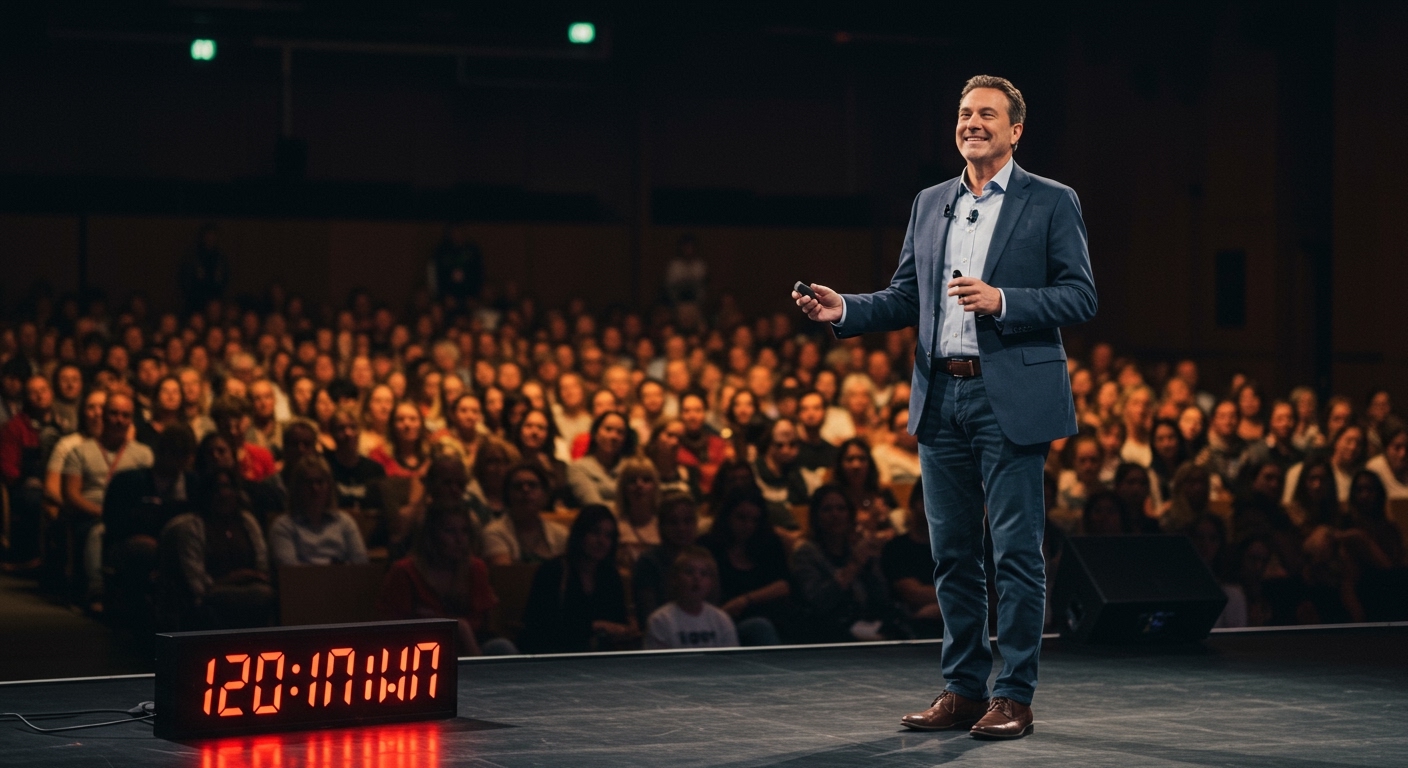
In my years of experience managing international conferences and coaching C-suite executives, I’ve observed that the “sweet spot” is rarely about the total minutes on the clock. It is about the effective attention span of the audience. If you go too short, you lack depth; if you go too long, you lose the room to cognitive fatigue.
TL;DR: Quick Guide to Speaker Durations
- Keynote Speeches: 45–60 minutes (including 10-15 minutes of Q&A).
- TED-Style Talks: 12–18 minutes for maximum retention.
- Workshop Sessions: 90 minutes to half-day (with breaks every 45-60 mins).
- Panel Discussions: 45–60 minutes (total time for all speakers).
- Wedding/Social Toasts: 3–5 minutes (to avoid “microphone hostage” situations).
- Elevator Pitches: 30–60 seconds.
Industry Benchmarks for Professional Speaking Durations
When determining how long do speakers talk for, you must first categorize the event. Based on data from the National Speakers Association (NSA), the following benchmarks represent the current industry standards for professional engagements.
The Keynote Address (45–60 Minutes)
The Keynote Address is the flagship of any conference. Most event planners allocate a one-hour slot. In practice, I advise my clients to speak for 40–45 minutes and leave the remaining time for a structured Q&A session. This prevents the “rushed finish” that often kills the momentum of a great closing story.
The TED Format (18 Minutes)
The TED Talk revolutionized the speaking industry by proving that you can change a mind in under 20 minutes. This duration is scientifically backed by research into cognitive load. After 18 minutes, the brain begins to require more glucose to process new information, leading to a drop-off in focus.
The Breakout or Seminar (60–90 Minutes)
Breakout sessions are designed for deeper dives. Because these are often more educational or “how-to” focused, the audience expects more engagement. If you are leading a 90-minute seminar, the actual “talking” should be broken up by group exercises, live polling, or peer-to-peer discussions.
| Speech Type | Ideal Duration | Primary Goal |
|---|---|---|
| Keynote | 45-60 Mins | Inspiration & Vision |
| TED-Style | 12-18 Mins | Idea Dissemination |
| Workshop | 90-180 Mins | Skill Acquisition |
| After-Dinner | 20-30 Mins | Entertainment |
| Commencement | 10-15 Mins | Advice & Encouragement |
Why Duration Matters: The Science of Attention
When asking how long do speakers talk for, we are really asking how long an audience can listen. According to studies on adult learning theory, the average adult has a “sustained attention span” of roughly 10 to 15 minutes.
The 10-Minute Reset
To keep a 60-minute speech engaging, I utilize a technique called the “10-Minute Reset.” This involves changing the stimulus every 10 minutes. This could be moving from a story to a data visualization, or transitioning from a solo lecture to an audience poll.
Managing Cognitive Load
Cognitive Load Theory suggests that our working memory has a limited capacity. If a speaker talks for too long without breaks or visual aids, the audience experiences “information overflow.” This is why professional speakers often use the “Rule of Three”—focusing on just three major takeaways regardless of the speech length.
Step-by-Step: How to Plan Your Speech Length
Planning how long do speakers talk for requires a tactical approach to content mapping. Follow this step-by-step framework to ensure you never go over time.
Step 1: Confirm the “Hard Stop”
Always ask the event organizer for the Hard Stop time versus the Buffer time. If your slot is from 9:00 AM to 10:00 AM, your “talking” time should conclude by 9:45 AM.
Step 2: The Word Count Calculation
As a general rule, the average person speaks at a rate of 130 to 150 words per minute.
- 5-Minute Speech: 650–750 words.
- 20-Minute Speech: 2,500–3,000 words.
- 60-Minute Speech: 7,500–9,000 words (though you should talk less and interact more).
Step 3: Segment Your Content
Divide your total time into sections. For a 45-minute keynote, I recommend:
- Introduction (5 mins): The hook and the promise.
- Point 1 (10 mins): Story, Data, Application.
- Point 2 (10 mins): Story, Data, Application.
- Point 3 (10 mins): Story, Data, Application.
- Conclusion/CTA (5 mins): The summary and the “ask.”
- Buffer (5 mins): For unexpected delays or transitions.
The Impact of Setting: Academic vs. Corporate vs. Social
The environment dictates how long do speakers talk for more than the topic itself.
Corporate Presentations
In the corporate world, time is literally money. Boardroom presentations are often scheduled for 30 minutes but usually get cut to 15. In these scenarios, I recommend the “Bottom Line Up Front” (BLUF) method. Deliver your conclusion in the first 2 minutes, then use the rest of the time to justify it.
Academic Lectures
Academic speakers often talk for 50 to 90 minutes. This is based on traditional university scheduling. However, modern pedagogy suggests that micro-lectures (15-20 minutes) followed by active learning phases are significantly more effective for student retention.
Social Speeches (Weddings & Galas)
The most common mistake in social speaking is going too long. For a wedding toast, 3 minutes is perfect. Once you hit the 7-minute mark, you aren’t a guest anymore—you’re a distraction from the party.
Expert Tips for Managing Time on Stage
Throughout my career, I’ve seen brilliant content ruined by poor time management. Here are the professional tools I use to stay on track.
Use a Confidence Monitor
If possible, request a Confidence Monitor at the foot of the stage. This should display a count-down timer (in green/yellow/red) rather than the actual time of day. Knowing you have exactly 4:12 remaining helps you decide whether to tell that last anecdote or skip to the closing.
The “Accordion” Method
I teach speakers to build “Accordion Content.” This is a section of your speech (usually near the end) that can be expanded or contracted based on the remaining time. If the previous speaker went over and you lost 10 minutes, you can “fold” your accordion content without ruining the flow of the presentation.
Recording and Reviewing
To truly understand how long do speakers talk for, you must record your rehearsals. Most people speak 20% faster on stage due to adrenaline. If your rehearsal is exactly 45 minutes, you might finish in 38 minutes on the big day—or conversely, you might ramble and hit 55.
Frequently Asked Questions
How long should a guest speaker talk for?
Most guest speakers are expected to talk for 30 to 45 minutes. This allows for a focused delivery of their expertise while leaving room for the host to introduce them and conduct a Q&A session.
Is 20 minutes too long for a speech?
No, 20 minutes is often considered the ideal length for a persuasive or informative speech. It is long enough to establish credibility and provide evidence, but short enough to fit within the human attention span.
How many slides is a 30-minute presentation?
While there is no hard rule, a common guideline is the 10/20/30 Rule by Guy Kawasaki, which suggests 10 slides for a 20-minute talk. For a 30-minute speech, 15 to 20 slides is usually appropriate, ensuring you aren’t rushing through visuals.
What do I do if I finish my speech too early?
If you finish early, do not simply walk off. Open the floor for a bonus Q&A, share a “bonus tip” you didn’t include in the main talk, or offer a live demonstration. Audiences rarely complain about a session ending 5 minutes early, but they do dislike feeling “short-changed” on value.
How do you estimate speech length from a script?
The most accurate way is to use a words-to-time calculator or read the script aloud at a conversational pace with a stopwatch. Remember to account for dramatic pauses, audience laughter, and technical transitions, which can add 10–15% to your total time.









