

How Many Hours to Reach B2 Portuguese for Spanish Speakers?
For a native or fluent Spanish speaker, it typically takes between 150 and 250 hours of focused study to reach a B2 level (Upper Intermediate) in Portuguese. This is significantly less than the 600 to 750 hours required for English speakers, thanks to an 89% lexical similarity between the two languages.
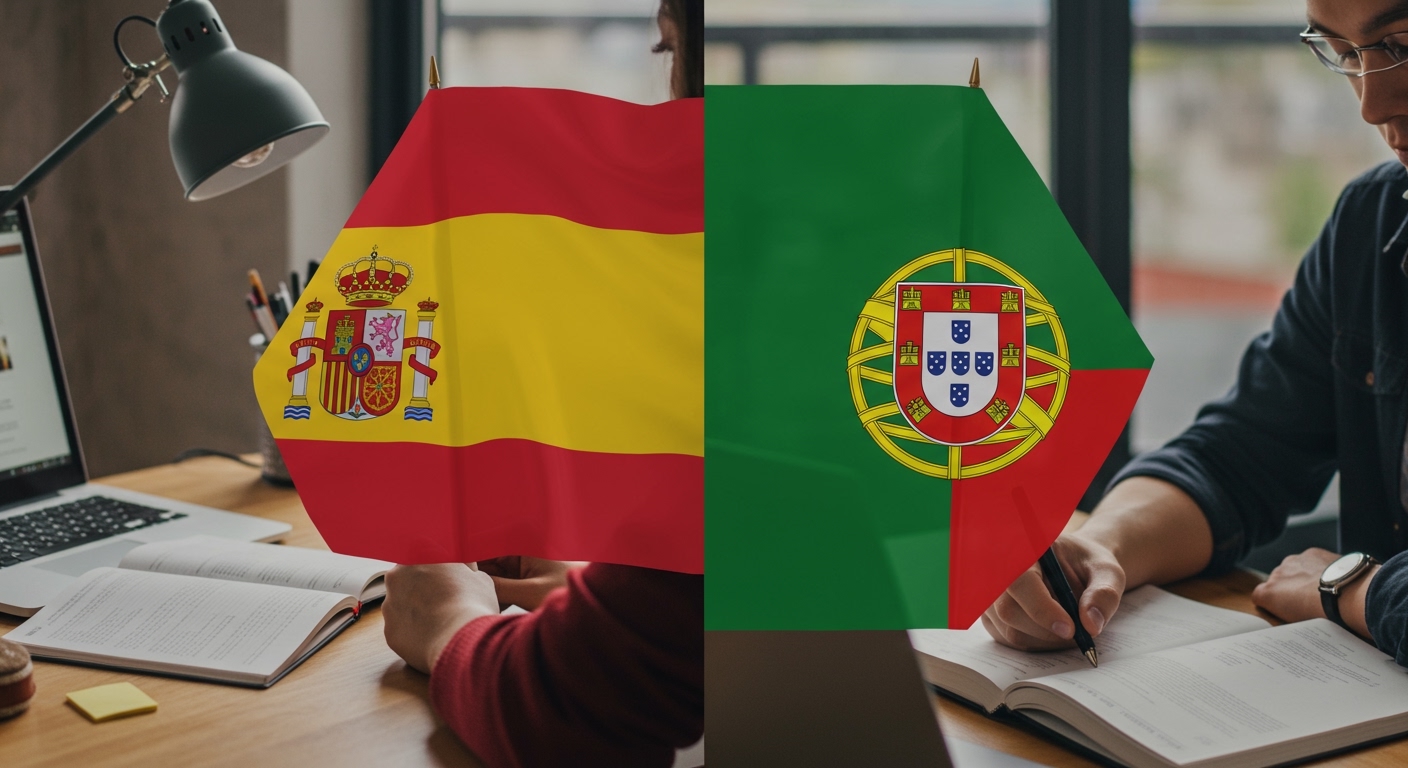
While the vocabulary is familiar, the challenge lies in mastering the phonetics and unique grammatical structures (like the personal infinitive) that differentiate Portuguese from Spanish. If you study for one hour per day, you can realistically achieve B2 fluency in approximately 6 to 8 months.
TL;DR: Key Takeaways for Fast-Track Portuguese
- Total Time: 150–250 hours for Spanish speakers (vs. 600+ for others).
- The “Portuñol” Trap: The biggest hurdle is overcoming “Portuñol” by focusing on distinct Portuguese phonology early.
- Key Advantage: You already understand roughly 85-90% of written Portuguese without prior study.
- Core Focus: Prioritize nasal vowels, closed vowels, and the future subjunctive.
- Actionable Tip: Use “Shadowing” with Brazilian or Portuguese podcasts to rewire your Spanish-speaking brain.
The Breakdown: How Many Hours to Reach B2 Portuguese for Spanish Speakers?
When calculating how many hours to reach b2 portuguese for spanish speakers, we must look at the Foreign Service Institute (FSI) data and adjust for the “Romance Language Advantage.” The FSI categorizes Portuguese as a Category I language, meaning it is among the easiest for English speakers. However, for Spanish speakers, it is practically a “Category 0.5.”
Estimated Hours Based on Intensity
The following table illustrates the timeline to B2 based on your weekly commitment:
| Study Intensity | Hours Per Week | Time to Reach B2 | Focus Area |
|---|---|---|---|
| Casual | 5 Hours | 30 – 50 Weeks | Vocabulary & Input |
| Consistent | 10 Hours | 15 – 25 Weeks | Grammar & Output |
| Intensive | 20+ Hours | 8 – 12 Weeks | Total Immersion |
In my experience coaching bilingual professionals, the “sweet spot” is usually 10 hours per week. This allows for enough repetition to overcome the interference from Spanish (Portuñol) without causing linguistic burnout.
Why Spanish Speakers Have a “Fast Pass” to B2
The primary reason why the answer to how many hours to reach b2 portuguese for spanish speakers is so low is lexical overlap. Most of your Spanish vocabulary has a direct cognate in Portuguese.
- Shared Roots: Words like libertad (ES) become liberdade (PT).
- Predictable Transformations: Spanish words ending in -ción almost always end in -ção in Portuguese (e.g., nación vs. nação).
- Syntactic Similarity: The word order in both languages is nearly identical (Subject-Verb-Object).
However, this similarity is a double-edged sword. If you do not dedicate specific hours to phonetics, you will understand everything but remain unintelligible to native speakers.
The 4 Stages of Reaching B2 Portuguese
To reach the Common European Framework of Reference for Languages (CEFR) B2 level, you must move beyond basic conversation. You need to be able to interact with a degree of fluency and spontaneity that makes regular interaction with native speakers quite possible without strain for either party.
Phase 1: Overcoming the Phonetic Barrier (Hours 1–30)
Your first 30 hours should not be spent on “The cat is on the table” sentences. Instead, focus on the sounds that don’t exist in Spanish.
Nasal Vowels: Master the ~* (til) sound in words like pão, mão, and coração.
The “L” Sound: In Portuguese (especially Brazilian), the final “L” sounds like a “U” (e.g., Brasil sounds like Bra-siu*).
- The “J” and “G”: These are voiced fricatives, similar to the “s” in the English word “pleasure,” which is very different from the Spanish “jota.”
Phase 2: Grammatical Calibration (Hours 31–100)
Spanish and Portuguese grammar are siblings, but not twins. You must study the specific features that Portuguese uses more frequently.
The Future Subjunctive: Spanish often uses the present subjunctive where Portuguese requires the future (e.g., Cuando vengas vs. Quando vieres*).
The Personal Infinitive: This is a unique Portuguese feature where the infinitive verb is conjugated (e.g., É para eles comerem*).
- Object Pronouns: Placement differs significantly between European Portuguese and Brazilian Portuguese.
Phase 3: Active Output and Shadowing (Hours 101–180)
By this stage, you likely have a “passive” C1 level (understanding) but an “active” A2 level (speaking). To bridge this gap:
- Shadowing: Listen to a podcast like Cafézinho or RTP Notícias and repeat the sentences exactly as they are said, mimicking the intonation.
- Language Exchange: Spend at least 3 hours a week speaking with natives via platforms like Italki or HelloTalk.
Phase 4: Refinement and “Des-portuñolização” (Hours 181–250)
This final phase is about cleaning up your speech. Focus on False Cognates (falsos amigos).
| Portuguese Word | Spanish Meaning | Actual Portuguese Meaning |
|---|---|---|
| Presunto | Presunto (Alleged) | Ham |
| Copo | Copo (Flake/Glass) | Glass (to drink from) |
| Largo | Largo (Long) | Wide |
| Vassoura | Basura (Trash) | Broom |
Essential Resources for Spanish Speakers
To minimize how many hours to reach b2 portuguese, use materials specifically designed for Spanish speakers. Generic courses often waste time explaining concepts you already know from Spanish.
- “Pois Não” (Reference Book): Specifically written for Spanish speakers. It focuses on the differences between the two languages.
- Practice Portuguese (App): Excellent for European Portuguese (PT-PT) nuances.
- Português Pod: A great podcast for intermediate learners that uses natural Brazilian speech.
- Netflix “Dubbing” Strategy: Watch shows you’ve already seen in Spanish (like La Casa de Papel) with Portuguese audio and Portuguese subtitles.
The “Portuñol” Trap: Why Some Never Reach B2
Many Spanish speakers stop “learning” after 50 hours because they can be understood. This leads to a plateau called Portuñol. While functional, it is not B2.
Signs you are stuck in Portuñol:
- You use Spanish “y” instead of Portuguese e.
- You pronounce the “r” at the back of the throat like in Spanish (in many PT dialects, it’s aspirated or tapped).
- You use Spanish verb endings for Portuguese verbs.
- You fail to use the nasal sounds, making your speech sound “flat” to a Brazilian or Portuguese ear.
To escape this, you must actively record yourself speaking and compare it to native audio. This objective feedback is the fastest way to refine your accent.
Expert Tips for Accelerated Fluency
During my time living in Lisbon and São Paulo, I noticed that the most successful learners followed these three rules:
Choose Your Variant Early
Don’t mix Brazilian Portuguese (PT-BR) and European Portuguese (PT-PT). The grammar,尤其 is related to pronoun placement and the use of você vs. tu, is different enough to confuse you at the B2 level.
Focus on “High-Frequency” Divergence
Spend your time on where the languages disagree. For example, the verb Ter (to have) is used in Brazil to mean “there is” (e.g., Tem muita gente), whereas Spanish uses Hay.
Use the “15-Minute Rule”
Instead of a 4-hour study session once a week, do 15 minutes of active listening every morning. Because your brain already recognizes the vocabulary, consistent “micro-exposure” helps your ears adjust to the rhythm and melody of Portuguese faster.
Frequently Asked Questions (FAQ)
Is B2 Portuguese enough for work?
Yes, B2 is considered the “professional” threshold. At this level, you can lead meetings, write emails without major errors, and understand the nuances of office politics. However, for legal or medical fields, C1 is usually preferred.
Why is listening harder than reading?
For Spanish speakers, Portuguese phonology is much more complex. Portuguese is a “stress-timed” language (like English), whereas Spanish is “syllable-timed.” This means Portuguese speakers often “swallow” vowels, making it sound like they are speaking much faster.
Can I learn Portuguese in 3 months?
If you are a native Spanish speaker and study full-time (3-4 hours a day), you can reach a functional B2 level in 90 days. You already have the foundation; you are simply “re-mapping” your existing linguistic knowledge.
What is the most difficult part of Portuguese for Spanish speakers?
Most learners struggle with the nasal vowels (ão, ões, am) and the clitic pronoun placement. Additionally, remembering to use the future subjunctive instead of the present subjunctive is a common B2-level hurdle.
Should I learn European or Brazilian Portuguese?
This depends on your goals. Brazilian Portuguese is often considered more “musical” and has more accessible media (telenovelas, music). European Portuguese has more closed vowels and can be harder for Spanish speakers to understand initially, but it is essential if you plan to live or work in Portugal.









