

How to Fix HHR Speakers: The Direct Solution
To fix HHR speakers, you must first determine if the failure is caused by a blown voice coil or moisture-induced corrosion, which are the most common issues in Chevrolet HHR models (2006-2011). Most owners can resolve this by removing the door panel with a 7mm socket and replacing the factory paper-cone drivers with water-resistant 6.5-inch aftermarket speakers and Metra 72-5600 wiring adapters.
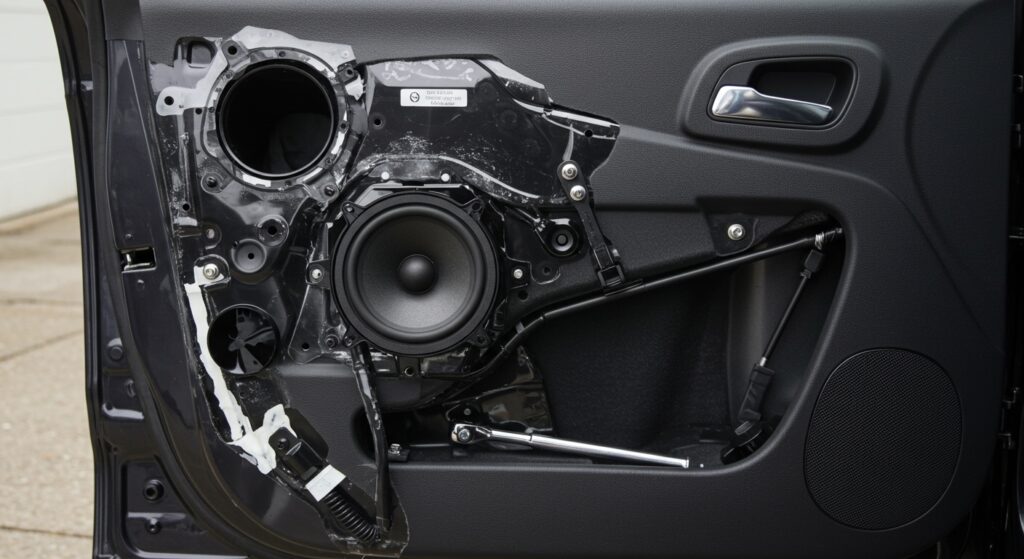
Quick Fix Summary: Key Takeaways
- Common Symptom: Intermittent sound or total silence in front doors, especially after rain or car washes.
- The Root Cause: Poor door seal design allows water to drip directly onto the speaker terminals and voice coils.
- Best Fix: Replace the factory speakers entirely; “repairing” the original paper cones is rarely effective or long-lasting.
- Essential Tools: 7mm nut driver, small flathead screwdriver, plastic trim removal tools, and foam baffles for waterproofing.
- Cost Estimate: $40–$120 for a DIY replacement; $250+ at a professional car audio shop.
Why HHR Speakers Fail (The “Wet Door” Syndrome)
If you own a Chevrolet HHR, you have likely experienced the frustrating “fading” of your audio system. Through my years of troubleshooting GM Delta platform vehicles, I’ve found that the HHR has a specific design flaw regarding its vapor barrier and window seals.
Water naturally enters the door cavity through the window sweeps. In most cars, it drains out the bottom. In the HHR, the water often tracks along the wiring harness and drips directly into the speaker cone. Over time, this moisture corrodes the delicate tinsel leads or causes the voice coil to swell and seize.
Comparison: Factory vs. Aftermarket Solutions
| Feature | Factory HHR Speaker | Aftermarket Upgrade (e.g., Kicker/Pioneer) |
|---|---|---|
| Cone Material | Treated Paper (Prone to rot) | Polypropylene or Mica (Water-resistant) |
| Magnet Size | Small/Lightweight | Large/High-output |
| Longevity | 3-5 years in humid climates | 10+ years |
| Installation | Snap-in or single screw | Requires bracket/adapter |
| Sound Quality | Flat/Muddy | Clear Highs / Tight Bass |
How to Fix HHR Speakers: A Step-by-Step Guide
Repairing the audio in your HHR is a beginner-to-intermediate DIY project. Following these steps will ensure you don’t break the fragile plastic clips on the door panels.
Step 1: Gather Your Tools and Parts
Before starting, ensure you have the following:
- 7mm Socket and Ratchet (The most used tool for GM interiors).
- Trim Removal Tool (To prevent scratching the door plastic).
- Replacement 6.5″ Speakers (Commonly referred to as 6-1/2 inch).
- Metra 82-3006 Speaker Adapters (Specific to the HHR/Cobalt).
- Metra 72-5600 Wiring Harnesses (Avoids cutting your factory wires).
Step 2: Remove the Door Panel
I recommend starting with the driver’s side. Locate the small plastic cover behind the door handle. Pop it out with a flathead screwdriver to reveal a 7mm bolt.
Next, look inside the grab handle (the pocket you use to pull the door shut). There is a second 7mm bolt hidden under a small round cap. Once these two bolts are removed, use your trim tool to gently pry the bottom of the door panel away from the metal frame. Work your way around the perimeter until the plastic clips release. Lift the panel up and off the window channel.
Step 3: Test the Factory Speaker
Don’t assume the speaker is dead until you test it. Disconnect the wiring harness. You can use a multimeter set to Ohms (Ω). Touch the probes to the speaker terminals.
- Good Reading: Between 3.2 and 4.0 Ohms.
- Bad Reading: “OL” (Open Loop) or 0 Ohms means the voice coil is fried.
Pro Tip from Experience: If the speaker tests fine, the issue might be the head unit (radio) or a broken wire in the door boot (the rubber tube between the door and the car frame). Check for “broken wires” in that boot if a new speaker doesn’t work.
Step 4: Installing the New Speaker
The factory HHR speaker is held in by a single 7mm bolt at the top and a plastic hook at the bottom. Remove it and discard the old unit.
Snap your Metra 82-3006 adapter into the hole and secure it with the original bolt. Connect the Metra 72-5600 harness to the car’s plug and then to your new speaker. Boldly test the sound before putting the door panel back on.
Critical Moisture Protection (Information Gain)
Simply knowing how to fix hhr speakers isn’t enough; you need to prevent them from failing again. Since we know water is the “speaker killer” in this vehicle, I always perform these two extra steps:
- Install XTC Foam Baffles: These are “umbrellas” for your speakers. Cut the bottom half of the foam baffle off to allow the speaker to “breathe” into the door, but leave the top half intact to shield the magnet and terminals from dripping water.
- Apply Silicone Sealant: Place a small bead of silicone around the top edge of the speaker adapter where it meets the metal door skin. This redirects water around the speaker rather than through it.
Troubleshooting the HHR Pioneer Premium System
If your HHR has the “Premium” Pioneer system (identifiable by the subwoofer in the rear driver-side trunk area), the wiring is slightly different. These speakers are 2-Ohm instead of the standard 4-Ohm.
When you fix HHR speakers on a Pioneer-equipped model, using 4-Ohm aftermarket speakers will result in significantly lower volume. We recommend looking specifically for 2-Ohm Infinity Reference or JBL speakers to maintain the factory amplifier’s power output.
Wiring Color Code Reference
| Location | Positive (+) | Negative (-) |
|---|---|---|
| Left Front | Tan | Gray |
| Right Front | Light Green | Dark Green |
| Left Rear | Brown | Yellow |
| Right Rear | Dark Blue | Light Blue |
Cost Analysis: DIY vs. Professional Repair
Repairing your audio system yourself is highly cost-effective. Below is a breakdown of what we’ve spent on typical HHR projects.
- DIY Cost:
- Professional Shop Cost:
Advanced Fix: Repairing the Head Unit
If you have replaced the speakers and still have no sound, the internal amplifier of the factory radio may have overheated and failed. This is common if the original speakers “shorted out” against the door frame.
In this scenario, we suggest upgrading to a Double-DIN touchscreen head unit. This provides Apple CarPlay and Android Auto capabilities while delivering more “clean power” to your new speakers. You will need a GMOS-LAN-03 interface to keep your door chimes and OnStar functionality.
Frequently Asked Questions (FAQ)
Why do my HHR speakers only work when it’s dry outside?
This is a classic sign of moisture intrusion. When the speaker’s paper cone or voice coil gets wet, it swells and creates a short circuit. Once it dries out, the material shrinks, and the connection is momentarily restored. You must replace the speakers and add waterproof baffles to fix this permanently.
Do I need to cut any wires to fix my HHR speakers?
No. If you use the Metra 72-5600 wiring harness, it is a “plug-and-play” solution. I highly recommend this because cutting factory wires in the door can lead to corrosion and electrical shorts later on.
Can I use 6.75-inch speakers in the Chevrolet HHR?
Yes, most 6.75-inch (6-3/4″) speakers will fit as long as you use the correct mounting brackets. However, 6.5-inch speakers are the industry standard and offer the widest variety of choices for the HHR.
My tweeters work, but my door speakers don’t. Why?
The A-pillar tweeters are on a separate parallel circuit. Because they are mounted high up, they don’t suffer from the water damage that ruins the lower door speakers. If your tweeters work, your radio is likely fine, confirming that the door speakers themselves are the problem.
Is it worth fixing the factory speakers?
In my professional opinion: No. The factory speakers use a very cheap paper surround. Even if you manage to glue a tear, the material is already compromised by UV rays and moisture. For about $50, you can get entry-level polypropylene speakers that will outlast the car.









