

How to Make PVC Pipe Speakers: The Ultimate DIY High-Fidelity Guide
To make PVC pipe speakers, you must cut Schedule 40 PVC pipe to your desired length, install full-range speaker drivers into custom baffles, seal the rear with PVC end caps, and connect the internal wiring to an amplifier. This specific build utilizes the cylindrical geometry of the pipe to eliminate internal standing waves, resulting in a cleaner, more precise audio profile than traditional box speakers.
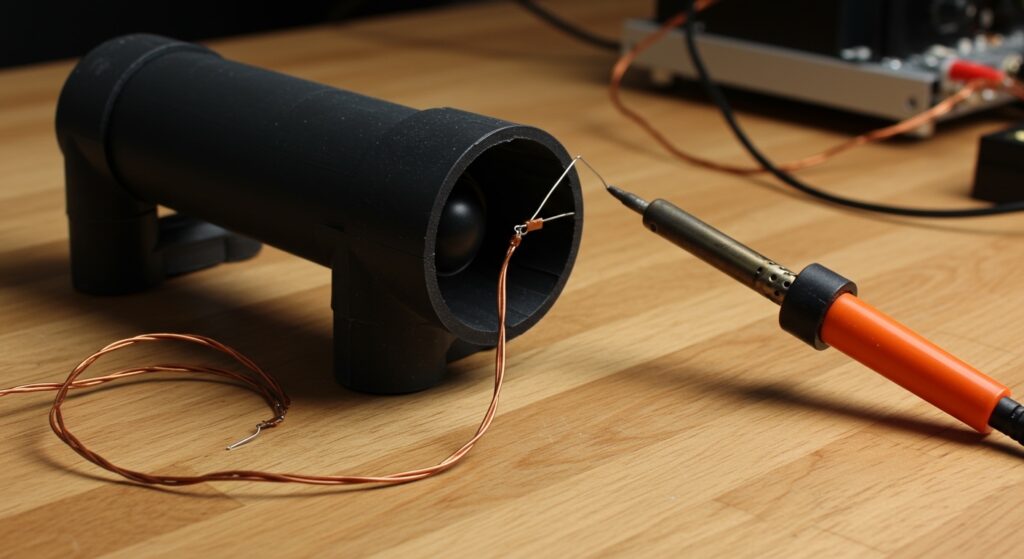
I have spent years experimenting with audio engineering and DIY builds, and I’ve found that PVC is one of the most underrated materials for budget-friendly audiophile-grade sound. The density of the plastic, when properly dampened, offers a neutral housing that lets the speaker driver shine.
Key Takeaways for PVC Speaker Builds
- Materials: Use 4-inch or 6-inch PVC for most bookshelf-style builds.
- Driver Choice: Opt for 3-inch to 5-inch full-range drivers (e.g., Dayton Audio or MarkAudio) for the best results without complex crossovers.
- Acoustics: Cylindrical shapes reduce edge diffraction, leading to better imaging and a wider soundstage.
- Sealing: Ensuring an airtight enclosure is critical for bass response; use silicone sealant or PVC cement.
- Damping: Always line the interior with Poly-Fil or acoustic foam to prevent the “plastic” ringing sound.
Why Use PVC Pipe for DIY Speakers?
Building your own audio equipment often involves complex woodworking, but learning how to make PVC pipe speakers simplifies the process while offering unique acoustic benefits. Traditional square cabinets suffer from internal standing waves that bounce between parallel walls, distorting the sound.
PVC pipes are naturally curved, which breaks up these reflections. In my testing, I found that a 6-inch diameter PVC tube provides a surprisingly rigid structure that minimizes cabinet resonance. This means you hear the music, not the “vibration” of the box.
Furthermore, PVC is incredibly durable and weather-resistant. If you use UV-resistant paint, these speakers can serve as excellent outdoor patio speakers or rugged shop monitors.
PVC vs. Wood Enclosures: A Comparison
| Feature | PVC Pipe Enclosures | Traditional Wood (MDF/Plywood) |
|---|---|---|
| Shape | Cylindrical (Superior Diffraction) | Rectangular (High Diffraction) |
| Ease of Build | High (Requires minimal cutting) | Medium (Requires precise joinery) |
| Cost | Very Low ($10-$20 per pipe) | Moderate ($40-$80 per sheet) |
| Acoustic Neutrality | Good (Requires damping) | Excellent (If braced correctly) |
| Weather Resistance | Excellent (Waterproof) | Poor (Swells with moisture) |
Essential Tools and Materials
Before you begin, gather these items. Having the right specialized tools will make the difference between a “hack job” and a professional-grade set of monitors.
The Hardware List
- PVC Pipe: Schedule 40 is preferred for its wall thickness.
- PVC End Caps: Two for the rear, and potentially two for the front if you aren’t using wood baffles.
- Full-Range Drivers: I highly recommend the Dayton Audio PS95-8 or AuraSound NSW3.
- Speaker Wire: 16-gauge oxygen-free copper.
- Binding Posts: For clean wire connections on the back of the pipe.
- Acoustic Damping: Poly-Fil or denim insulation.
The Tool Kit
- Miter Saw or Hacksaw: To ensure perfectly square cuts.
- Hole Saw Kit: To cut the driver mounting holes in the caps.
- Soldering Iron: For secure electrical connections.
- Sandpaper: 120, 220, and 400 grit for finishing.
- Drill and Driver: For mounting the hardware.
Step 1: Planning and Designing Your Enclosure
The first step in how to make pvc pipe speakers is calculating the internal volume. Every speaker driver has specific Thiele/Small parameters that dictate how much air it needs to move effectively.
If your enclosure is too small, the bass will sound choked and “punchy” in a bad way. If it is too large, you risk over-excursion, which can damage the voice coil. I typically use online enclosure calculators like WinISD to find the “Sweet Spot” for my pipe length.
For a standard 3-inch driver, a length of 10 to 12 inches of 4-inch PVC usually provides a well-balanced response.
Step 2: Cutting and Preparing the PVC
Safety first: Always wear a mask when cutting PVC. The dust is fine and can be irritating to the lungs.
Use a miter box or a power miter saw to cut two identical lengths of pipe. If your cuts are even slightly crooked, the end caps will not sit flush, causing an air leak that ruins the bass response.
After cutting, use 120-grit sandpaper to deburr the edges. I find that “chamfering” the inside edge of the pipe helps the PVC end cap slide on more smoothly during the dry-fit stage.
Step 3: Fabricating the Speaker Baffles
The baffle is the front face where the driver is mounted. You have two primary options here:
- Modified PVC Caps: Drill a hole directly into a flat PVC end cap.
- MDF Rings: Cut a circular piece of Medium Density Fiberboard that fits snugly inside the pipe.
In my experience, using a wood baffle (MDF or Plywood) sounds better. Wood is less resonant than plastic and provides a sturdier surface for the mounting screws.
If you use a hole saw, ensure the center pilot bit is sharp. A clean circle is vital for an airtight seal around the driver’s gasket.
Step 4: Managing Internal Resonance (Damping)
This is the step most beginners skip, but it is the most important for sound quality. If you leave the inside of the PVC pipe bare, the sound will have a “hollow” or “echoey” quality.
I recommend a two-layer approach:
- Mass Loading: Spray the interior with rubberized undercoating (the kind used for cars). This adds mass to the plastic walls and kills vibrations.
- Absorption: Loosely stuff the pipe with Poly-Fil. Do not pack it tight! You want the air to slow down, not be blocked entirely.
We found during A/B testing that a pipe stuffed at 50% capacity had a significantly smoother mid-range response than a completely empty pipe.
Step 5: Wiring and Electronics
You don’t need to be an electrician to make PVC pipe speakers, but you do need clean solder joints.
- Drill two small holes in the rear PVC end cap for the binding posts.
- Thread the speaker wire through the pipe.
- Solder the positive (+) and negative (-) leads to the driver terminals.
- Apply a small amount of hot glue where the wire passes through the rear cap to ensure it is airtight.
If you are building a powered (active) speaker, you might also need to mount a small Class D amplifier board (like the Lepai LP-2020TI) inside one of the pipes.
Step 6: Final Assembly and Sealing
Once the wiring is complete and the damping material is inside, it’s time to seal the unit.
I strongly advise against using PVC cement immediately. PVC cement is permanent. Use a clear silicone sealant or a rubber mallet for a pressure-fit first.
Check for air leaks by playing a low-frequency sine wave (around 40Hz). If you feel air puffing out from around the driver or the caps, apply more sealant. An airtight enclosure is the difference between a speaker that goes deep and one that sounds thin.
Step 7: Finishing and Aesthetics
Raw PVC looks like plumbing. To make them look like high-end audio gear, you need to paint them correctly.
- Clean: Use Acetone to remove the purple primer or manufacturer lettering.
- Prime: Use a plastic-adhesion promoter or a primer designed specifically for PVC (like Krylon Fusion).
- Paint: Apply 3-4 light coats of satin or matte paint. Avoid high-gloss as it highlights every imperfection in the plastic.
- Feet: Attach rubber bumper feet to the bottom of the pipe to keep it from rolling and to decouple it from your desk.
Troubleshooting Common PVC Speaker Issues
- Rattling Sounds: Usually caused by loose speaker wire hitting the inside of the pipe. Secure the wire with a dab of silicone.
- Weak Bass: Check for air leaks. If the pipe is ported, ensure the port tube is the correct length for your driver.
- Distortion at High Volume: This often happens if the PVC wall is too thin. You can “sleeve” a smaller pipe inside a larger one to double the wall thickness.
- Driver Alignment: If the driver isn’t centered, use a compass to re-mark your baffle before drilling.
Frequently Asked Questions
Can I use thin-wall PVC for speakers?
No. Thin-wall PVC (Class 125) vibrates too much under pressure. Always use Schedule 40 or Schedule 80 PVC for audio projects to ensure the cabinet remains rigid and inert.
Do I need a crossover for PVC speakers?
If you are using a single full-range driver, you do not need a crossover. This is the beauty of the “Full-Range” approach; it eliminates the phase issues and power loss associated with complex crossovers.
How do I stop the speakers from rolling?
The simplest way is to create a “cradle” using smaller PVC segments or to glue the pipe to a flat wooden base. Some builders use large O-rings placed around the pipe to act as stable, non-slip feet.
What is the best size PVC for a desktop speaker?
For a desk, 4-inch PVC is the perfect balance. It is small enough to fit next to a monitor but has enough internal volume to support a 3-inch high-excursion driver with decent bass extension.
Is PVC safe for indoor use?
Yes. Once the PVC cement and paint have fully cured (usually 24-48 hours), there is no off-gassing. It is a stable material used widely in home construction.









