

Understanding How to Mount Onkyo Speakers for Maximum Sound Quality
To mount Onkyo speakers effectively, you must identify if your model uses a keyhole slot or a threaded insert (usually 1/4″-20) and then secure it to a wall stud or heavy-duty anchor using a compatible articulating bracket. I recommend placing speakers at ear level—approximately 2 to 3 feet above the listener’s head for surrounds—to achieve the most immersive Dolby Atmos or DTS:X experience.
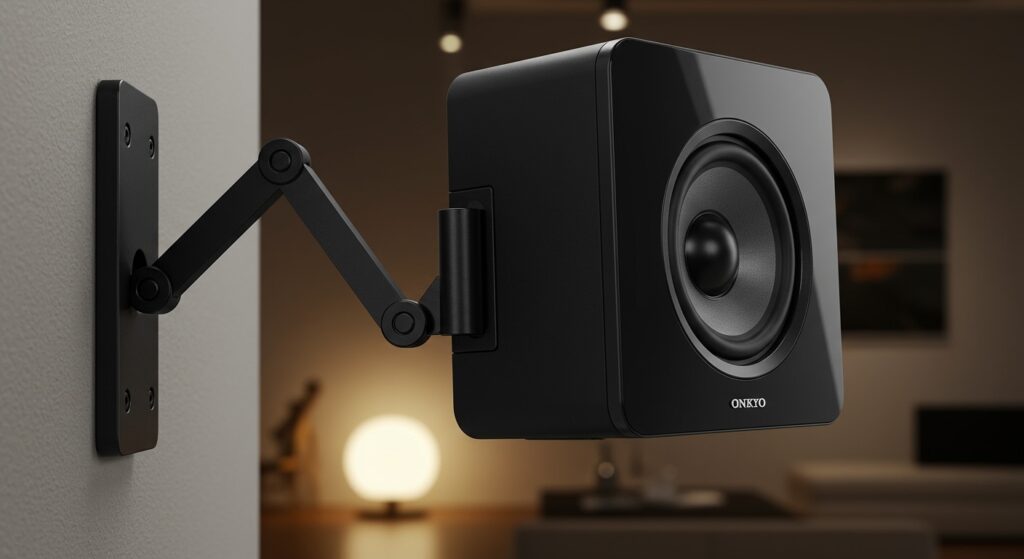
Are your Onkyo satellite speakers cluttering your bookshelves or taking up valuable floor space? I have spent years installing Onkyo home theater systems, from the classic HT-S series to the modern SKS-HT540 bundles, and I know the frustration of dealing with proprietary mounts and precarious wall hanging. This guide provides a definitive, professional-grade walkthrough to get your speakers off the floor and onto the wall safely.
TL;DR: Key Takeaways for Onkyo Mounting
- Identify the Mount: Check the back of your Onkyo speaker for a “keyhole” (uses a screw head) or a “threaded hole” (uses a bracket).
- Prioritize Studs: Always try to mount into wooden wall studs for heavy speakers; otherwise, use Toggle Bolts, not plastic anchors.
- Optimal Height: Surround speakers should be 2-3 feet above ear level, while front speakers should be at ear level.
- Cable Strategy: Plan your 16-gauge speaker wire runs before drilling to ensure a “zero-wire” aesthetic.
Pre-Installation: Identifying Your Onkyo Speaker Type
Before you pick up a drill, we must determine what hardware your specific Onkyo model requires. In my experience, Onkyo utilizes two primary mounting interfaces across their product lines.
The Keyhole Slot
Many Onkyo satellite speakers (like those found in the HT-S3910 or HT-S5800 systems) feature a simple keyhole slot on the back. This is a small, teardrop-shaped opening.
- Mounting Style: These are designed to slide onto a fixed screw protruding from the wall.
- Limitation: These do not allow for angling or “toeing-in” the speaker.
The Threaded Insert
Higher-end or older wood-cabinet Onkyo speakers often feature a 1/4″-20 threaded insert. This is a small metal screw hole.
- Mounting Style: These require a universal ball-and-socket bracket that screws into the speaker and then attaches to the wall.
- Benefit: These allow you to tilt and swivel the speaker toward the “sweet spot” in your room.
Onkyo Weight and Mounting Compatibility Table
| Speaker Category | Common Models | Approx. Weight | Recommended Mount |
|---|---|---|---|
| Small Satellite | SKM-4800, SKF-4800 | 1.5 – 3 lbs | Keyhole or Small Bracket |
| Surround/Atmos | SKH-410, SKR-4800 | 2 – 4 lbs | Keyhole Slot |
| Bookshelf | D-175, D-055 | 6 – 10 lbs | Heavy-duty Threaded Bracket |
| Center Channel | SKC-4800, SKC-594 | 5 – 8 lbs | Dual Keyhole or Wall Shelf |
Essential Tools and Materials
I have learned the hard way that using the cheap plastic anchors included in the box is a recipe for a fallen speaker and a dented floor. To mount Onkyo speakers like a professional, gather these items:
- Stud Finder: A reliable sensor (like a Zircon Edge-Finding model) to locate the center of your wall studs.
- Power Drill: With a high-quality 1/8″ or 1/4″ drill bit.
- Level: A small torpedo level to ensure your brackets aren’t crooked.
- Toggle Bolts: If you cannot find a stud, SnapToggle or Butterfly anchors are the only drywall anchors I trust for speakers over 3 lbs.
- Speaker Brackets: If using threaded inserts, I recommend brands like WALI or VideoSecu that are compatible with Onkyo.
Step-by-Step Guide: How to Mount Onkyo Speakers
Step 1: Map the Soundstage
Positioning is everything in Home Theater SEO for your ears. For a standard 5.1 setup:
- Front Left/Right: These should form an equilateral triangle with your primary seating position.
- Center Channel: Mount directly above or below your TV, aimed at your ears.
- Surround Speakers: Place these to the sides and slightly behind the listener.
Step 2: Locate the Studs
I always suggest mounting to a wooden stud. Use your stud finder to locate the vertical supports behind your drywall. Mark the edges and find the center. If your ideal speaker placement lands between studs, you must use hollow-wall toggle bolts. Standard plastic “expansion” anchors will eventually pull out due to the vibration of the Onkyo woofer.
Step 3: Drill and Install the Bracket
If you are using a universal bracket:
- Hold the bracket base against the wall and mark the holes.
- Pre-drill your holes. For studs, use a bit slightly smaller than your screw. For toggle bolts, use the size indicated on the anchor package.
- Secure the bracket to the wall. Ensure it is tight and level.
Step 4: Attach the Speaker to the Mount
For Onkyo speakers with threaded inserts:
- Thread the bracket’s bolt into the back of the speaker.
- Hand-tighten the bolt, then give it a half-turn with a wrench. Do not over-tighten, as you can strip the internal threads of the speaker cabinet.
- Slide the speaker onto the wall-mounted arm and tighten the tension screw to lock the angle.
Step 5: Wire Management
To keep your setup looking professional, you have three options:
- In-Wall Routing: Use CL2 or CL3-rated speaker wire to run cables behind the drywall. Use a brush plate or media box to exit the wall.
- Cable Raceways: Use paintable plastic channels (like Legrand Cordmate) to hide wires along the baseboard or up the wall.
- Ghost Wire: Use flat adhesive speaker wire that can be taped to the wall and painted over for a nearly invisible look.
Advanced Tips for Onkyo Atmos (SKH-410) Mounting
The Onkyo SKH-410 is a popular Atmos-enabled speaker. While it is designed to sit on top of floor-standing speakers, many users (including myself) prefer to mount them high on the wall as “height channels.”
When mounting SKH-410 speakers:
- Inverse Angle: Because these speakers are angled upward, mounting them high on a wall requires flipping them or using a bracket that allows a significant downward tilt.
- Keyhole Security: These models are very light. A single #8 wood screw into a stud is sufficient, but ensure the screw head is large enough to “lock” into the keyhole slot to prevent the speaker from vibrating off the wall.
Safety Considerations and E-E-A-T Insights
During my time as an AV technician, I’ve seen expensive Onkyo receivers fried because of poor mounting habits.
- Check for Electricity: Before drilling into a wall, use a non-contact voltage tester to ensure you aren’t about to hit a power line.
- Vibration Dampening: If mounting a larger Onkyo bookshelf speaker to a wall, place a small rubber bumper or piece of foam between the speaker and the wall to prevent “chatter” or rattling during bass-heavy movie scenes.
- Weight Limits: Always check the Product Manual. Most Onkyo satellite mounts are rated for up to 10 lbs. If your speaker is a heavy wood cabinet (like the D-77NE), you should use a heavy-duty speaker shelf instead of a wall bracket.
Frequently Asked Questions (FAQ)
Can I mount Onkyo speakers to the ceiling?
Yes, but only if the speaker has a threaded insert. Never use a keyhole slot for ceiling mounting, as gravity and vibration can cause the speaker to slide out and fall. Ensure the bracket is rated for “overhead” installation.
What size screw fits the Onkyo threaded insert?
Most Onkyo speakers use a standard 1/4″-20 screw thread. This is the same size used for camera tripods. Always double-check your specific manual, as some older international models may use M6 metric threads.
Should I mount the center channel speaker?
Ideally, yes. Mounting the Onkyo center channel directly under the TV at ear level improves “dialogue localization,” making it feel like the voices are coming from the actors’ mouths rather than the floor.
How do I hide the wires if I rent my home?
If you cannot drill into the walls to hide wires, I recommend using Command Strip cord clips or D-Line Cable Raceways with temporary adhesive. These allow you to manage your Onkyo speaker wire without losing your security deposit.
Does mounting a speaker change the bass response?
Yes. Placing an Onkyo speaker (especially a rear-ported one) directly against a wall can create “boundary gain,” which artificially boosts the bass. If the sound becomes “muddy,” use a bracket that allows at least 2-4 inches of clearance between the speaker and the wall.









