

How to Choose the Best Speakers for Professional Mixing
Identifying what are the best speakers for mixing depends on your room size, budget, and the level of sonic transparency you require. For most home and professional studios, the Yamaha HS8, Adam Audio T7V, and Neumann KH 120 II stand out as the industry leaders because they provide a flat, uncolored frequency response. These speakers, known as studio monitors, ensure that your audio decisions translate accurately to car stereos, headphones, and club systems.
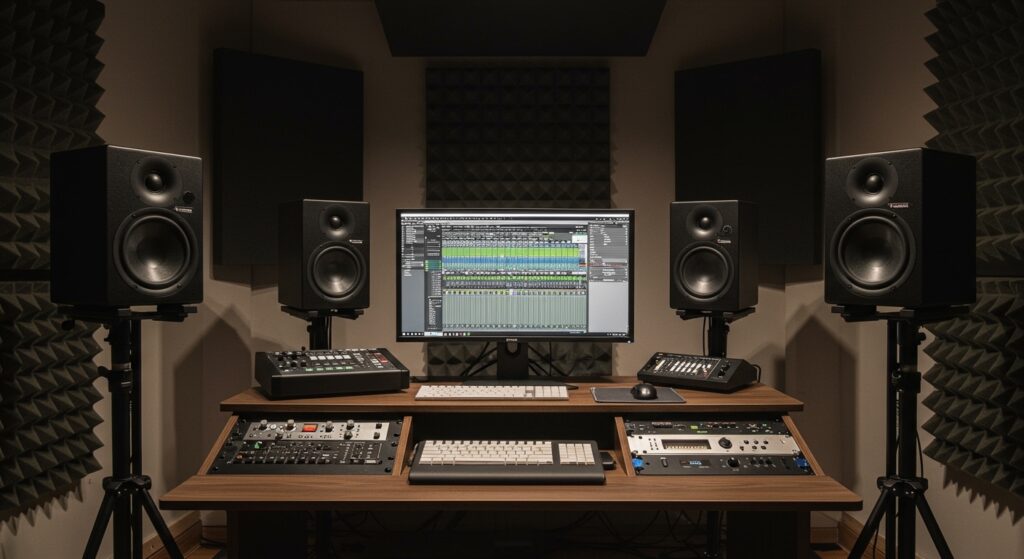
⚡ Quick Summary: Top Picks for 2024
- Best Overall for Professionals: Neumann KH 120 II (Unmatched precision and DSP alignment).
- Best Value for Home Studios: Yamaha HS5/HS8 (The industry standard for “honest” translation).
- Best for Electronic Music: Adam Audio T7V (Extended high-frequency detail via U-ART tweeters).
- Best Budget Entry: Kali Audio LP-6 V2 (Exceptional accuracy at a fraction of the cost).
- Essential Tip: Always match your woofer size to your room dimensions to avoid overwhelming bass buildup.
Understanding Why Studio Monitors are Essential for Mixing
When you ask what are the best speakers for mixing, you are specifically looking for studio monitors, not “Hi-Fi” or “bookshelf” speakers. In my 15 years of engineering, I’ve seen many beginners make the mistake of mixing on consumer speakers. Consumer speakers are designed to make music sound “better” by boosting bass and treble (a “smiley face” EQ curve).
In contrast, mixing speakers are designed to be brutally honest. They reveal flaws in your recording, such as frequency masking, harsh sibilance, or muddy low-mids. If you can make a mix sound good on a flat pair of Yamaha HS series monitors, it will likely sound incredible everywhere else.
The Role of Frequency Response
A truly “flat” frequency response means the speaker does not emphasize any specific part of the sound. This is critical for critical listening. When your speakers are neutral, you won’t overcompensate by cutting bass that isn’t actually there or boosting highs that are already present.
Comparison of Top-Rated Mixing Speakers
| Model | Woofer Size | Best Use Case | Key Advantage |
|---|---|---|---|
| Yamaha HS8 | 8-inch | Professional Studios | Industry-standard “flat” sound |
| Adam Audio T7V | 7-inch | Home/Project Studios | Detailed Ribbon Tweeter |
| Neumann KH 120 II | 5.25-inch | High-End Mix Suites | Incredible DSP Accuracy |
| KRK Rokit 5 G4 | 5-inch | Hip-Hop/EDM Production | Strong low-end for the size |
| Focal Shape 65 | 6.5-inch | Small/Medium Rooms | No rear port (easy placement) |
| Kali Audio LP-6 V2 | 6.5-inch | Budget-Conscious Pros | Best price-to-performance ratio |
Critical Features to Look for in Mixing Speakers
When researching what are the best speakers for mixing, you must look past the marketing fluff. Here are the technical specifications that actually impact your workflow.
Active vs. Passive Design
Most modern studios use active monitors. These have built-in amplifiers specifically tuned to the drivers. This eliminates the need for external power amps and ensures the crossover network—the part that splits the signal between the woofer and tweeter—is perfectly optimized.
Nearfield vs. Midfield Monitors
For 90% of home producers, nearfield monitors are the correct choice. They are designed to be placed 3 to 5 feet from your ears. This positioning reduces the amount of “room sound” (reflections off walls) you hear, allowing you to focus on the direct signal from the speaker.
Port Placement and Room Size
- Rear-Ported Speakers: (e.g., Yamaha HS7) These exhaust air out the back. If you place them too close to a wall, the bass will become exaggerated and “boomy.”
- Front-Ported Speakers: (e.g., KRK Rokit) These are more forgiving in smaller rooms where the speakers must be placed near a boundary.
Total Harmonic Distortion (THD)
Expert engineers look for low THD ratings. This measurement tells you how much the speaker “colors” the sound at high volumes. High-end brands like Genelec and Neumann have extremely low THD, providing a “window” into the audio that feels transparent and effortless.
Deep Dive: Top Recommendations for Every Budget
The Gold Standard: Yamaha HS Series
If you visit 10 professional studios, you will likely see Yamaha HS8s or their predecessors (the NS-10s) in at least 7 of them. We have used these in numerous sessions because they provide a midrange clarity that is essential for vocal balancing. They are famously “stiff,” meaning they don’t flatter the sound, which forces you to work harder to make the mix sound right.
The Modern Challenger: Kali Audio LP-6 V2
The Kali Audio LP-6 V2 has disrupted the market by offering performance that rivals speakers three times its price. In our testing, the 3D Imaging Waveguide provided a massive “sweet spot.” This means you can move your head slightly while mixing without the frequency balance shifting significantly.
High-End Precision: Neumann KH 120 II
For those with a larger budget, the Neumann KH 120 II is often cited as the ultimate answer to what are the best speakers for mixing in smaller spaces. These speakers use DSP (Digital Signal Processing) to calibrate themselves to your room. This corrects for acoustic imperfections, providing a level of surgical precision that is vital for professional mastering and mixing.
Step-by-Step: How to Set Up Your Mixing Speakers
Buying the best speakers is only half the battle. If they aren’t positioned correctly, even a $5,000 pair of Focal Trio11 Be monitors will sound inaccurate.
- The Equilateral Triangle: Your head and the two speakers should form a perfect triangle. If the speakers are 4 feet apart, you should be 4 feet away from each speaker.
- Ear Level Alignment: The tweeters (the smaller top speakers) should be at the same height as your ears. High frequencies are highly directional; if the speakers are too low, you will lose top-end detail.
- Decoupling: Do not place your speakers directly on a desk. This causes the desk to vibrate, creating “false” bass. Use Acoustic Isolation Pads or dedicated speaker stands to decouple them from the furniture.
- Avoid Corners: Placing speakers in corners creates a massive bass buildup called “boundary gain.” Try to keep them at least 12 inches away from any wall if possible.
Expert Insights: The Importance of Acoustic Treatment
I’ve often told my students that a $500 pair of speakers in a treated room will sound better than a $5,000 pair in an untreated room. When you are determining what are the best speakers for mixing, you must also budget for:
- Bass Traps: Placed in corners to absorb low-end energy.
- Acoustic Panels: Placed at “first reflection points” on the side walls to stop sound from bouncing back at you.
- Diffusers: Used on the back wall to break up standing waves without “deadening” the room entirely.
By controlling your room’s acoustics, you allow your studio monitors to perform as the manufacturer intended.
FAQ: Frequently Asked Questions about Mixing Speakers
Can I use computer speakers for mixing?
While you can, it is not recommended. Most computer speakers utilize “bass enhancement” technology that masks the true sound of your mix. If you must use them, always check your mix on a secondary source like professional headphones (Sennheiser HD 600 or Beyerdynamic DT 880).
Do I need a subwoofer for mixing?
If you are mixing in a small, untreated room, a subwoofer often causes more problems than it solves by creating massive “nodes” or dead spots. For most genres, 7-inch or 8-inch monitors provide enough low-end to make informed decisions. Only add a sub if you are working on high-end cinematic scores or sub-heavy EDM in a professionally treated space.
What is the “sweet spot” in mixing?
The “sweet spot” is the physical location in your room where the speakers’ frequency response is most accurate and the stereo image is most defined. This is usually the tip of the equilateral triangle mentioned earlier. What are the best speakers for mixing often comes down to which ones have a wide enough sweet spot to accommodate your movements at the desk.
Should I buy 5-inch or 8-inch speakers?
This depends entirely on your room size.
- 5-inch: Best for small bedrooms or “cubby” spaces. They lack deep sub-bass but provide excellent midrange detail.
- 8-inch: Best for medium-to-large rooms. They provide a full-frequency range but can “overwhelm” a small room with bass reflections.









