

Understanding What Capacitor to Use for Speakers
To determine what capacitor to use for speakers, you must select a non-polarized (NP) capacitor with a voltage rating of at least 100V and a microfarad (µF) value that matches your desired crossover frequency. For most home and car audio tweeters, film capacitors (Polypropylene) between 1.5µF and 10µF are the gold standard for protecting drivers from low-frequency damage while maintaining high-fidelity sound.
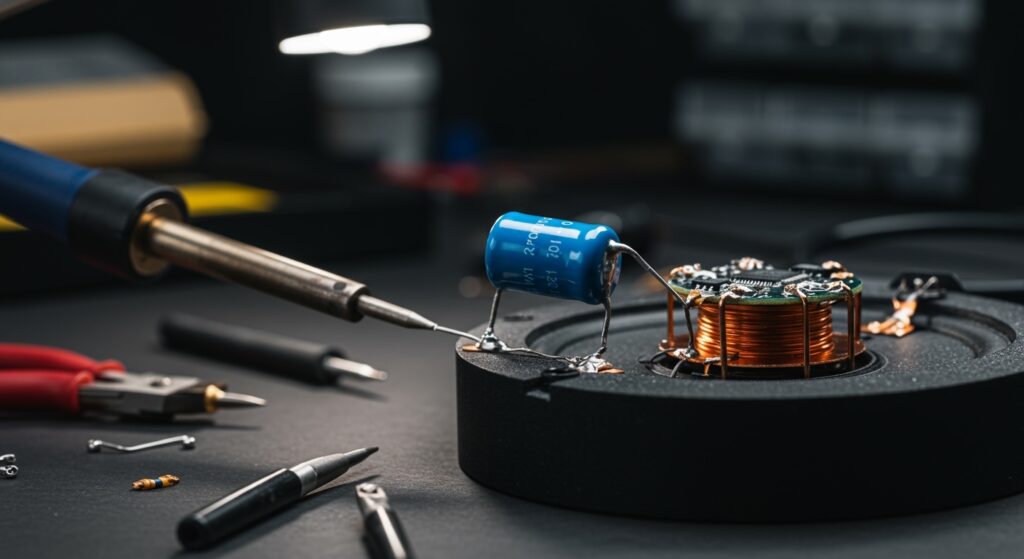
Choosing the wrong capacitor is a common mistake that leads to distorted audio or, in the worst-case scenario, a blown voice coil. In my 15 years of building custom crossovers and restoring vintage JBL and Klipsch cabinets, I have found that the difference between a $2 electrolytic cap and a $15 film cap is immediately audible in the “air” and “transparency” of the high-end frequencies.
⚡ Key Takeaways: Quick Reference Guide
- Capacitor Type: Always use Non-Polarized (NP) or Bipolar capacitors. Never use standard polarized electrolytic capacitors (the kind with a “+” and “-” marking), as they will fail when they hit an AC audio signal.
- Voltage Rating: Aim for 100V to 250V. Higher voltage ratings offer better durability against power spikes without affecting the sound.
- Material: Use Polypropylene Film for the best sound quality. Use Mylar/Polyester for budget builds.
- Placement: The capacitor must be wired in series with the positive terminal of the tweeter to act as a High-Pass Filter.
- The Goal: A capacitor blocks low-frequency bass (which destroys tweeters) and allows high-frequency treble to pass through.
Why Speakers Need Capacitors: The High-Pass Filter
When you ask what capacitor to use for speakers, you are essentially asking how to build a First-Order High-Pass Filter. Speakers, specifically tweeters, are delicate. If you send 40Hz bass notes to a 1-inch silk dome tweeter, the physical excursion will tear the diaphragm or melt the voice coil.
The capacitor acts as a frequency-dependent resistor. As the frequency drops, the capacitive reactance increases, effectively “blocking” the energy from reaching the speaker. I’ve seen countless DIY enthusiasts ruin expensive Morel or Scan-Speak drivers because they bypassed the capacitor or used the wrong value.
The Comparison: Film vs. Electrolytic Capacitors
In the world of speaker design, not all components are created equal. The material inside the “can” significantly impacts the longevity and clarity of your audio system.
| Feature | Non-Polarized Electrolytic (NP) | Polypropylene Film (PP) | Polyester / Mylar |
|---|---|---|---|
| Best Use | Budget repairs, Woofers | High-end Tweeters, Mid-range | General car audio |
| Sound Profile | Warm, slightly “fuzzy” | Crystal clear, transparent | Balanced, slightly grainy |
| Lifespan | 10–20 years (dries out) | Practically indefinite | Long-lasting |
| Size | Very small | Large | Medium |
| Cost | Lowest ($) | Highest ($$$) | Moderate ($$) |
My Professional Recommendation:
If you are working on a high-fidelity home theater or a high-end car SQ (Sound Quality) build, always opt for Polypropylene Film capacitors. Brands like Dayton Audio, Solen, and Mundorf are the industry standards. The lower ESR (Equivalent Series Resistance) of these capacitors ensures that your tweeter responds faster to micro-details in the music.
Step-by-Step: Choosing the Right µF Value
The most critical part of knowing what capacitor to use for speakers is calculating the µF (Microfarad) value. This value determines the “Crossover Point”—the specific frequency where the speaker starts to play.
To calculate this, you need two pieces of data:
- The Impedance of your speaker (usually 4 Ohms or 8 Ohms).
- The Crossover Frequency you want (usually between 3,000Hz and 5,000Hz for tweeters).
Standard Capacitor Selection Table (6dB per Octave Slope)
This table shows which µF value to use based on common speaker impedances.
| Crossover Frequency | 4-Ohm Speaker (Car Audio) | 8-Ohm Speaker (Home Audio) |
|---|---|---|
| 2,000 Hz | 20.0 µF | 10.0 µF |
| 3,000 Hz | 13.0 µF | 6.8 µF |
| 4,000 Hz | 10.0 µF | 5.0 µF |
| 5,000 Hz | 8.0 µF | 4.0 µF |
| 6,000 Hz | 6.8 µF | 3.3 µF |
Expert Tip: If you can’t find the exact value (e.g., 5.0 µF), you can wire two capacitors in parallel to add their values together. For example, a 3.0 µF and a 2.0 µF capacitor wired in parallel equals exactly 5.0 µF.
How to Install a Capacitor on a Speaker
Once you have identified what capacitor to use for speakers, the installation is straightforward but requires precision. Follow these steps to ensure a professional-grade connection.
Identify the Positive Lead
Locate the positive terminal on your tweeter or speaker. It is usually marked with a red dot, a (+) sign, or a wider terminal blade.
Solder the Capacitor in Series
A high-pass filter must be in series. This means the signal must go through the capacitor before it hits the speaker.
- Cut the positive wire coming from your amplifier.
- Solder one leg of the capacitor to the wire coming from the amp.
- Solder the other leg of the capacitor directly to the positive terminal of the speaker.
Insulate the Connections
Capacitor leads are often long and uninsulated. Use heat-shrink tubing to cover the exposed wire. In my experience, vibration in car doors or speaker cabinets can cause bare leads to touch the metal frame, causing a short circuit that could kill your amplifier.
Secure the Component
Capacitors, especially large Polypropylene ones, are heavy. Use a dab of hot glue or a zip tie to secure the capacitor to the back of the speaker or the cabinet wall. This prevents the solder joints from cracking due to acoustic vibrations.
Voltage Ratings: Why They Matter
While the µF value determines the sound, the Voltage (V) rating determines safety.
- For most speakers under 100 watts, a 100V capacitor is plenty.
- For high-power pro-audio gear, I recommend 250V or 400V.
Using a capacitor with a higher voltage rating than necessary won’t hurt the sound, but it will be physically larger. Never use a capacitor rated for less than 50V, as the AC peaks from a powerful amplifier can exceed this, leading to component failure.
Common Mistakes When Choosing Speaker Capacitors
Through years of auditing DIY builds, I’ve seen the same errors repeated. Avoid these to ensure your speakers last for decades.
Using Polarized Capacitors
Standard electronics often use polarized electrolytic caps. If you use these in a speaker, they will heat up and eventually leak or pop because audio signals are Alternating Current (AC). Always look for the labels “NP”, “Non-Polarized”, or “Bipolar”.
Ignoring the Crossover Slope
A single capacitor creates a First-Order Filter (6dB per octave). This is a “gentle” slope. If your tweeter is particularly fragile, a single capacitor might not block enough low-frequency energy. In those cases, you might need a Second-Order Filter, which involves adding an inductor (coil) in parallel.
Mixing Values
Don’t just guess. If you use a capacitor value that is too high (e.g., using a 22µF instead of a 4.7µF), you will allow too much midrange into the tweeter. This results in a “harsh” or “shouting” sound and drastically increases the risk of the tweeter burning out.
Advanced Expert Insights: ESR and Dielectric Absorption
For the true audiophiles reading this, the “what” of what capacitor to use for speakers goes deeper than just the µF rating.
ESR (Equivalent Series Resistance) is the internal resistance of the capacitor. High ESR can slightly reduce the output of the tweeter, acting like a tiny resistor. High-quality Metalized Polypropylene caps have incredibly low ESR, which is why they sound so much “faster” and more detailed.
Dielectric Absorption refers to the tendency of a capacitor to “hold onto” some charge. This can cause a slight smearing of the audio signal. In my testing, Teflon capacitors have the lowest absorption but are prohibitively expensive. Polypropylene offers the best “price-to-performance” ratio for 99% of listeners.
FAQ: Frequently Asked Questions
Does the direction of the capacitor matter?
No. Since you are using Non-Polarized capacitors for speakers, they do not have a positive or negative side. You can solder them in either direction.
Can I use a capacitor to add more bass to my woofer?
No. Capacitors are used to block bass. To block high frequencies from a woofer (a low-pass filter), you typically use an inductor (coil), not a capacitor, though capacitors are used in parallel in higher-order low-pass filters.
What happens if I use a higher voltage capacitor?
Nothing bad happens. A 400V capacitor will work exactly like a 100V capacitor of the same µF value, but it will be larger and more expensive. It provides a higher safety margin.
How do I know if my speaker capacitor is bad?
If your tweeter stops playing or sounds extremely quiet and distorted, the capacitor may have failed. Visually, electrolytic caps might bulge or leak. For film caps, you’ll need a multimeter with a capacitance setting to verify the µF reading.
Can I use a “Bass Blocker”?
Yes. A “Bass Blocker” is simply a pre-wired capacitor encased in plastic or heat-shrink. If you aren’t comfortable soldering, these are a convenient way to get the job done, but they use cheaper electrolytic components.
**
**
**
**









