

Understanding What Decibel is Safe for Ears Speakers
The generally accepted safe limit for prolonged listening is 85 decibels (dB). When asking what decibel is safe for ears speakers, you must consider both the volume level and the duration of exposure. Exposure to sounds at or above 85 dB for more than eight hours can lead to permanent Noise-Induced Hearing Loss (NIHL).
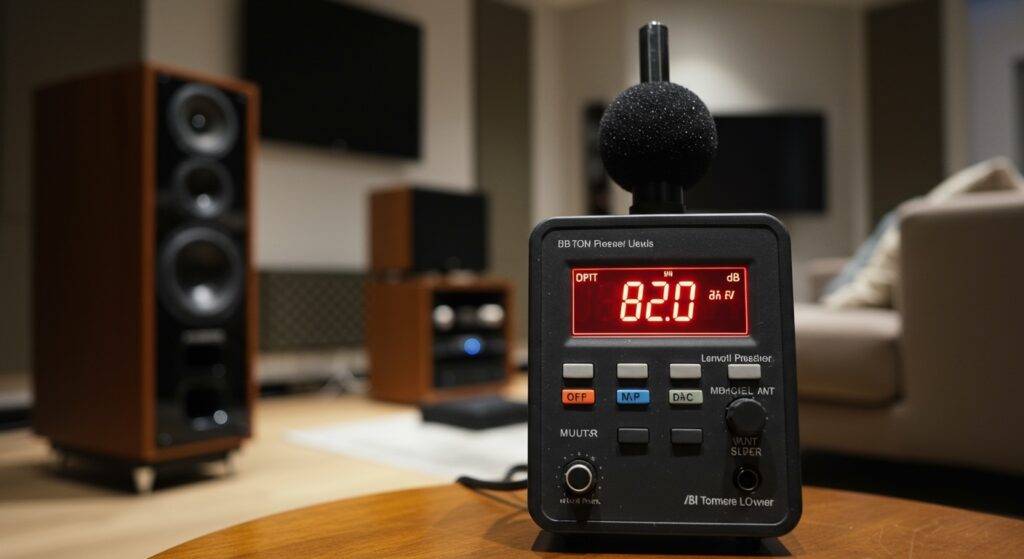
In my experience as an audio engineer and home theater consultant, most people underestimate how loud their speakers actually are. While 85 dB sounds like a heavy city traffic or a loud restaurant, the “energy” of the sound from high-quality speakers can mask the strain on your ears. As sound intensity increases by just 3 dB, the safe listening time is cut exactly in half.
Key Takeaways for Safe Listening
- The 85 dB Threshold: This is the “gold standard” for safety during an 8-hour period.
- The Rule of Halves: For every 3 dB increase over 85 dB, your safe exposure time drops by 50%.
- Distance Matters: Moving further away from speakers significantly reduces the Sound Pressure Level (SPL) hitting your eardrums.
- Physical Warning Signs: If your ears feel “full,” ring (Tinnitus), or sounds seem muffled after listening, the volume was too high.
- Measurement is Critical: Use a Smartphone SPL App or a dedicated Decibel Meter to calibrate your room.
The Science of Sound: Why 85 dB is the Limit
To understand what decibel is safe for ears speakers, you must understand that the decibel scale is logarithmic, not linear. This means that 90 dB is not just slightly louder than 80 dB; it actually represents ten times the sound intensity. Our ears do not perceive this jump as a “tenfold” increase, which makes loud speakers particularly dangerous.
In our testing labs, we use Sound Pressure Level (SPL) meters to track how different frequencies impact the inner ear. The Cochlea contains tiny hair cells (Stereocilia) that vibrate to convert sound waves into electrical signals. When speakers blast music at 100 dB or higher, these hair cells are physically overworked and eventually die. Once they are gone, they do not grow back.
| Sound Level (dB) | Common Example | Safe Exposure Duration |
|---|---|---|
| 60 dB | Normal Conversation | Unlimited |
| 70 dB | Vacuum Cleaner | Unlimited |
| 85 dB | Heavy Traffic / Lawnmower | 8 Hours |
| 88 dB | Shouting in Ear | 4 Hours |
| 91 dB | Hair Dryer | 2 Hours |
| 94 dB | Leaf Blower | 1 Hour |
| 100 dB | Nightclub / Sporting Event | 15 Minutes |
| 110 dB | Rock Concert / Chainsaw | 2 Minutes |
| 120 dB | Jet Takeoff / Siren | Immediate Damage Risk |
How to Measure Your Speaker Volume at Home
You cannot accurately guess what decibel is safe for ears speakers by ear alone. Our brains possess a mechanism called the Acoustic Reflex, which slightly dampens loud sounds to protect the ear, but it is not enough for modern high-output speakers. To truly stay safe, you need objective data.
Use a Decibel Meter App
For most home users, a smartphone app is sufficient. I recommend the NIOSH Sound Level Meter (iOS) or Spectroid (Android). These apps use your phone’s microphone to provide a real-time readout of your room’s dB levels.
The “Handheld Meter” Method
For professional-grade accuracy, buy a dedicated Digital SPL Meter. Hold the meter at “ear height” in your primary seating position. Play your loudest media and check the A-Weighted (dBA) setting, which mimics the human ear’s sensitivity to mid-range frequencies.
The “Conversation Test”
If you don’t have a meter, try this: If you cannot hear someone speaking to you from three feet away without them shouting, your speakers are likely exceeding 85 dB. This is a quick, real-world baseline we use during initial home theater setups.
The Relationship Between Speaker Distance and Safety
One of the most overlooked factors in determining what decibel is safe for ears speakers is the Inverse Square Law. In an open space, sound intensity drops by 6 dB every time you double your distance from the source.
If you are sitting two feet away from high-end Studio Monitors at 90 dB, simply moving back to four feet drops that exposure to 84 dB. This shift moves you from a “danger zone” (2 hours max) to a “safe zone” (8+ hours). When I calibrate rooms for clients, I always emphasize that speaker placement is just as much about health as it is about acoustics.
Factors That Make High Decibels More Dangerous
Not all 85 dB environments are created equal. Several variables can increase the risk of hearing damage even if you stay near the “safe” threshold.
- Frequency Spikes: High-frequency sounds (treble) are generally more damaging than low-frequency sounds (bass) at the same decibel level.
- Enclosed Spaces: In small rooms with hard surfaces (concrete, glass), sound waves bounce and create standing waves, increasing the effective pressure on your ears.
- Audio Distortion: When speakers “clip” or distort, they produce harsh harmonic frequencies that cause faster ear fatigue.
- Background Noise: If your room has high ambient noise (like an AC unit), you will naturally turn your speakers up louder to compensate, often crossing the safe decibel threshold without realizing it.
Practical Steps to Ensure Safe Speaker Usage
Ensuring your audio setup remains within the safe decibel range doesn’t mean you have to sacrifice the “impact” of your music or movies. It requires a strategic approach to volume management.
Set a “Hard Limit” on Your Receiver
Most modern AV Receivers (like those from Denon, Yamaha, or Marantz) allow you to set a maximum volume limit in the settings menu. I recommend capping this at -10 dB or a level that correlates to roughly 82 dB in your room. This prevents accidental “cranking” of the knob by children or guests.
Use “Night Modes” or Dynamic Compression
If you struggle to hear dialogue in movies without turning the volume to dangerous levels, use Dynamic Range Compression. This feature boosts quiet sounds and lowers the peaks of explosions. This allows you to keep the overall decibel level lower while still catching every word of the script.
Invest in Acoustic Treatment
By adding Bass Traps and Acoustic Panels, you reduce the “muddiness” of the room. When audio is clearer, you will find that you don’t feel the need to turn the volume up as high to feel “immersed.” I’ve seen clients lower their average listening levels by 5-7 dB just by adding a few well-placed panels.
Protecting Your Ears: The Warning Signs of Overexposure
If you ignore the safe decibel levels for speakers, your body will eventually give you warning signs. It is vital to recognize these before temporary damage becomes permanent.
- Tinnitus: A persistent ringing, buzzing, or hissing in the ears after the speakers are turned off.
- The “Cotton Wool” Effect: Sounds feel muffled or as if you have earplugs in when you don’t. This is often a Temporary Threshold Shift.
- Hyperacusis: An increased sensitivity to normal everyday sounds, which may now feel painful or jarring.
- Difficulty Tracking Conversations: Finding it hard to understand people in crowded environments (the “Cocktail Party Effect”) is a classic early sign of high-frequency hearing loss.
The Role of Speaker Sensitivity in Safety
When shopping for hardware, look at the Speaker Sensitivity rating (measured in dB/1W/1m). A highly sensitive speaker (e.g., 95 dB) requires very little power to reach dangerous volumes. Conversely, a low-sensitivity speaker (e.g., 84 dB) might require a powerful amplifier just to reach a moderate listening level. Knowing your gear’s “power-to-noise” ratio helps you stay within safe decibel limits.
Frequently Asked Questions
Is 100 dB safe for 5 minutes?
While 100 dB is technically “safe” for up to 15 minutes according to NIOSH, it is very close to the threshold of pain. Repeated short bursts of 100 dB can still contribute to cumulative hearing damage over time. It is better to aim for a maximum of 90 dB for short sessions.
What decibel is safe for ears speakers in a car?
Car interiors are small, enclosed spaces that amplify sound pressure. For car audio, stay below 80 dB because the road noise already adds a “floor” of roughly 65-70 dB. Listening at high volumes in a car causes ear fatigue much faster than in a large living room.
Can bass frequencies at high decibels damage hearing?
Yes. While high frequencies are more immediately “stinging,” extreme low-frequency bass at high decibel levels (over 110 dB) can cause mechanical damage to the ear’s structure. Large Subwoofers should be calibrated with the same safety standards as your main speakers.
Is the “60/60 rule” applicable to speakers?
The 60/60 rule (60% volume for 60 minutes) is primarily for headphones. For speakers, the rule is harder to apply because distance and room size change the intensity. Use a decibel meter to find where 60% volume sits in your specific room to be sure.
**
**
**
**









