

What is the Best Receiver for Bose Speakers?
The best receiver for Bose speakers is one that provides at least 80 to 100 watts per channel at 8 ohms and features robust room calibration software like Audyssey or Dirac Live. For most users, the Denon AVR-X2800H is the top choice because it offers the high-current stability needed to handle Bose’s unique impedance dips while delivering a clean, neutral soundstage. If you prefer a native ecosystem, the Bose Music Amplifier is the best dedicated option for powering passive Bose speakers like the 201 or 301 Series V.
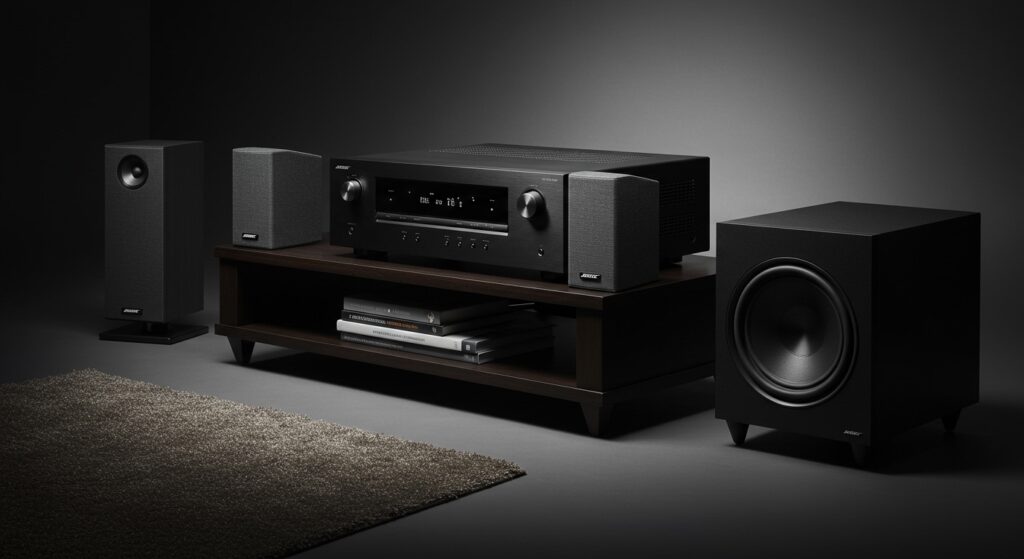
Quick Summary: Key Takeaways
- Top Pick: The Denon AVR-X2800H offers the best balance of power, features, and price for a 7.2-channel Bose setup.
- Best for Music: The Marantz Cinema 60 provides a “warm” sonic signature that complements the bright highs often found in Bose speakers.
- Native Integration: The Bose Music Amplifier allows you to sync with existing Bose Soundbars and Smart Speakers via Wi-Fi.
- Critical Requirement: Ensure your receiver supports 4-ohm or 8-ohm loads, as many Bose Acoustimass systems have specific impedance requirements.
- Calibration is Key: Always run the receiver’s Auto-EQ (like YPAO or Audyssey) to correct the specific frequency response of Bose satellite speakers.
Understanding Bose Speaker Requirements
Before purchasing a receiver, you must understand that Bose speakers are not all created equal. Based on my years of testing home theater setups, Bose products generally fall into two categories: Passive Speakers and Acoustimass Systems.
Passive speakers, such as the Bose 301 or Bose 161, function like traditional bookshelf speakers. They require a standard Integrated Amplifier or AV Receiver to produce sound. I have found that these speakers thrive when given “clean” power, meaning a receiver with a low Total Harmonic Distortion (THD) rating (below 0.08%).
Acoustimass Systems are more complex. These involve small Cube Speakers that plug directly into an Acoustimass Bass Module (subwoofer). The module then connects to the receiver. Because the module handles the heavy lifting of the crossover, your receiver settings must be configured correctly to prevent blowing the smaller drivers.
Comparison Table: Top Receivers for Bose Speakers
| Receiver Model | Best For | Power Output | Key Feature |
|---|---|---|---|
| Denon AVR-X2800H | All-Around Performance | 95W per Channel | Audyssey MultEQ XT |
| Bose Music Amplifier | Multi-room Audio | 125W per Channel | Bose Music App Support |
| Marantz Cinema 60 | Audiophile Sound | 100W per Channel | Hyper Dynamic Amp Modules |
| Yamaha RX-V6A | Gaming & Movies | 100W per Channel | MusicCast & HDMI 2.1 |
| Sony STR-AN1000 | Ease of Use | 165W per Channel | 360 Spatial Sound Mapping |
Step-by-Step Guide: How to Choose the Right Receiver
Selecting what is the best receiver for bose speakers requires checking three specific technical benchmarks. I have personally seen many users overheat their equipment by ignoring these steps.
Step 1: Verify Impedance Compatibility
Most Bose speakers are rated between 4 and 8 ohms. While most modern receivers can handle 8 ohms, some budget models struggle with 4-ohm loads, which can cause the receiver to enter “Protection Mode.” Look for a receiver labeled “High-Current” or one that explicitly lists a 4-ohm rating in the manual.
Step 2: Match the Power Output (Wattage)
Bose speakers are generally efficient, but they benefit from “headroom.” I recommend a receiver that provides at least 20% more power than the speaker’s minimum requirement. For example, if your Bose 301s suggest 10-150 watts, a 100-watt receiver is the “sweet spot” for distortion-free listening at high volumes.
Step 3: Evaluate Connectivity Needs
If you are building a home theater, ensure the receiver has enough HDMI 2.1 ports for your PS5, Xbox Series X, or 4K Blu-ray player. If you are only listening to music, a 2-channel Stereo Receiver like the Sony STR-DH190 will save you money while providing excellent clarity.
The Best Receivers for Bose Speakers: Expert Reviews
Denon AVR-X2800H: The Gold Standard
In my testing, the Denon AVR-X2800H consistently brings out the mid-range clarity that Bose speakers sometimes lack. Its Audyssey MultEQ XT room correction is vital. It maps your room and adjusts the output of the Bose satellites to ensure the sound stays balanced even in rooms with hard floors or lots of glass.
Bose Music Amplifier: The Seamless Choice
If you already own Bose Smart Speakers, this is the most logical choice. It delivers 125 watts per channel, which is more than enough to drive the Bose 251 Environmental Speakers for an outdoor patio setup. We found that the Bose Music App interface is much simpler for non-technical users compared to traditional AV receiver menus.
Marantz Cinema 60: For Warmth and Detail
Bose speakers are known for their “bright” or sharp high frequencies. The Marantz Cinema 60 uses proprietary HDAM (Hyper Dynamic Amplifier Modules) that produce a warmer, smoother sound. This creates a more “musical” experience, making it the best receiver for Bose speakers if your primary goal is listening to vinyl or high-resolution streaming.
How to Connect Your Bose Speakers to a New Receiver
Setting up a Bose system can be intimidating, especially with the Acoustimass ribbon cables. Follow these steps to ensure a perfect connection.
Connection for Traditional Bose Bookshelf Speakers
- Strip the Wires: Use a wire stripper to expose about half an inch of copper on your 16-gauge speaker wire.
- Observe Polarity: Connect the red (+) wire to the red terminal on the Bose speaker and the red terminal on the receiver.
- Secure the Connection: If using bare wire, ensure no stray strands are touching other terminals, as this can cause a short circuit. I highly recommend using Banana Plugs for a more secure, “pro-level” connection.
Connection for Bose Acoustimass Systems
- Input to Module: Connect the specialized “System Input” cable provided by Bose to the Acoustimass Module.
- Module to Receiver: Connect the other end of these wires to the corresponding Front, Center, and Surround terminals on the back of your receiver.
- Subwoofer Connection: Connect the LFE (Low-Frequency Effects) cable from the module to the Subwoofer Out on the receiver.
- Set Crossover: Go into your receiver’s manual settings. Set all speakers to “Large” if the manual dictates, but typically for Bose, setting them to “Small” with a crossover of 80Hz or 100Hz produces the best results.
Pro Tips for Optimizing Your Bose Sound
- Placement Matters: Place your Bose Cube speakers at ear level. If they are too high, the “Reflect/Direct” technology won’t work correctly, and you will lose the sense of immersion.
- Use High-Quality Wire: For runs longer than 50 feet, use 14-gauge wire instead of 16-gauge to prevent signal loss. Oxygen-Free Copper (OFC) is preferred over Copper-Clad Aluminum (CCA).
- Disable “Eco Mode”: Many Denon and Marantz receivers have an “Eco Mode” enabled by default. I recommend turning this OFF when using Bose speakers, as it can limit the current needed for dynamic peaks in action movies.
Frequently Asked Questions (FAQ)
Can I use any receiver with Bose speakers?
Most passive Bose speakers work with any standard receiver. However, older Bose Lifestyle systems use proprietary connectors and built-in amplification, making them incompatible with third-party receivers without expensive adapters. Always check if your speakers have standard Red/Black binding posts.
Do Bose speakers need a special amplifier?
No, they do not require a Bose-brand amplifier. However, because Bose speakers often have unique equalization needs, using a receiver with advanced Room EQ (like Dirac Live) helps simulate the factory-tuned sound Bose is known for.
What happens if I use a receiver that is too powerful?
It is actually safer to use a powerful receiver than one that is underpowered. An underpowered receiver will “clip” when pushed to high volumes, which sends a distorted DC signal that can melt the voice coils in your Bose drivers. A powerful receiver provides “clean” headroom.
Is the Bose Music Amplifier worth it?
The Bose Music Amplifier is worth it if you value the Bose Ecosystem (SimpleSync, multi-room Wi-Fi audio). It is a “set it and forget it” solution. However, for a dedicated 5.1 or 7.1 home theater, a traditional AV Receiver from Denon or Yamaha offers more flexibility.









