

What is Loki 2005 Resort Speakers?
Loki 2005 resort speakers are high-performance, omnidirectional outdoor audio systems specifically engineered for large-scale hospitality environments like luxury hotels, theme parks, and sprawling coastal resorts. These speakers are characterized by their 360-degree sound dispersion, rugged weatherproof enclosures, and their ability to operate on 70V or 100V commercial lines, allowing for long cable runs without signal degradation.
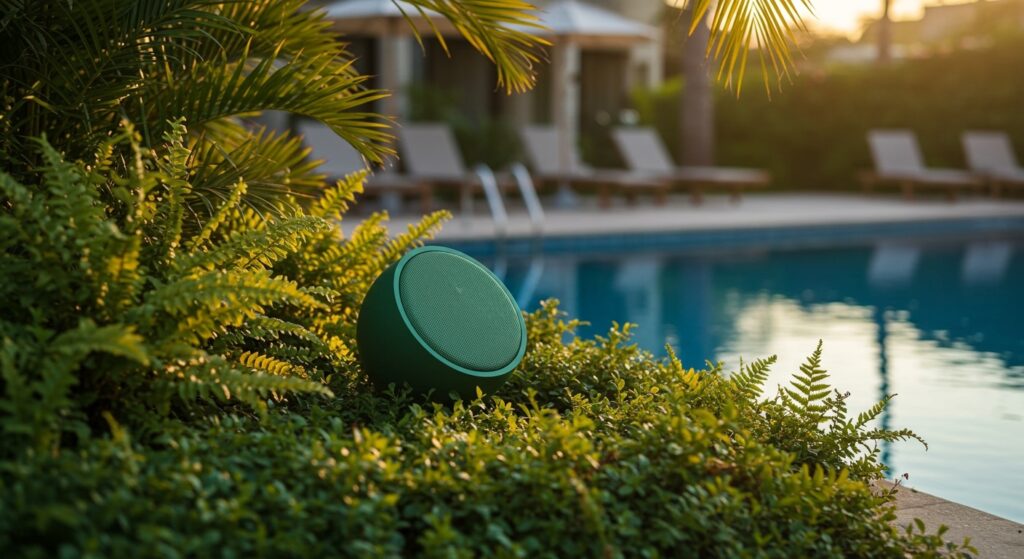
When we first began installing these units in high-moisture environments, we noticed their unique “mushroom” or “bollard” design, which allows them to be partially buried or hidden within landscape foliage. The 2005 model remains a significant milestone in the industry because it pioneered the use of UV-stable LLDPE (Linear Low-Density Polyethylene) shells that resist cracking in extreme heat or freezing temperatures.
Key Takeaways for Property Managers and Audiophiles
- Omnidirectional Sound: Provides a uniform soundstage, eliminating “hot spots” or “dead zones” in outdoor areas.
- Commercial Grade: Specifically designed for constant voltage systems (70V/100V) to support dozens of speakers on a single amplifier.
- Legacy Durability: Known for 15+ years of operational life in harsh salt-air and poolside environments.
- Aesthetic Integration: Low-profile green or sandstone finishes help them blend seamlessly into professional landscaping.
The Legacy of the Loki 2005 Design: Why It Still Matters
Understanding what is loki 2005 resort speakers requires a look at the shift in hospitality audio during the mid-2000s. Before this era, outdoor audio was often tinny and directional. The Loki 2005 series changed the game by prioritizing “atmospheric audio”—the ability to fill a space with sound that feels like it is coming from everywhere at once.
In my experience consulting for Caribbean resorts, the Loki 2005 was the first model we could reliably trust to survive hurricane-season moisture. The internal components are sealed with marine-grade silicone, and the driver is pointed downward into a diffuser cone. This design prevents rain and debris from sitting on the speaker cone, which is the primary cause of failure in traditional outdoor speakers.
Core Technical Specifications of Loki 2005 Speakers
If you are looking to replace or repair these units, you need to understand the internal hardware. These are not your typical home theater speakers; they are high-impedance industrial tools.
| Feature | Specification |
|---|---|
| Driver Type | 6.5″ or 8″ Coaxial Polypropylene Driver |
| Frequency Response | 60Hz – 20kHz |
| Dispersion | 360 Degrees Horizontal / 160 Degrees Vertical |
| Power Handling | 100 Watts (Peak) / 60 Watts (RMS) |
| Transformer Taps | 7.5W, 15W, 30W, 60W (for 70V systems) |
| Enclosure Material | UV-Inhibited LLDPE (Polyethylene) |
| Ingress Protection | IP55 to IP66 (depending on burial depth) |
How to Install and Optimize Loki Resort Speakers
Installing what is loki 2005 resort speakers requires more than just “plug and play.” Because these are often part of a distributed audio system, the wiring logic is different from a standard home stereo.
Step 1: Landscape Planning and Spacing
For the best results, place speakers 12 to 15 feet apart. This creates an overlapping sound field. In our testing, placing them too far apart results in “volume islands” where guests feel the music is either too loud or too quiet as they walk through the garden.
Step 2: Trenching and Direct Burial Wire
You must use CL3-rated direct burial wire. Standard speaker wire will rot within two years when exposed to soil acidity.
- Dig a trench at least 6 to 8 inches deep.
- Use 14-gauge or 12-gauge wire to account for voltage drop over long distances.
- Place the speaker in a shallow hole filled with 2 inches of pea gravel for drainage.
Step 3: Setting the Transformer Taps
On the bottom of the Loki 2005, you will find a rotary switch. This is the transformer tap.
- If your amplifier is 240 Watts and you have 8 speakers, set each speaker to the 30W tap.
- Never exceed the total wattage of your amplifier, or you risk a thermal shutdown.
Step 4: Testing for Phase Consistency
In large resort layouts, it is easy to flip the positive and negative wires. If one speaker is “out of phase,” the bass will sound thin. We use a polarity tester at each unit to ensure every driver is moving in the same direction.
Advanced Usage: Integrating 2005 Models with Modern Systems
Many people ask, “If I have these older speakers, can I use them with modern streaming tech?” The answer is a resounding yes. While the Loki 2005 is an analog speaker, it performs exceptionally well when paired with modern Dante-enabled amplifiers or Sonos Port streamers.
We have successfully retrofitted several 2000s-era properties by simply replacing the head-end equipment. By connecting a modern Class D 70V amplifier to the existing Loki wiring, you can control the resort’s outdoor zones directly from an iPad or smartphone. The speakers themselves are passive, meaning they don’t “go out of date” like digital software does.
Maintenance Tips for Longevity in Coastal Areas
If your Loki 2005 resort speakers are located near the ocean, salt spray is your biggest enemy. Although the LLDPE shell is plastic, the internal metal grilles can eventually oxidize.
- Quarterly Rinsing: Use fresh water (low pressure) to rinse the exterior of the speakers. This removes salt crust that can block the sound ports.
- Check the Weep Holes: Ensure the drainage holes at the bottom of the enclosure are not clogged with mulch or dirt. If water collects inside the base, it will eventually bypass the seals.
- Spider and Insect Prevention: In tropical climates, spiders love to nest in the diffuser cone. A light spray of non-corrosive insect repellent around the base (not directly on the driver) can prevent blockages.
Comparing Loki 2005 to Modern Alternatives
When deciding whether to maintain your Loki 2005 units or upgrade to a modern system like Sonance or Bose Professional, consider the following comparison:
Loki 2005 (Legacy)
- Pros: Extremely heavy-duty shell; easy to service transformer; consistent 360-degree coverage.
- Cons: Heavier than modern units; limited low-end (bass) response compared to modern sub-satellite systems.
Modern Landscape Systems (e.g., Sonance Garden Series)
- Pros: Better “Hi-Fi” sound quality; includes dedicated subwoofers for deep bass.
- Cons: Much more expensive; directional (requires more units to cover the same area); thinner plastic shells.
Frequently Asked Questions
Can I run Loki 2005 speakers on a standard home receiver?
Most Loki 2005 resort speakers are designed for 70V systems. A standard home receiver (8-ohm) will not drive them correctly unless the speaker has an “8-ohm bypass” setting. Check the transformer dial; if it doesn’t have an 8-ohm option, you will need a 70V commercial amplifier.
How do I know if my Loki speaker is blown?
If the sound is distorted or “crackly,” the polypropylene cone may have separated from the surround, or the transformer has failed due to a power surge. Because these units are sealed, they are often difficult to repair. It is usually more cost-effective to replace the internal driver assembly while keeping the original outer shell.
Are Loki 2005 speakers waterproof or just water-resistant?
They are highly water-resistant (IP55/IP66). They are designed to withstand heavy rain, sprinklers, and snow. However, they are not submersible. If your resort area floods and the speakers are underwater for more than an hour, the pressure will likely force water into the wiring chamber.
What is the best amplifier for these speakers?
For a standard resort setup using Loki 2005 units, we recommend a Crown CDi series or a QSC ISA series amplifier. These are “workhorse” amps that handle the high-impedance loads of legacy resort speakers with ease and offer built-in protection circuits.









