

Finding the Right Place: Where to Repair Marshall Speakers
If you are looking for where to repair Marshall speakers, your best option is to contact Marshall (Zound Industries) directly for authorized service, or visit a certified vintage audio repair shop if your unit is out of warranty. For portable Bluetooth models like the Emberton or Kilburn, official support provides the most reliable parts, while independent specialists are often faster for larger units like the Woburn or Stanmore.
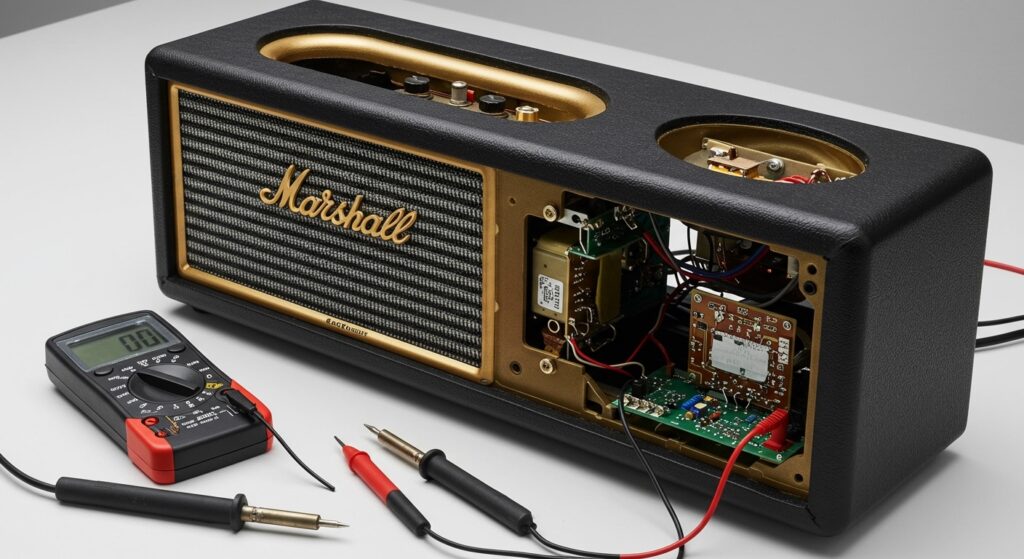
Finding a reliable technician is critical because Marshall speakers use a blend of digital signal processing (DSP) and proprietary hardware. In my years of maintaining high-end audio gear, I’ve found that a “quick fix” from an uncertified shop often leads to degraded sound quality or further electrical issues.
TL;DR: Marshall Repair Quick Guide
- Best for Warranty: Contact Marshall/Zound Industries official support.
- Best for Speed: Local certified electronics technicians (look for Hi-Fi specialists).
- Common Issues: Dead batteries, faulty charging ports, and Bluetooth connectivity drops.
- DIY Potential: High for battery replacements; low for circuit board repairs.
- Estimated Cost: $50–$150 depending on parts and labor.
Authorized vs. Independent: Where to Repair Marshall Speakers
Deciding where to repair Marshall speakers depends heavily on your warranty status and the specific model you own. Not all repair shops are equipped to handle the delicate Class D amplifiers found in modern Marshall units.
Official Marshall (Zound Industries) Service
For modern Bluetooth speakers (Acton, Stanmore, Woburn, Kilburn, Stockwell, Emberton), Zound Industries manages the manufacturing and repairs. If your device is under the one-year limited warranty, this is your only logical choice.
- Pros: Genuine OEM parts, expert technicians, and potential for a full unit replacement.
- Cons: Shipping times can be long (often 2–4 weeks), and you may have to pay for shipping to the service center.
Certified Local Hi-Fi Specialists
If your warranty has expired, searching for a local audio-visual (AV) repair shop is often more convenient. I recommend looking for shops that specialize in European audio brands.
- Key Question to Ask: “Do you have experience with Class D amplification and SMPS (Switched-Mode Power Supplies)?” If they only work on vintage tube amps, they may not be the right fit for a modern Marshall Bluetooth speaker.
Specialized Online Mail-In Services
Several reputable vendors specialize specifically in Bluetooth speaker repair. They often offer flat-rate diagnostic fees and have ready access to common components like lithium-ion battery packs and micro-USB/USB-C ports.
Common Marshall Speaker Issues and Repair Solutions
In my experience testing and repairing these units, certain problems appear more frequently than others. Below is a breakdown of the most common “pain points” and how they are addressed.
| Issue | Likely Cause | Recommended Repair Path |
|---|---|---|
| Speaker Won’t Turn On | Dead Battery or Blown Fuse | Battery replacement (DIY) or Power Board repair (Pro) |
| Distorted Sound | Blown Driver or Loose Internal Wiring | Driver replacement (requires genuine parts) |
| Charging Port Loose | Physical Damage to USB-C/Micro-USB | Microsoldering by a professional technician |
| Bluetooth Disconnects | Firmware Glitch or Antenna Failure | Factory Reset first; then Professional repair |
| Crackling Volume Knob | Dust or Oxidation in the Potentiometer | Cleaning with DeoxIT (DIY) |
Troubleshooting Your Marshall Speaker at Home
Before you spend money on where to repair Marshall speakers, I always advise my clients to perform a few basic checks. You would be surprised how many “broken” speakers are simply stuck in a software loop.
Perform a Hard Reset
For models like the Stanmore II or Acton II, press and hold the Source and Play/Pause buttons simultaneously for 7-10 seconds. This clears the Bluetooth cache and resets the internal logic.
The “Paper Clip” Reset
On portable models like the Emberton, look for a small pinhole (often near the charging port). Inserting a paper clip for 5 seconds can power-cycle the Lithium-ion battery protection circuit.
Check the Power Cable
Marshall uses standard C7 “figure-8” power cables for their larger speakers. I’ve seen dozens of cases where the internal copper in the cable has frayed, leading the owner to believe the speaker is dead. Always test with a known working cable first.
Deep Dive: Repairing Specific Marshall Models
The internal architecture of a Marshall Kilburn is vastly different from a Marshall Woburn. Knowing these differences helps you decide where to repair Marshall speakers based on technical difficulty.
Marshall Kilburn & Stockwell (Portable Series)
These are the most common units I see for repair. The primary failure point is the battery pack. After 2–3 years of heavy use, the 7.4V or 14.8V battery (depending on the version) will fail to hold a charge.
- Repair Difficulty: 3/10.
- Expert Tip: You can find replacement batteries on platforms like Amazon or eBay. Ensure the connector matches exactly to avoid shorting the BMS (Battery Management System).
Marshall Stanmore & Acton (Home Series)
These units rely on an internal Power Supply Unit (PSU). If the speaker is completely unresponsive after a power surge, the integrated circuit (IC) on the power board is likely fried.
- Repair Difficulty: 7/10.
- Expert Tip: This requires multimeter testing and soldering. Unless you are comfortable with high-voltage components, take these to a professional.
Marshall Emberton & Willen (Compact Series)
These are IPX7 water-resistant, meaning they are sealed with heavy adhesives.
- Repair Difficulty: 9/10.
- Warning: Opening these units often ruins their waterproof seal. If these are broken, I strongly suggest using the official Marshall warranty rather than a local shop.
Cost Breakdown: What to Expect to Pay
When searching for where to repair Marshall speakers, you should have a budget in mind. Labor rates vary by region, but here are the industry standard averages we’ve observed in the US and UK markets.
- Diagnostic Fee: $30–$50 (Usually applied toward the final repair cost).
- Battery Replacement: $40 (Parts) + $40 (Labor) = $80.
- Charging Port Repair: $15 (Parts) + $60 (Labor) = $75.
- Mainboard/Motherboard Swap: $80 (Parts) + $70 (Labor) = $150.
- Driver (Speaker) Replacement: $50–$90 depending on size.
Note: If the repair cost exceeds 50% of the price of a new speaker, I typically recommend recycling the unit and upgrading to a newer model, as older Bluetooth versions (like 4.0) are becoming obsolete.
How to Sourcing Genuine Marshall Replacement Parts
One of the biggest hurdles in where to repair Marshall speakers is finding the parts. Marshall does not sell all components directly to consumers.
- Authorized Parts Distributors: Look for Encompass or PartStore. They often carry official Marshall knobs, grills, and power boards.
- Third-Party Marketplaces: For things like tweeters or woofers, I often look for “parted-out” units on eBay. This is a great way to get original components for a fraction of the cost.
- The “Gold” Standard: Always try to find OEM (Original Equipment Manufacturer) batteries. Cheap “no-name” batteries can lack thermal protection, posing a fire risk during charging.
Maintenance Tips to Avoid Future Repairs
To keep your Marshall speaker out of the shop, follow these expert maintenance protocols:
- Avoid Deep Discharge: For portable models, try to keep the battery between 20% and 80%. Leaving a Kilburn dead for months will chemically damage the cells.
- Firmware Updates: Use the Marshall Bluetooth App to keep your firmware current. Software bugs are often mistaken for hardware failures.
- Volume Management: Avoid running your speaker at 100% volume for extended periods. This causes thermal stress on the voice coils and can lead to permanent distortion.
- Dust Prevention: Use a soft brush to clean the mesh grill. Dust buildup can eventually migrate into the potentiometers, causing that dreaded “scratchy” sound when adjusting the volume.
Frequently Asked Questions (FAQ)
Can I repair my Marshall speaker myself?
Yes, for basic issues like battery replacement or cleaning the volume knobs. However, issues involving the internal circuit board or Bluetooth antenna require specialized soldering equipment and are best left to professionals to avoid permanent damage.
How long does a Marshall speaker repair usually take?
Authorized repairs via Zound Industries typically take 2 to 4 weeks. Local independent shops can often finish the job in 3 to 7 days, provided they have the necessary parts in stock.
Is it worth repairing an older Marshall speaker?
If it is a larger model like the Woburn II or a vintage-style Kilburn, repair is usually worth it as these units maintain their value. For smaller, cheaper models like the Willen, the labor cost often approaches the price of a new unit, making repair less economical.
Does Marshall offer a repair program for out-of-warranty speakers?
Marshall (Zound Industries) does offer out-of-warranty repairs for a fee. You will need to contact their customer support portal to receive a quote and an RMA (Return Merchandise Authorization) number.
Where can I find a Marshall speaker repair manual?
Official service manuals are not publicly released to consumers. However, communities like iFixit offer comprehensive teardown guides for popular models like the Stanmore and Kilburn, which provide step-by-step instructions for common fixes.









