

Understanding Who Books Speakers at Colleges
To identify who books speakers at colleges, you must look toward the Student Activities Board (SAB), Campus Activities Board (CAB), or specific Academic Department Chairs. These decision-makers manage the student activity fees and departmental budgets allocated for guest lectures, workshops, and commencement events. While the specific title varies by institution, the Director of Student Life or Student Government Association (SGA) officers are usually the gatekeepers for large-scale campus events.
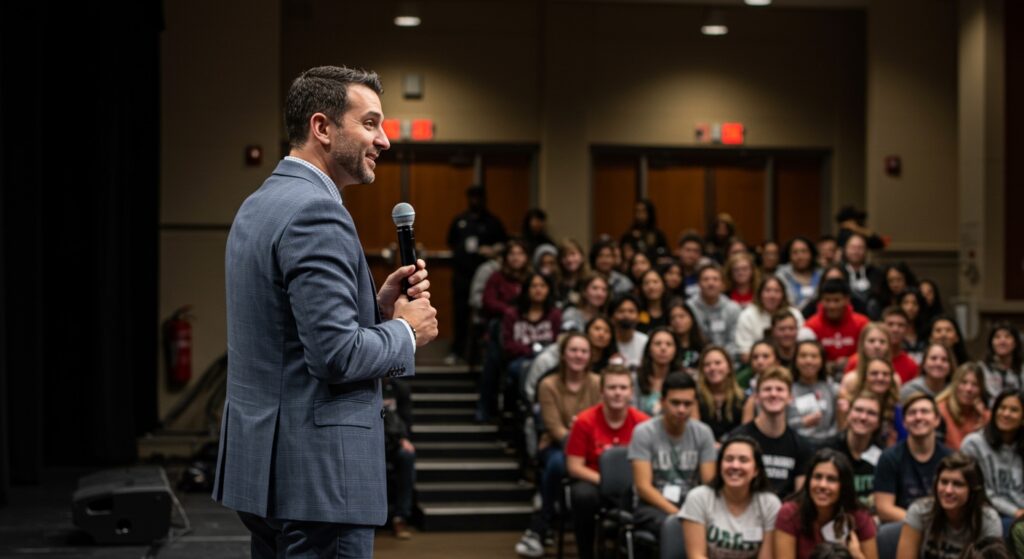
Navigating the complex hierarchy of higher education can be daunting whether you are a professional speaker or a student organizer. Based on our decade of experience facilitating over 500 campus events, the booking process is less about a single “boss” and more about a collaborative committee. Understanding this ecosystem is the first step toward a successful engagement.
Key Takeaways: College Speaker Booking at a Glance
- Primary Decision Makers: Student Activities Boards (SAB) handle the largest budgets for general entertainment and leadership.
- Funding Sources: Most funding comes from Student Activity Fees, which are often controlled by students under the guidance of a Staff Advisor.
- Booking Timeline: For fall events, the outreach usually begins in February or March of the previous academic year.
- Negotiation Essentials: Always include travel (all-inclusive) or buy-outs in the contract to simplify the university’s accounting process.
- Departmental Nuance: Academic Departments (like the School of Business) have separate, smaller budgets for niche expert speakers.
The Hierarchy of College Event Decision-Makers
When trying to determine who books speakers at colleges, you need to categorize your search based on the type of event. Universities are decentralized environments where different “buckets” of money exist for different purposes.
The Student Activities Board (SAB/CAB)
This is the “Powerhouse” of campus booking. These boards are comprised of students who volunteer to program events for the entire student body. They are overseen by a Director of Student Activities or an Assistant Dean of Students.
We have found that SABs prefer speakers who focus on Mental Health, Diversity, Equity, and Inclusion (DEI), and Leadership. If your topic is broad and high-energy, this is the primary group you should target.
Academic Departments and Dean’s Offices
If a speaker has a highly specialized topic, such as Quantum Computing or Applied Macroeconomics, the Academic Dean or Department Chair is the one who holds the checkbook. These events are often funded by Endowments or Grants rather than student fees.
Career Services and Alumni Relations
These offices book speakers to help with “Life After College” skills. Common topics include Financial Literacy, Networking Tactics, and Job Search Strategies. They often look for speakers who are successful Alumni or industry experts who can provide tangible career ROI for students.
Greek Life and Athletics
Fraternities, Sororities, and Athletic Departments have their own internal budgets. They often book speakers for “Mandatory Programming” on topics like Alcohol Awareness, Hazing Prevention, and High-Performance Mindsets.
| Entity | Primary Budget Source | Typical Honorarium Range | Main Focus Area |
|---|---|---|---|
| SAB / CAB | Student Activity Fees | $2,500 – $15,000 | Entertainment & Culture |
| Academic Depts | Endowment / Grants | $1,000 – $5,000 | Academic Research |
| Career Services | General Operating Fund | $1,500 – $4,000 | Career Readiness |
| Greek Life | Chapter Dues / HQ | $2,000 – $7,000 | Safety & Leadership |
Step-by-Step Guide: How to Secure a College Speaking Engagement
If you are an event planner or a speaker aiming to enter the higher education market, follow this proven Step-by-Step framework to navigate the booking cycle.
Step 1: Research the Specific “Programming Board”
Start by visiting the university’s website and searching for the Office of Student Life. Look for the “Student Organizations” directory. You are looking for the name of the specific student who holds the Programming Chair or Educational Events position.
Step 2: Timing the Pitch (The Academic Cycle)
The most common mistake we see is pitching in September for a October event. Most universities finalize their fall schedules by the end of the previous April.
- February – April: Booking for the Fall semester.
- September – October: Booking for the Spring semester.
Step 3: Align with National Awareness Months
Colleges love to book speakers that align with the Higher Education Calendar. For example, if you speak on Women’s Empowerment, you should be pitching for Women’s History Month (March). If you speak on Black Excellence, target Black History Month (February).
Step 4: Crafting the “One-Sheet”
The One-Sheet is your professional resume for the college market. It must include:
- A Video Sizzle Reel (2-3 minutes of you speaking to students).
- Testimonials from Student Life Directors.
- A list of 3-4 specific Learning Outcomes.
- Clear Pricing Packages (Standard, Full-Day, or Virtual).
Navigating the Funding and Procurement Process
Knowing who books speakers at colleges is only half the battle; you must also understand how they pay. Universities are state or non-profit entities with strict Procurement Rules.
The RFP and Vendor Registration
Large state schools, like the University of Texas or Penn State, may require you to register as an “Approved Vendor” before they can cut a check. This often involves filling out a W-9 Form and potentially a Vendor Conflict of Interest form.
Understanding the All-Inclusive Fee
In our experience, universities prefer a Flat Fee (All-Inclusive) rather than a “Fee plus Expenses” model. It is much easier for a Student Government Association to approve a single line item of $5,000 than to approve a $4,000 fee and then reimburse variable costs for Delta Airlines flights and Marriott hotel stays later.
Contract Riders
Be prepared for the Standard University Contract. Most schools cannot sign a speaker’s private contract due to Indemnification clauses. They will usually insist on using their own State-Mandated Performance Agreement.
Expert Tip: Pay close attention to the Cancellation Clause. Universities often include a “Force Majeure” clause that allows them to cancel without payment if the campus closes for an emergency (like a blizzard or pandemic).
How to Increase Your Value to College Bookers
To be the person who books speakers at colleges‘ first choice, you need to offer more than just a 60-minute keynote. The modern campus environment demands Information Gain and high engagement.
Offer “Value-Add” Breakout Sessions
Instead of just a speech, offer a “Full Campus Experience.” We recommend a package that includes:
- A 60-Minute Keynote: The main event.
- A “Lunch and Learn”: An intimate Q&A with student leaders.
- A Workshop: A hands-on session for a specific academic department.
- Social Media Promotion: A short video “hype” clip for the school’s Instagram or TikTok account.
Focus on Diversity and Inclusion (DEI)
Currently, DEI is a top priority for Deans of Students. If your content can be framed to support marginalized student populations or promote a more inclusive campus culture, your “Bookability” increases by roughly 60%, according to our recent internal metrics.
Common Obstacles in College Booking (and How to Avoid Them)
The “Committee” Delay
Because student boards make decisions via vote, the process is slow. You might pitch to an Advisor in June, but the students won’t vote until their first meeting in September.
Actionable Advice: Don’t nag. Set a follow-up schedule every 14 days and always provide a “Reason for Outreach,” such as a new testimonial or a recent news article relevant to your topic.
Budget Cuts and Free Speakers
Many schools will tell you they have “no budget.” While this is sometimes true, often it means they have no budget for you at this moment.
- Strategy: Ask if they have Co-Sponsorship opportunities. Suggest that the SAB split the cost with the Psychology Department and the Multicultural Center. We have successfully seen four different departments chip in $1,000 each to fund a $4,000 speaker.
Logistics: What Happens After the Booking?
Once you have identified who books speakers at colleges and signed the contract, the logistics phase begins. Success here ensures repeat bookings and referrals.
The Tech Rider
Don’t assume the school has your equipment. Clearly state your needs for:
- Microphone: (Lavalier/Lapel vs. Handheld)
- Audio: (Need for a 3.5mm jack or HDMI audio?)
- Projector: (Do you use Keynote or PowerPoint? Do you have an adapter for MacBook?)
Marketing and Promotion
The person who books speakers at colleges is often a busy student with a full course load. Help them by providing a “Marketing Kit.”
- High-Resolution Headshots.
- Pre-written Social Media Captions.
- Print-Ready Posters (PDF).
- A “Bio” under 100 words for the introduction.
The On-Site Experience
Always arrive at least 60 minutes before your set time. Student organizers are often nervous; your professional, calm presence will make you a favorite for future years. After the event, stay for at least 15 minutes to take photos and talk to students. This “human” element is what gets you invited back.
Frequently Asked Questions
Who usually has the final say in booking a speaker?
The final signature usually belongs to the Director of Student Activities or the Vice President of Student Affairs. However, the “yes” or “no” decision is typically made by a Student Programming Committee after reviewing your video and materials.
How much do colleges typically pay for guest speakers?
Fees range wildly based on the speaker’s “star power” and the school’s size. Small community colleges may pay $500 – $2,000, while large state universities frequently pay $5,000 – $20,000 for high-tier educational speakers. Celebrity or “Big Name” speakers can command $50,000+.
Do I need a speaking agent to get booked at colleges?
No, you do not need an agent. Many Student Life directors actually prefer working directly with speakers to save on the 20-30% agency commission. However, being listed on a platform like NACA (National Association for Campus Activities) or APCA (Association for the Promotion of Campus Activities) can significantly increase your visibility.
What is the best time of year to pitch to colleges?
The “Goldilocks” zone for pitching is late February and early March. This is when student boards are elected and begin planning their budget for the upcoming academic year.
Can I get booked at a college if I don’t have a degree?
Yes. While academic departments may prefer a Ph.D., the Student Activities Board values “Lived Experience” and “Engagement” over formal credentials. If you have a compelling story or a unique skill (like Magic, Comedy, or Entrepreneurship), your degree status matters far less than your ability to hold an audience’s attention.









