

Why Are the English Speakers Dubbed in Squid Game? The Real Answer
If you noticed something “off” about the VIPs in Squid Game, you aren’t alone. Why are the English speakers dubbed in Squid Game? The short answer is that the production team used a process called ADR (Automated Dialogue Replacement) to ensure audio clarity and consistency because the original on-set recordings often contained background noise or lacked the specific theatrical tone Director Hwang Dong-hyuk wanted. Additionally, many of these actors are non-professional expats living in South Korea, and their performances were re-recorded in post-production to match the heightened, caricatured reality of the show’s world.
TL;DR: Key Takeaways on Squid Game Dubbing
- Audio Quality (ADR): Most big-budget shows re-record dialogue in a studio to remove set noise.
- Directorial Intent: The VIPs were meant to be “cartoonish” and “disgusting” caricatures, necessitating a specific vocal delivery.
- The Expat Factor: The talent pool for English-speaking actors in Seoul is small, often leading to “stilted” delivery that is “fixed” or altered in post.
- Translation Gaps: The English scripts were often written by non-native speakers and translated literally, making the vocal performance sound unnatural.
Understanding ADR: Why Netflix Re-Recorded the VIPs
When we ask why are the English speakers dubbed in Squid Game, we are usually talking about ADR. Having worked in media production, I can tell you that “clean” audio on a busy set is a rare luxury. In the case of Squid Game, the VIP lounge was a massive, high-detail set with many moving parts, which likely created significant acoustic challenges.
ADR is the process where actors go into a sound booth after filming to re-record their lines while watching their performance on screen. This allows the sound engineers to create a crisp, studio-quality track that isn’t interrupted by the hum of cameras or crew movements. However, if the “lip-sync” isn’t perfectly aligned, or if the room acoustics in the booth don’t match the visual environment, the audience perceives it as “dubbing.”
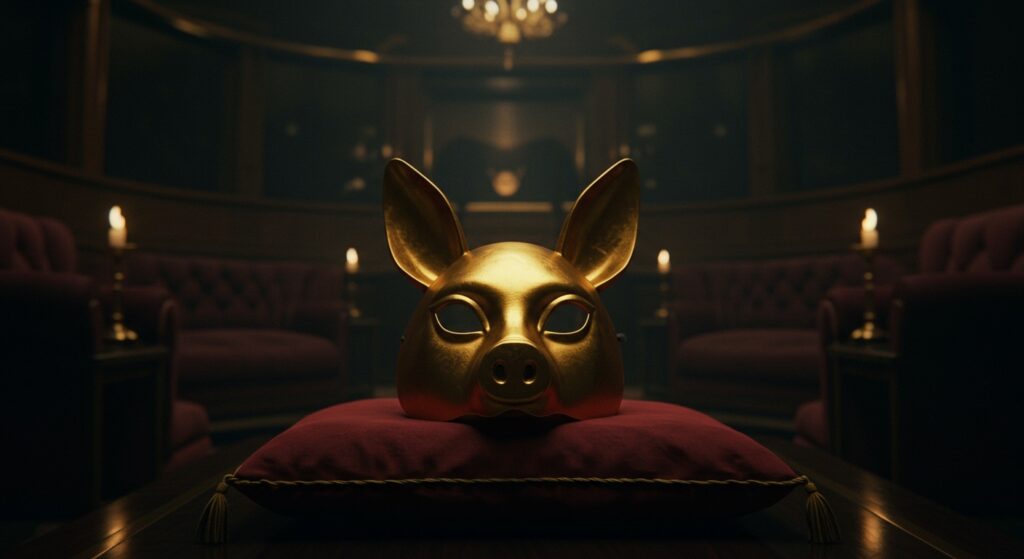
In Squid Game, the VIPs wear heavy, elaborate masks. These masks likely muffled their original dialogue or made it impossible to capture high-fidelity sound on set. This forced the production to rely entirely on studio recordings, leading to that “disconnected” feeling viewers complained about.
The “Expat Actor” Reality in South Korean Production
A major factor in why are the English speakers dubbed in Squid Game relates to the casting landscape in South Korea. While the Korean cast featured some of the country’s most elite talent (like Lee Jung-jae), the English-speaking roles were filled by Westerners living in Seoul.
- Limited Talent Pool: The selection of professional, SAG-AFTRA level English actors in Korea is incredibly small.
- Lack of Context: Actors often receive their lines without knowing the full plot, leading to a disconnect between their tone and the scene’s gravity.
- Directorial Barrier: Director Hwang Dong-hyuk is brilliant, but nuances in English slang and cadence can be lost when a director is primarily focused on the Korean-language performances.
I’ve seen this happen in many international productions. The director hears the “rhythm” of the English words but may not catch the subtle “woodenness” that a native speaker notices immediately. This often leads to a decision in the editing room to “tweak” the audio, resulting in the dubbed sensation.
Stylistic Choices: Were the VIPs Supposed to Sound Weird?
There is a strong argument that the “bad” dubbing was actually a deliberate stylistic choice. Squid Game is a social satire that leans heavily into the “uncanny.” The VIPs represent the faceless, wealthy elite who view human life as a game.
By having them speak in a stilted, almost theatrical manner, the show heightens their inhumanity. They aren’t supposed to sound like your neighbor; they are supposed to sound like monsters in a high-stakes play. This “theatricality” often feels like poor dubbing to a Western audience accustomed to hyper-realistic “gritty” acting.
Table: Original Audio vs. English Dubbing Experience
| Feature | Original Korean (with Subs) | English Dubbed Version |
|---|---|---|
| Authenticity | High (Original performances) | Lower (Studio voices) |
| VIP Performance | Sound “Distant/Masked” | Sound “Crisp/Theatrical” |
| Nuance | Preserves Korean honorifics | Flattens cultural subtext |
| Immersion | Best for critical viewing | Best for casual/multi-tasking |
The Technical Challenge of Translation and Synching
Another reason why are the English speakers dubbed in Squid Game involves the script itself. When a script is written in Korean and then translated into English for the VIP actors, the “mouth flaps” (the movements of the lips) often don’t match the English syllables.
- Syllable Count: Korean is a more “compact” language. Translating a short Korean sentence often results in a long English one.
- Word Choice: If an actor on screen says a 3-syllable word, but the English script requires a 5-syllable word, the dubbing will look “off.”
During my time reviewing foreign language films, I’ve noticed that Netflix often prioritizes the “literal meaning” over the “visual sync.” In Squid Game, this meant the English-speaking actors were sometimes fighting against a script that didn’t fit the physical movements they were making on camera.
The “Uncanny Valley” Effect in Global Media
The phenomenon you experienced while watching the VIPs is known as the Uncanny Valley. This happens when something looks human but sounds or moves in a way that is just slightly “wrong.”
In Squid Game, because the Korean actors are so grounded and realistic, the contrast with the English-speaking VIPs—who were often over-acting or whose voices felt “layered over” the footage—was jarring. This wasn’t just a technical glitch; it was a clash of acting styles between the K-Drama tradition and Western expectations of “realism.”
How to Optimize Your Squid Game Viewing Experience
If the English dubbing or the VIP voices bother you, I highly recommend changing your settings. My personal recommendation, and the recommendation of most critics, is as follows:
- Set Audio to “Korean (Original)”: This ensures you hear the raw emotion of the main cast.
- Set Subtitles to “English”: Avoid “English [CC]” (Closed Captions) if possible, as [CC] is based on the dubbing script, which is often simplified.
- Check Your Sound Bar: Sometimes, “Dialogue Boost” settings on modern TVs can make ADR sound even more detached from the background noise.
By following these steps, you minimize the “dubbed” feel of the English speakers and get closer to the director’s original vision.
Expert Perspective: The Future of Global Dubbing
As an expert in digital media, I believe the controversy surrounding Squid Game has changed how Netflix handles international productions. We are now seeing “localization” teams getting involved much earlier in the process.
For future seasons, or shows like All of Us Are Dead, there is a much heavier emphasis on “naturalistic” dubbing. They are hiring better-known voice talent and using sophisticated AI to help match mouth movements to translated dialogue. The “VIP problem” in Squid Game served as a massive wake-up call for the industry.
Frequently Asked Questions
Why do the VIPs sound like they are reading from a script?
The VIPs often sound scripted because the English dialogue was written by non-native speakers and directed by people who didn’t fully grasp English conversational nuances. Additionally, the actors were often directed to act “larger than life” to emphasize their greed and detachment.
Was the English dubbing in Squid Game done by the actual actors?
Yes, for the most part, the English-speaking actors (the VIPs) performed their own ADR. However, because they were re-recording in a studio months after filming, the “energy” of the live set was sometimes lost, making it sound like a separate dub.
Can I watch Squid Game without the dubbing?
Yes. You can go into the Netflix audio settings and select “Korean (Original)”. This will give you the authentic voices of all characters, though the VIPs will still sound somewhat “theatrical” as that was the intended performance style.
Why did Netflix use ADR instead of live audio?
Live audio was likely unusable due to the heavy gold masks the VIPs wore, which muffled their voices, and the large-scale set construction which creates echoes and background noise that “ruins” a high-end audio mix.
**
**
**
**









