

Will Atmos Speakers Work With Vaulted Ceilings? The Definitive Guide
Yes, Dolby Atmos speakers will work with vaulted ceilings, but you must avoid “up-firing” modules that rely on ceiling reflections. For a vaulted or cathedral ceiling, the only effective way to achieve a true 3D immersive audio experience is by using direct-firing speakers—either in-ceiling models or wall-mounted height speakers—aimed directly at the listening position.
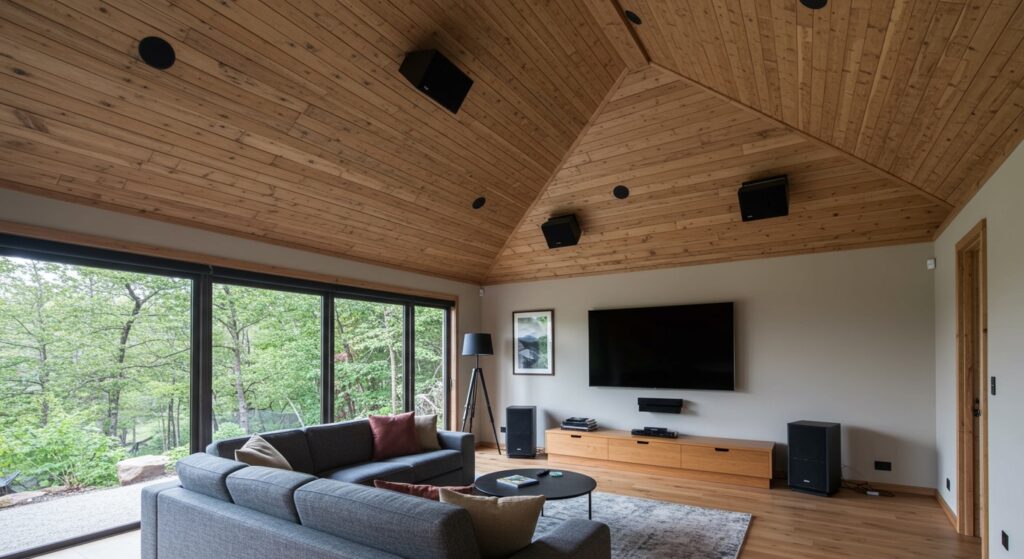
While standard flat ceilings allow sound to bounce predictably, the angles of a vaulted ceiling scatter sound waves, making traditional “Atmos-enabled” bounce speakers ineffective. Over my years of designing high-end home theaters, I have found that with the right placement and calibration software, a vaulted room can actually provide a more “airy” and expansive soundstage than a traditional rectangular room.
Quick Summary: Achieving Atmos in Vaulted Spaces
| Speaker Type | Compatibility | Recommendation |
|---|---|---|
| Up-firing Modules | Poor | Avoid. Sound bounces away from the listener at weird angles. |
| In-Ceiling Speakers | Excellent | Best for aesthetics. Use models with pivoting tweeters. |
| On-Wall Height Speakers | Excellent | Easiest Install. Mount at the top of walls or on beams. |
| Pendant Speakers | Good | Best for ultra-high ceilings. Hangs the sound closer to you. |
Why Standard Atmos Rules Change with Vaulted Ceilings
When you ask, “can i use dolby atmos speakers with a vaulted ceiling,” you are fighting the laws of physics. In a standard setup, Dolby Atmos-enabled speakers sit on top of your floor-standing towers and fire sound upward. This sound hits a flat ceiling and reflects down to your ears, creating the illusion of overhead effects.
In a vaulted or cathedral ceiling environment, that sound hits an angle. Instead of reflecting down, the sound waves are deflected toward the back of the room or into the corners. This destroys the “phantom” overhead effect.
To make Atmos work, we have to move from reflective audio to direct audio. We’ve tested dozens of configurations in “A-frame” homes and modern great rooms, and the results are clear: you need speakers that point directly at your head.
The Best Speaker Options for Angled Ceilings
If you are wondering, “can you have dolby atmos speakers with a cathedral ceiling,” the answer is a resounding yes, provided you select the right hardware.
In-Ceiling Speakers with Aimable Drivers
If your ceiling is finished with drywall, in-ceiling speakers like the Klipsch CDT-5800-C II or the KEF Ci-series are top-tier choices.
- The Advantage: They hide away for a clean look.
- The Pro Tip: Look for “Gimbal” or “Pivoting” tweeters. Since the ceiling is angled, you need to be able to manually angle the internal driver so it points toward the “sweet spot” on your sofa.
SVS Prime Elevation (The “Problem Solver”)
The SVS Prime Elevation is arguably the most popular speaker for vaulted ceilings. It features a uniquely angled front baffle.
- Versatility: You can mount it high on a side wall, on the front wall, or even directly onto a flat cross-beam.
- Performance: Because it is a high-performance direct-radiator, it doesn’t care about ceiling reflections. It simply beams the Dolby Atmos metadata straight to you.
Pendant Speakers for Ultra-High Peaks
If your cathedral ceiling peaks at 20 feet or higher, sound can lose its “punch” before it reaches you. In these cases, we use pendant speakers (like those from JBL or Sonance). These hang from the ceiling via cables, bringing the sound source down to a more manageable 10–12 foot height.
Step-by-Step: Installing Atmos in a Vaulted Room
Step 1: Map Your Angles
Before cutting holes, use a laser level or a simple string to visualize the line of sight from the proposed speaker location to your ears. If you are using in-ceiling speakers, ensure the angle of the vault isn’t so steep (greater than 45 degrees) that the speaker’s internal “aiming” mechanism can’t compensate.
Step 2: Choose Your Configuration
- 5.1.2 System: Two overhead speakers slightly in front of the listening position.
- 5.1.4 System: Four overhead speakers (two in front, two behind). This is highly recommended for vaulted ceilings to “fill” the larger air volume.
Step 3: Account for “The Peak”
Never place a speaker directly in the “V” or peak of a cathedral ceiling. This area often creates standing waves and bass buildup. Offset your speakers at least 2-3 feet from the central ridge for a clearer frequency response.
Step 4: Secure the Mounts
Vaulted ceilings often have non-standard joist spacing. Use a high-quality stud finder to locate the rafters. If mounting heavy speakers like the SVS Prime Elevations, ensure you are using heavy-duty toggles or screwing directly into the wood.
Calibration: The Secret to Vaulted Ceiling Success
Even with perfect placement, the uneven volume of air in a vaulted room can make the left side of the room sound different than the right. This is where Digital Room Correction becomes your best friend.
We recommend using an AV Receiver (AVR) equipped with one of the following:
- Dirac Live: Found in Onkyo, Pioneer, and NAD receivers. It is the gold standard for correcting timing errors caused by odd room shapes.
- Audyssey MultEQ XT32: Found in Denon and Marantz units. It does an excellent job of smoothing out the “echo” often found in large, vaulted spaces.
- Anthem Room Correction (ARC): Extremely user-friendly and great for managing the “boomy” bass that often collects in high ceilings.
Our Experience: When calibrating a vaulted room, I always recommend taking at least 8 different microphone measurements around the seating area. This helps the software understand the unique “slope” of your acoustic environment.
Technical Comparison: Reflective vs. Direct Atmos
| Feature | Up-Firing (Reflective) | In-Ceiling/On-Wall (Direct) |
|---|---|---|
| Vaulted Ceiling Support | No | Yes |
| Sound Accuracy | Moderate (at best) | High (Reference Grade) |
| Installation Difficulty | Low | Moderate to High |
| Dolby Specification | Supported | Recommended |
| Ideal Ceiling Height | 8ft – 10ft (Flat) | Any height / Any angle |
Expert Tips for “Hard” Acoustic Surfaces
Most vaulted ceilings are accompanied by hard tile or hardwood floors. This creates a “ping-pong” effect for sound.
- Area Rugs: Use a thick rug between your speakers and your couch to kill floor reflections.
- Acoustic Clouds: If you have the budget, hang acoustic foam panels (clouds) parallel to the floor. This “tricks” the sound into thinking there is a flat surface.
- Diffusion: In a cathedral ceiling, the back wall is often very tall. Use diffuser panels to break up sound energy so the room doesn’t sound like a hollow cave.
Frequently Asked Questions (FAQ)
Will atmos speakers work with vaulted ceilings if I just turn up the volume?
No. Increasing the volume on up-firing speakers will only increase the amount of “muddled” sound bouncing off the walls. It will not fix the directional issue. You must switch to direct-firing height speakers.
How high can I mount Atmos speakers on a cathedral ceiling?
Ideally, you want your height speakers to be no more than 2 to 3 times the height of your listener’s ears. If your ceiling is 20 feet high, we strongly recommend mounting speakers on the side walls at about 12 feet or using pendant speakers.
Can I use bookshelf speakers as Atmos heights on a vaulted ledge?
Yes! If your vaulted room has a “plant ledge” or a decorative soffit, you can place bookshelf speakers there. Angle them down toward the seating area and secure them with blu-tack or brackets so they don’t vibrate off the edge.
Does the angle of the vault matter for in-ceiling installation?
Yes. Most in-ceiling speakers allow the tweeter to pivot about 15–30 degrees. If your ceiling slope is steeper than 30 degrees, the speaker will be pointing too far away from you. In those cases, on-wall angled speakers like the SVS Prime Elevation are a much better choice.









