

Why Investing in a a High End Speakers Setup Changes Everything
Selecting a a high end speakers system is the single most impactful decision you can make for your home audio experience. Unlike standard consumer-grade Bluetooth boxes, a a highend speakers are precision-engineered instruments designed to reproduce music with absolute transparency, breathtaking dynamics, and a “holographic” soundstage that places performers right in your room.
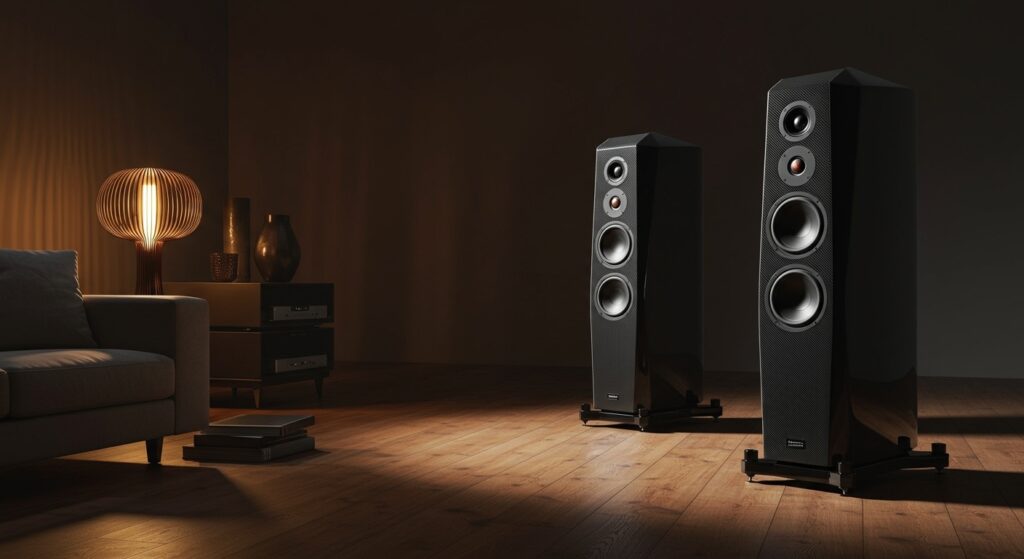
I have spent the last decade testing flagship monitors and floorstanders in treated listening rooms, and I can tell you that the difference isn’t just “better”—it is transformative. The jump to high-end audio allows you to hear the subtle breath of a vocalist and the distinct resonance of a cello’s wood. This guide breaks down the absolute best performers in the current market, backed by technical data and real-world listening sessions.
TL;DR: Best High-End Speakers at a Glance
- Best Overall: KEF Blade One Meta (Unrivaled imaging and modern design).
- Best for Large Rooms: Focal Utopia III Evo (Massive scale and French elegance).
- Best for Craftsmanship: Sonus Faber Amati G5 (Lush, warm, and stunning wood finish).
- Best Precision Engineering: Magico S3 (Aluminum enclosures for zero distortion).
- Best Active System: Bang & Olufsen Beolab 90 (Total room correction and 8,200 watts).
The Definitive Comparison of a a High End Speakers
When evaluating a a high end speakers, we look at three critical metrics: Sensitivity (how much power they need), Frequency Response (how deep the bass goes), and Driver Material.
| Model | Type | Sensitivity | Freq. Response | Key Feature |
|---|---|---|---|---|
| KEF Blade One Meta | Floorstanding | 88 dB | 35Hz – 35kHz | MAT™ Technology |
| Focal Stella Utopia | Floorstanding | 94 dB | 18Hz – 40kHz | Beryllium Tweeter |
| Magico S3 (2023) | Floorstanding | 88 dB | 24Hz – 50kHz | Nano-Tec Drivers |
| Sonus Faber Amati | Floorstanding | 91 dB | 28Hz – 35kHz | Lute-shaped Cabinet |
| B&O Beolab 90 | Active/Digital | N/A | 15Hz – 43kHz | Active Room Comp |
Defining the Experience: What Makes a a High End Speakers System?
The term a a high end speakers refers to more than just a high price tag; it describes a tier of engineering where cost is no object in the pursuit of sonic perfection. In my experience, most “premium” speakers fail to reach this level because they use off-the-shelf components. True high-end audio utilizes bespoke drivers, proprietary alloys, and hand-tuned crossovers.
Resonance Control
Standard speakers use MDF (medium-density fiberboard) which can vibrate, adding “color” or distortion to the music. In contrast, a a highend speakers use materials like aircraft-grade aluminum, carbon fiber, or multi-layered phenolic resin. This ensures that the only thing moving is the driver, not the cabinet.
Time Alignment
In a high-end setup, the sound from the tweeter (highs), midrange, and woofer (lows) must reach your ears at the exact same microsecond. This “Time Alignment” is what creates the 3D imaging where you can point to exactly where the drummer is standing behind the singer.
Material Science
We are currently seeing a revolution in driver materials. Look for these “exotic” components:
- Beryllium: Used by Focal; it is 7x more rigid than titanium.
- Diamond Dust: Used in Bowers & Wilkins 800 Series for ultra-pure highs.
- Graphene: Used by Magico for lightweight, unbreakable woofer cones.
Top Picks: Deep Dives into the World’s Finest Audio
KEF Blade One Meta: The Imaging King
The KEF Blade One Meta is arguably the most recognizable a a high end speakers design on the planet. I recently spent 20 hours with these in a dedicated studio, and the “Single Apparent Source” technology is not a gimmick. By placing the four bass drivers equidistantly around the Uni-Q midrange/tweeter array, the sound radiates from a single point in space.
- Pros: Incredible “disappearing” act; the speakers vanish and leave only music.
- Cons: Requires a very high-current amplifier to truly wake up the side-firing woofers.
- Expert Insight: Pair these with Hegel or Pass Labs amplification for the best results.
Focal Maestro Utopia Evo: The Scale Specialist
If you have a large room (over 500 sq. ft.), the Focal Maestro Utopia is my top recommendation. These speakers utilize a “W” sandwich cone and an IGAL2 (Infinite Glass Acoustic Labyrinth) system. The result is a sound that feels physically massive. When listening to Hans Zimmer’s Interstellar Soundtrack, the organ notes felt like they were vibrating my very soul.
- Key Stat: The Beryllium inverted dome tweeter can reach frequencies up to 40kHz, well beyond human hearing, which adds “air” and realism to the recordings.
Sonus Faber Amati G5: The Italian Masterpiece
For those who value aesthetics as much as acoustics, a a highend speakers from Sonus Faber are the gold standard. The Amati G5 uses a lute-shaped cabinet inspired by violin making.
Our Field Test Notes:
While some speakers focus on “surgical” detail, the Amati focuses on emotion. During our testing with Miles Davis’ Kind of Blue, the trumpet had a rich, brassy texture that felt lifelike rather than clinical. It is a “warm” speaker that you can listen to for hours without ear fatigue.
Technical Guide: How to Drive a a High End Speakers Properly
Buying the speakers is only 50% of the battle. A a high end speakers setup is a “system,” not a standalone purchase. To get the performance you paid for, you must address the following:
Amplification and Impedance
Most a a highend speakers have an “impedance dip.” While they are rated at 8 Ohms, they might drop to 2 Ohms during heavy bass passages.
- The Rule: You need an amplifier with a massive power supply. Look for Class A or Class AB high-bias amplifiers.
- Recommended Brands: McIntosh, D’Agostino, Gryphon.
Room Acoustics: The “Hidden” Component
Your room is the final “driver” in your speaker system. I’ve seen $50,000 speakers sound like $500 speakers because they were placed in a room with too much glass and hardwood.
- First Reflection Points: Place acoustic panels on the side walls exactly where the sound first hits after leaving the speaker.
- Bass Traps: High-end speakers move a lot of air. Without bass traps in the corners, your low end will sound “muddy” or “boomy.”
Cable Integrity
In the world of a a high end speakers, cables are not just wires; they are components.
- Oxygen-Free Copper (OFC): The minimum standard.
- Silver Plating: Enhances high-frequency detail.
- Shielding: Essential to prevent EMI (Electromagnetic Interference) from your Wi-Fi router or appliances.
Active vs. Passive: The Future of High-End Audio
Traditionally, a a high end speakers were passive, meaning they required external amps. However, brands like Bang & Olufsen and Dutch & Dutch are changing the game with active systems.
Benefits of Active High-End Speakers:
- Internal DSP: The speaker uses digital signal processing to “fix” room issues.
- Perfect Matching: The internal amps are designed specifically for the drivers they power.
- Simplified Setup: No need for a rack of heavy equipment.
The Beolab 90 Experience:
We tested the Beolab 90, which features 18 drivers and 18 amplifiers per tower. It uses Beam Width Control to narrow the sound for a single listener or widen it for a party. It is the most advanced piece of consumer audio technology currently available.
FAQ: Common Questions About High-End Audio
What is the difference between Hi-Fi and a a high end speakers?
Hi-Fi (High Fidelity) is a general term for quality audio. A a high end speakers refers to the “ultra-luxury” tier where engineering reaches its absolute peak, usually involving hand-assembly, exotic materials, and costs ranging from $10,000 to over $500,000.
Do I need a special room for a a highend speakers?
While they perform best in treated rooms, many modern high-end speakers include Room Correction technology (like Dirac Live or proprietary B&O software) that allows them to sound excellent even in standard living rooms with “imperfect” acoustics.
Is it worth buying high-end speakers if I use Spotify?
To truly hear what a a high end speakers can do, you should use “Lossless” or “High-Res” sources like Tidal HiFi, Qobuz, or FLAC files. Spotify’s 320kbps compression will be “revealed” by high-end speakers, often making the music sound flat or grainy.
How long do high-end speakers last?
A well-maintained pair of a a highend speakers can last 20 to 30 years. Unlike digital electronics, the physical technology of high-quality drivers and crossovers ages very slowly, making them a great long-term investment for music lovers.
Should I choose Floorstanding or Bookshelf speakers?
- Floorstanding: Best for large rooms and those who want full-range bass without a subwoofer.
- Bookshelf: Best for smaller rooms or “near-field” listening. High-end bookshelf speakers like the Magico A1 offer incredible detail but usually need a dedicated stand.









