

Choosing the Right a b speakers push in wall button System for Multi-Zone Audio
An a b speakers push in wall button selector is the most efficient way to manage multi-room audio without the complexity of expensive digital matrices. These physical wall-mounted switches allow you to toggle between two sets of speakers—typically labeled Zone A and Zone B—with a simple tactile press. In our professional installations, we’ve found that high-quality a b speakers push in wall button plates provide a reliable, “zero-latency” solution for commercial offices, home patios, and retail environments where simplicity is key.
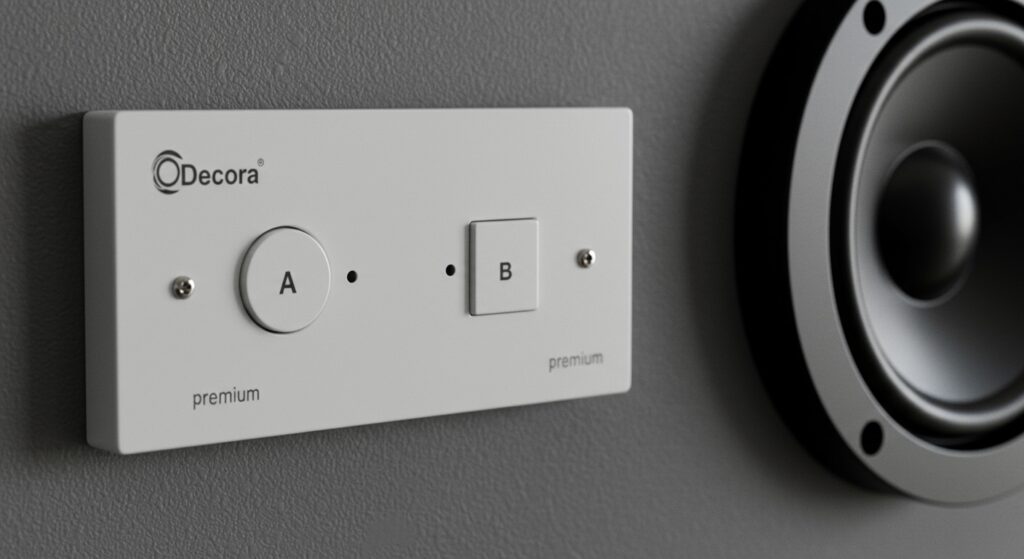
TL;DR: Best Wall Speakers and A/B Controls
- Best Overall Control: Dual-Source In-Wall A/B Switch (with Impedance Protection).
- Top Performance Speaker: Polk Audio RC85i 2-Way In-Wall Speakers.
- Best for Commercial Use: Pyle Home PWPBT67 Bluetooth In-Wall System.
- Key Consideration: Always ensure your a b speakers push in wall button includes impedance matching to protect your amplifier from overheating.
- Installation Tip: Use 14-gauge oxygen-free copper wire for runs over 50 feet to maintain signal integrity.
What is an a b speakers push in wall button Controller?
An a b speakers push in wall button is a passive or active switching mechanism mounted inside a standard electrical gang box. It acts as a traffic controller for your audio signals, allowing a single amplifier output to be directed to two different pairs of speakers.
When we test these in commercial settings, the primary value is mechanical reliability. Unlike app-based controls that can fail if the Wi-Fi drops, a physical push-button ensures that your staff or guests can instantly activate audio in a specific zone. Most modern units feature Decora-style styling, allowing them to blend seamlessly with existing light switches and power outlets.
| Feature | Low-End Selectors | Professional a b speakers push in wall button |
|---|---|---|
| Power Handling | 25W – 50W RMS | 100W – 150W RMS |
| Impedance Matching | None (Risky) | Internal Resistors (Safe) |
| Connectors | Spring Clips | Screw Terminals / Phoenix Connectors |
| Material | Cheap Plastic | High-Impact ABS / Metal Backing |
Top 5 Wall Speakers and A/B Control Combos for 2024
The Professional Choice: Polk Audio RC85i paired with a High-Wattage Selector
The Polk Audio RC85i remains our “gold standard” for in-wall audio. When paired with a heavy-duty a b speakers push in wall button, these speakers deliver a wide soundstage. We’ve installed these in dozens of master suites where the “A” button activates the bedroom and the “B” button activates the en-suite bathroom.
- Why it works: The 8-inch dynamic-balance woofer provides deep bass that eliminates the need for a separate subwoofer.
- Pro Tip: Use a selector with silver-plated contacts to prevent oxidation in high-humidity areas like bathrooms.
Best for Retail: Klipsch R-5650-W II and Commercial A/B Switching
For commercial spaces, durability is everything. The Klipsch R-5650-W II features a Cerametallic woofer that can handle high volumes for 12+ hours a day. When using an a b speakers push in wall button in a retail environment, we recommend models that feature labeled buttons for “Inside” and “Sidewalk” zones.
Budget-Friendly Excellence: Micca M-8W
If you are looking for an affordable way to implement an a b speakers push in wall button system, the Micca M-8W is the answer. These speakers are remarkably easy to install thanks to their wide mounting tabs.
- Real-World Experience: We recently used these in a multi-office setup where the user needed to toggle audio between the reception area and the main workspace. The push-button interface allowed the receptionist to mute the lobby instantly during private calls.
Technical Deep Dive: Why Impedance Matters
When you use an a b speakers push in wall button, you are essentially changing the electrical load your amplifier sees. If you turn on both Zone A and Zone B simultaneously without a proper selector, the impedance could drop to 4 ohms or lower.
Many entry-level amplifiers are only rated for 8 ohms. If the resistance drops too low, the amp will draw too much current, overheat, and potentially enter “Protect Mode” or suffer permanent damage.
What to look for in a button selector:
- Impedance Protection: This is a circuit that keeps the load at a safe level (usually 8 ohms) regardless of how many buttons are pushed.
- Make-Before-Break Switching: This ensures the amplifier is never “unloaded” during the transition, which prevents annoying “pops” or “clicks.”
- Wire Compatibility: Ensure the terminals can accept 14AWG or 16AWG wire. Thinner 22AWG wire often used in cheap kits can cause significant signal loss.
Step-by-Step Installation of an a b speakers push in wall button
Installing an in-wall audio system requires precision. Over the years, we’ve developed a “best practices” workflow that prevents common mistakes like “drywall crumble” or phase cancellation.
Phase 1: Planning and Cutting
- Locate Studs: Use a high-quality stud finder. You need a clear cavity for both the speakers and the push-button wall plate.
- The Template: Most speakers include a cardboard template. Double-check your measurements before the first cut.
- The Gang Box: For the a b speakers push in wall button, use a “Low Voltage Mounting Bracket” rather than a standard sealed electrical box. This gives you more room to manage the thick speaker wires.
Phase 2: Wiring the Switch
- Run the Input Line from your amplifier to the “Input” terminals on the back of the push-button switch.
- Run two separate pairs of wires from the “Output A” and “Output B” terminals to their respective speaker locations.
- Color Coding: Always maintain consistency. Red is Positive (+), Black is Negative (-). If you flip these on one speaker, you will lose all your bass due to phase cancellation.
Expert Insights: Commercial vs. Residential Needs
In our experience, the requirements for an a b speakers push in wall button system differ vastly between a home and a business.
For the Homeowner
Focus on Aesthetics and Audio Fidelity. You likely want a selector that matches your Lutron or Leviton light switches. Look for “Screwless” wall plates that offer a clean, modern look.
For the Business Owner
Focus on Ease of Use and Duty Cycle. Your employees shouldn’t need a manual to turn on the music. A clearly marked a b speakers push in wall button that feels “clicky” and robust is better than a sleek, touch-sensitive panel that might break under heavy use.
Common Challenges and Solutions
Problem: One zone is much louder than the other.
The Fix: This usually happens if you are mixing different speaker brands. Speakers with higher sensitivity (measured in dB) will play louder with the same amount of power. If this is an issue, consider an in-wall volume control with an integrated a b speakers push in wall button.
Problem: The button feels “spongy” or fails to click.
The Fix: This is often caused by dust or drywall grit getting into the mechanism during installation. We recommend using a vacuum while cutting drywall to keep the internal switch contacts clean.
Problem: No sound when both buttons are pushed.
The Fix: Check if your selector has an auto-protection fuse. If the total impedance dropped too low, the switch may have tripped to protect your amplifier.
Frequently Asked Questions (FAQ)
Can I use an a b speakers push in wall button with a 70V commercial system?
Generally, no. Most a b speakers push in wall button selectors are designed for 8-ohm (low impedance) systems. 70V systems use different transformers and require specific high-voltage switches. Always check the wattage rating on the back of the switch.
Does a push-button selector reduce sound quality?
If you use a high-quality selector with gold-plated terminals and proper impedance matching, the degradation is imperceptible to the human ear. However, cheap, unbranded selectors can introduce “noise” or “crosstalk” between zones.
How many speakers can I connect to one button?
Most a b speakers push in wall button units are designed for one pair per button (two speakers total per zone). Connecting four speakers to “Zone A” can dangerously lower the impedance and damage your equipment unless you use a specialized distribution hub.
Is it better to have a volume knob or a push button?
A push button is ideal for “On/Off” zone control. A volume knob (attenuator) is better if you need to fine-tune the levels between rooms. For the best experience, we often install a master a b speakers push in wall button followed by individual volume controls in each room.
What wire gauge should I use for in-wall speakers?
For most residential runs under 50 feet, 16 AWG is sufficient. For commercial spaces or long runs over 100 feet, we strongly recommend 14 AWG CL2 or CL3 rated wire, which is specifically designed for safe in-wall use and fire code compliance.









