

Understanding A Class A Annunciating Zone Speakers and Their Critical Role in Life Safety
A class a annunciating zone speakers are fire alarm notification appliances wired in a redundant loop configuration to ensure that an emergency message reaches every occupant even if a single wire is severed or faulted. Unlike standard wiring, Class A circuits return to the fire alarm control panel, providing a secondary path for the signal that guarantees system integrity during a critical failure.
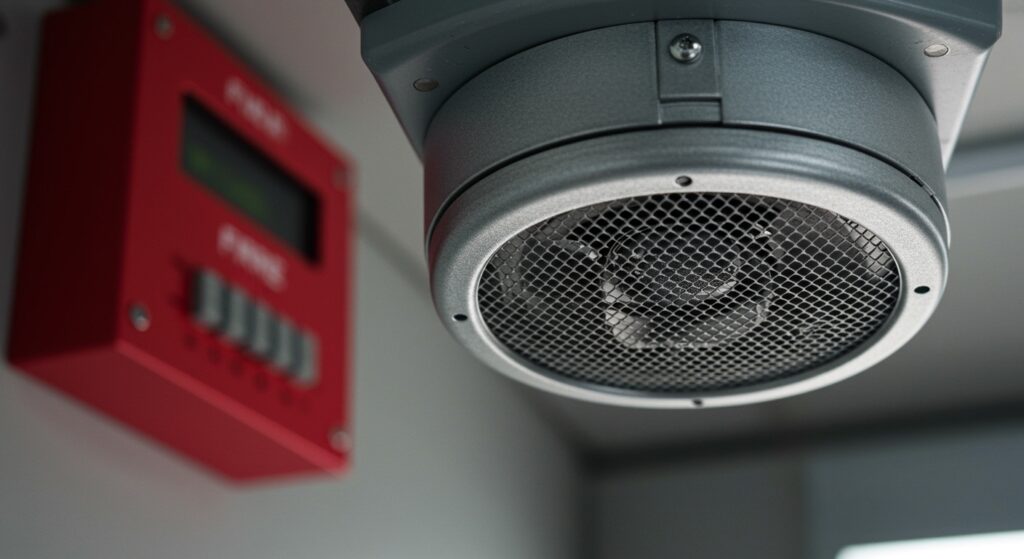
In my twenty years of designing emergency communication systems (ECS), I have seen firsthand how a single renovation mistake can sever a fire alarm wire. In a standard Class B setup, that entire floor goes silent. With a class a annunciating zone speakers, the system simply “backfeeds” the message from the other direction, potentially saving lives in a real-world fire scenario.
TL;DR: Key Takeaways for Class A Systems
- Redundancy: Class A wiring provides a “return” path to the panel, ensuring operation after a single open circuit.
- No EOL Resistor: Unlike Class B, Class A circuits do not use an End-of-Line resistor; the panel supervises the loop via the return terminals.
- Code Compliance: Many jurisdictions require a class a annunciating zone speakers in high-rise buildings and healthcare facilities under NFPA 72.
- Survivability: These systems are designed to withstand physical damage to the cable without losing “annunciation” (the ability to broadcast a message).
The Technical Difference: Class A vs. Class B Annunciation
When we talk about a class a annunciating zone speakers, we are specifically discussing the Survivability and Supervision of the circuit. In the fire protection industry, we classify circuits based on how they behave during a “trouble” condition.
How Class A Circuits Function
A Class A circuit starts at the Fire Alarm Control Panel (FACP), travels through every speaker in the “zone,” and then returns to a separate set of terminals on the panel. The panel sends a small supervisory current through this loop.
If the wire is cut (an “open” condition), the panel detects the break and immediately begins sending the audio signal out of both the “start” and “return” terminals. This ensures every speaker on both sides of the break still functions.
Comparison Table: Class A vs. Class B Wiring
| Feature | Class A (Redundant Loop) | Class B (Radial/End-of-Line) |
|---|---|---|
| Wiring Path | Returns to the Control Panel | Ends at an EOL Resistor |
| Fault Tolerance | Continues to work if wire is severed | Fails beyond the point of the break |
| T-Tapping | Strictly Prohibited | Not allowed (usually) |
| Hardware Cost | Higher (more wire + panel hardware) | Lower |
| Primary Use | High-rise, Hospitals, High-risk | Residential, Small Commercial |
| Supervision | Loop-back monitoring | Resistance-based monitoring |
Step-by-Step Guide: Installing A Class A Annunciating Zone Speakers
Installing these systems requires precision. In my experience, the most common failure point is not the speakers themselves, but the technician’s failure to maintain the loop integrity at the panel.
Step 1: Planning Your Zones and Power Budget
Before pulling wire, you must calculate the Wattage Draw. Most a class a annunciating zone speakers operate on a 25V or 70.7V audio bus.
- Identify the total number of speakers in the zone.
- Determine the “tap” setting for each speaker (e.g., 0.5W, 1W, or 2W).
- Add the total wattage and include a 20% safety margin for future expansion.
- Ensure your Fire Alarm Amplifier can handle the calculated load.
Step 2: Selecting the Correct Cable
For a class a annunciating zone speakers, you cannot use standard speaker wire. You must use FPL (Power-Limited Fire Alarm Circuit Cable) or FPLP (Plenum rated).
- Gauge: Typically 18 AWG to 14 AWG depending on the length of the run and voltage drop.
- Twisted Pair: Always use twisted, shielded wire to prevent “cross-talk” and electromagnetic interference (EMI) from lighting ballasts.
Step 3: Physical Installation of the Speakers
Mount the speakers according to the manufacturer’s specifications (e.g., System Sensor, Gentex, or Potter).
- Spacing: Ensure speakers are spaced to maintain a minimum of 15 dBA above ambient noise levels or 5 dBA above maximum noise levels per NFPA 72.
- Mounting: Ensure backboxes are secured. In plenum spaces, use “fire cans” (metal backboxes) to maintain the fire rating of the ceiling.
Step 4: Wiring the Loop (The Class A Path)
This is where most errors occur. Follow this exact sequence:
- Run the “Out” pair from the FACP to the first speaker.
- Daisy-chain from speaker 1 to speaker 2, and so on.
- DO NOT T-TAP. A Class A circuit must be one continuous line.
- Run the wire from the last speaker all the way back to the Return/Class A terminals on the FACP.
Step 5: Testing and Commissioning
Once wired, you must perform a “Return Path” test.
- Disconnect one lead of the “Out” side at the panel.
- Check if the speakers still broadcast.
- If they do, your Class A redundancy is functional.
- Test for Intelligibility using an STI (Speech Transmission Index) meter. It isn’t enough for the speakers to be loud; they must be clear enough for a panicked person to understand the instructions.
Best Practices for Maintaining A Class A Annunciating Zone Speakers
Over the years, I’ve managed dozens of large-scale systems. The key to longevity is rigorous maintenance.
Avoid “T-Tapping” at All Costs
In a standard audio system, you can tap off a wire to add a speaker. In a class a annunciating zone speakers, this is a violation of code. T-tapping creates a “dead end” that the panel cannot supervise. If that T-tap fails, the panel won’t know, and the speaker won’t work in an emergency.
Manage Voltage Drop
When using 70V systems, voltage drop is less of a concern than with 25V systems, but it still matters. If your wire run is too long or the gauge is too thin, the speakers at the end of the loop will be significantly quieter than those at the beginning. We recommend keeping voltage drop below 10% for critical life safety paths.
Document Your Loop Returns
Label every wire at the panel clearly as “Zone 1 Out” and “Zone 1 Return”. During a “Trouble” condition (like a ground fault), a technician needs to know exactly which wire is the return to isolate where the break has occurred in the building.
Advanced Troubleshooting: Finding a “Class A” Ground Fault
A ground fault occurs when the insulation of the wire is nicked and the copper touches the metal conduit or the building’s structure. In a class a annunciating zone speakers, a ground fault can be elusive.
- Split the Loop: Go to the middle of the speaker run and disconnect the wires.
- Meter the Sections: Use a multimeter to check the resistance to ground on both halves of the loop.
- Isolate: The half showing continuity to ground is where your fault lies.
- Repeat: Continue splitting that section in half until you find the specific speaker or length of wire that is damaged.
Choosing the Right Hardware for Your System
Not all speakers are created equal. When selecting a class a annunciating zone speakers, look for these specific features:
| Feature | Importance | Why it matters |
|---|---|---|
| Field-Selectable Taps | High | Allows you to adjust volume (wattage) on-site without replacing hardware. |
| Frequency Response | Medium | Higher range (400Hz – 4000Hz) improves the clarity of the human voice. |
| Synchronized Strobe | Critical | If the speaker includes a strobe, it must be synced with others in the field of view. |
| UL 1480 Listing | Mandatory | This ensures the speaker is rated for Fire Protective Signaling. |
Leading Manufacturers to Consider:
- System Sensor (L-Series): Excellent for low-current draw and high-output.
- Wheelock (E-Series): Known for robust mounting options and durability.
- Bosch: Preferred for high-fidelity voice evacuation in airports and stadiums.
Frequently Asked Questions (FAQ)
Can I mix Class A and Class B zones on the same fire panel?
Yes, most modern Fire Alarm Control Panels (FACPs) allow for a mix. However, you must use a Class A Converter Module or specific expansion cards if the base panel only supports Class B. Always check the panel’s “point capacity” before adding Class A loops, as they effectively use twice the terminal space.
Why does a class a annunciating zone speaker not need an EOL resistor?
In a Class B circuit, the panel looks for a specific resistance (e.g., 4.7k ohms) to know the circuit is intact. In a Class A circuit, the panel monitors the continuity of the loop by sending a signal out the “A” terminals and receiving it back at the “B” terminals. If the signal doesn’t return, the panel knows there is a break.
Is Class A wiring required by law?
It depends on your local building code and the occupancy type. Under NFPA 72, “Level 2” or “Level 3” pathway survivability often mandates Class A (or better) for high-rise buildings where the evacuation may take a long time and the system must remain operational despite fire damage.
What is the maximum distance for a Class A speaker loop?
Distance is limited by Voltage Drop. For a 70V system using 14 AWG wire, you can often run several thousand feet. However, always use a Voltage Drop Calculator specific to fire alarm circuits to ensure your last speaker receives at least 90% of the intended voltage.
Can I use Class A for background music as well?
Yes, many a class a annunciating zone speakers are used for “Mass Notification” which includes background music and general paging. However, the fire alarm override must always take precedence, automatically cutting off music to broadcast emergency tones or voice instructions.









