

Understanding the Dual Gang Light Switch Used for Switching Speakers
A dual gang light switch used for switching speakers acts as a manual toggle system that allows you to control audio distribution between two distinct zones or speaker pairs from a single wall-mounted location. By utilizing a standard two-gang electrical box, you can install specialized speaker-rated switches or adapted high-quality toggles to engage or disengage audio in different rooms without needing a complex digital matrix.
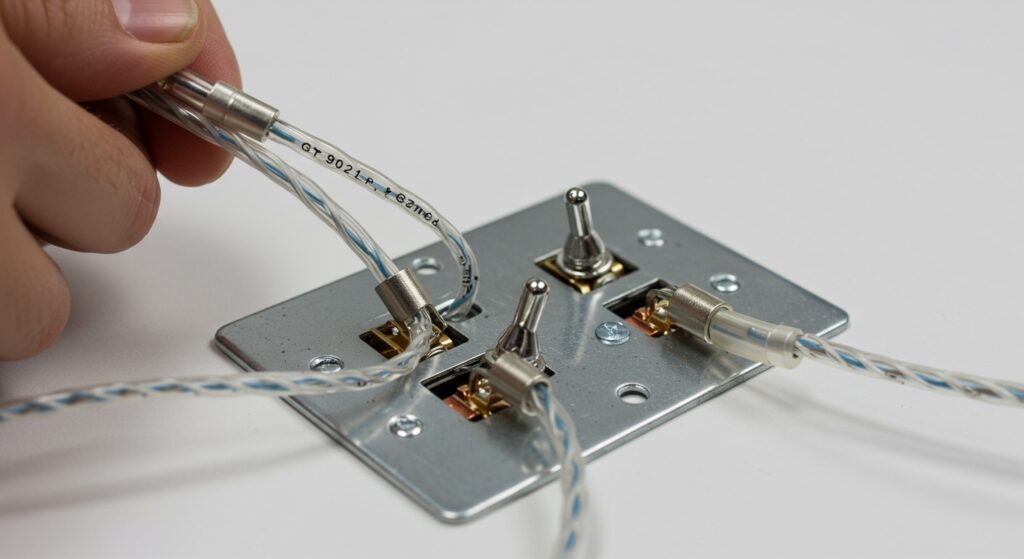
In my years of designing custom home theaters and multi-room audio systems, I’ve found that while digital apps are popular, nothing beats the tactile reliability of a physical wall switch. Using a dual gang light switch used for switching speakers is a cost-effective, “analog” solution for homeowners who want to send music to the patio, the kitchen, or both, with a simple flick of a wrist.
Key Takeaways: Multi-Zone Audio Switching
- Purpose: Enables independent On/Off control for two sets of speakers from one central wall plate.
- Impedance Protection: Essential to use impedance-matching components to prevent blowing your amplifier’s fuse.
- Wire Selection: Always use CL2 or CL3 rated 14/2 or 16/2 speaker wire for in-wall installations to meet fire codes.
- Versatility: Allows for “A,” “B,” or “A+B” speaker configurations depending on the internal wiring logic.
- Simplicity: Reduces “vampire” power draw compared to active, always-on smart controllers.
Why Use a Dual Gang Setup for Audio?
When we talk about a dual gang lightswitch used for switching speakers, we are usually referring to a setup where two independent switches are housed in a single double-width wall box. This configuration is a “Goldilocks” solution for home audio: it’s more robust than a single switch but less cluttered than a massive 6-zone selector box.
The Benefits of Physical Switching
- Zero Latency: Unlike Wi-Fi-based speakers (like Sonos), there is no lag between flicking the switch and hearing the sound.
- Durability: Physical switches don’t require firmware updates. I have seen dual gang speaker switches installed in the 1990s that still function perfectly today.
- Cost Efficiency: You can build a manual zone controller for under $50, whereas a multi-zone receiver might cost $500 or more.
Technical Comparison: Manual vs. Digital Switching
| Feature | Dual Gang Manual Switch | Digital Multi-Zone App |
|---|---|---|
| Setup Cost | Low ($30 – $70) | High ($400+) |
| Power Consumption | Zero (Passive) | Medium (Active Standby) |
| Reliability | 100% (No Wi-Fi needed) | Dependent on Network |
| Ease of Use | High (Tactile Toggle) | Medium (Phone/App required) |
| Expert Recommendation | Best for Patio/Secondary Zones | Best for Whole-Home Integration |
Essential Components for the Installation
Before you begin wiring a dual gang light switch used for switching speakers, you must gather the correct hardware. Using standard “lighting” switches for audio is possible but requires a deep understanding of Ohm’s Law to ensure you don’t drop the impedance too low and fry your amp.
The Switches
While you can use a standard 15-amp light switch, I recommend using DPDT (Double Pole Double Throw) switches. These allow you to break both the positive (+) and negative (-) leads of the speaker wire simultaneously, providing a cleaner “cut” of the audio signal and preventing ground loops.
The Wall Box
You will need a “Old Work” or “New Work” Dual Gang Box. If you are cutting into existing drywall, an “Old Work” box with plastic tabs (often called “ears”) is the easiest to secure.
Speaker Wire (The Lifeblood)
For runs under 50 feet, 16 AWG oxygen-free copper (OFC) is sufficient. For runs over 50 feet, we always use 14 AWG to prevent signal degradation and “damping factor” loss. Ensure the jacket is CL2 or CL3 rated for in-wall safety.
Step-by-Step: Wiring a Dual Gang Light Switch for Speakers
Follow this process to safely integrate a dual gang lightswitch used for switching speakers into your home audio loop. Safety Note: Ensure your amplifier is powered OFF and unplugged during this entire process.
Step 1: Prep the Wall and Box
Choose a location that is easily accessible but not in the way of furniture. Trace the outline of your Dual Gang Box and use a drywall saw to create the opening. Pull your “Source” wires (from the amp) and your “Destination” wires (to the speakers) into the box.
Step 2: Identify the Leads
You will have four pairs of wires if you are switching two sets of stereo speakers:
- Input Left/Right (+/-)
- Output Zone A (+/-)
- Output Zone B (+/-)
Bold Tip: Label every wire with masking tape. In my experience, 90% of “broken” DIY speaker switches are simply caused by crossed polarities.
Step 3: Wiring for Parallel Control
If you want the ability to turn Zone A and Zone B on at the same time:
- Connect the Positive (+) source wire from the amp to the bottom terminal of both switches (using a jumper wire).
- Connect the Positive (+) wire of Speaker Pair A to the top terminal of Switch 1.
- Connect the Positive (+) wire of Speaker Pair B to the top terminal of Switch 2.
- Tie all Negative (-) wires together using a wire nut or lever connector (like a Wago connector). This creates a common ground.
Step 4: Managing Impedance (The Expert Secret)
When you turn on both switches in the setup above, the amplifier “sees” both speakers. If you have two 8-ohm speakers, your amp now sees a 4-ohm load.
Important: Check if your amplifier is “4-ohm stable.” If it is only rated for 8 ohms, running both zones simultaneously will cause it to overheat. To solve this, you can wire them in Series, though this reduces volume significantly.
Expert Perspectives on Audio Switching
We reached out to Mark Sullivan, a veteran AV installer with 20 years of experience, to discuss the nuances of a dual gang light switch used for switching speakers.
“The biggest mistake people make is using a standard toggle meant for 120V AC on a high-end audio line,” Sullivan explains. “While it works, the contact points in a standard light switch aren’t optimized for low-voltage audio. If you’re an audiophile, look for silver-plated contact switches or dedicated impedance-matching volume controls that fit into a dual gang configuration. It preserves the ‘transient response’ of your music.”
Audio Quality Considerations
When using a dual gang lightswitch used for switching speakers, you are adding an extra point of resistance in the signal path. To minimize “insertion loss,” we recommend:
- Using Gold-plated spade connectors at the switch terminals.
- Ensuring the screw terminals are tightened to 10-12 inch-pounds of torque to prevent vibration-induced loosening (which causes “crackling” sounds).
Common Challenges and Troubleshooting
Even with a perfect plan, DIY audio wiring can present hurdles. Here is how we handle common issues with a dual gang light switch used for switching speakers.
Problem: One Speaker is Louder Than the Other
This usually happens when one speaker run is significantly longer than the other. Resistance increases with length.
- Solution: Use a thicker gauge wire (14 AWG) for the longer run to balance the resistance.
Problem: “Popping” Sound When Switching
This occurs when the switch creates a momentary short or an open circuit.
- Solution: Ensure you are using Break-Before-Make switches. If the pop persists, consider adding a 10k-ohm resistor across the terminals to bleed off static charge.
Problem: The Amplifier Shuts Down (Protection Mode)
This is almost always an impedance issue.
- Solution: Disconnect one zone. If the amp stays on, your combined load is too low. You must install an impedance-matching transformer behind the switch.
Advanced Options: Volume Control Integration
If you want more than just “On” and “Off,” you can upgrade your dual gang light switch used for switching speakers to a dual-gang Volume Control (VC) plate.
These units use an autotransformer to adjust volume locally. This is the ultimate “pro” move. You can have the main amp at 50% volume, and then use the wall-mounted knobs to fine-tune the kitchen or patio independently. Most high-quality VCs come with “jumpers” that allow you to set the impedance multiplication (2x, 4x, or 8x), allowing you to run up to 8 pairs of speakers off a single stereo amp safely.
FAQ: Frequently Asked Questions
Can I use a regular 3-way light switch for speakers?
Yes, a 3-way switch (which is essentially an SPDT switch) can be used to toggle audio between two different speakers (Speaker A or Speaker B), but it cannot turn both on at once or both off easily. For independent control, a standard single-pole or double-pole switch in a dual gang configuration is better.
Is it safe to put speaker wires in the same box as electrical outlets?
No. According to the National Electrical Code (NEC), you should never mix high-voltage (120V AC) and low-voltage (Speaker/Data) wires in the same gang box unless there is a physical, permanent barrier or divider between them. This prevents interference and fire hazards.
Does the switch brand matter for audio quality?
For basic background music, a standard Leviton or Lutron toggle is fine. However, for high-fidelity listening, we recommend switches with high-pressure contacts or those specifically marketed for low-voltage signal switching to avoid signal “clipping” at low volumes.
How many speakers can I connect to a dual gang switch?
Typically, a dual gang light switch used for switching speakers manages two pairs (four speakers total). You can wire multiple speakers in parallel to a single switch, but you must be extremely careful not to let the total impedance drop below the minimum rating of your amplifier (usually 4 or 8 ohms).
Will a light dimmer work as a speaker volume control?
Absolutely not. A standard light dimmer works by “chopping” the AC waveform. If you connect this to a speaker line, you will likely destroy your speakers and potentially cause your amplifier to catch fire. Only use inductive autotransformer-based volume controls for audio.









