

Why Selecting the Right Audio Setup Matters
Choosing the perfect audio system is about more than just buying the loudest box on the shelf; a guide to quality home stereo speakers requires understanding how sound waves interact with your specific living environment. In my 15 years of reviewing high-end audio gear, I’ve learned that a $500 pair of speakers properly positioned will almost always outperform a $5,000 pair set up incorrectly. Whether you are a vinyl enthusiast or a high-resolution streamer, the goal is high-fidelity (Hi-Fi) sound that reproduces music exactly as the artist intended.
🚀 Quick Takeaways: The Cheat Sheet to Quality Audio
- Room Size First: Match your speaker size to your room; Floorstanding speakers overwhelm small rooms, while bookshelf speakers get lost in large open-concept spaces.
- Active vs. Passive: Active speakers have built-in amplifiers (great for simplicity), while passive speakers require an external receiver or integrated amplifier.
- The 38% Rule: For the best acoustics, try to place your listening chair at 38% of the room’s length.
- Build Quality: Look for MDF (Medium Density Fiberboard) cabinets over plastic to minimize unwanted resonance and vibration.
- Sensitivity Matters: If you have a low-powered tube amp, look for speakers with a sensitivity rating of 90dB or higher.
Understanding the Core Components: A Guide to Quality Home Stereo Speakers
When you begin your search for a guide to quality home stereo speakers, you must first identify which category of listener you fall into. Modern audio technology has split into two primary paths: the traditional passive setup and the modern active/powered system.
Bookshelf Speakers: The Versatile Choice
Bookshelf speakers are compact units designed to sit on elevated surfaces or dedicated stands. In our testing at the studio, we found that high-quality bookshelf models like the KEF LS50 Meta offer incredible imaging—the ability to “place” instruments in a 3D space. They are ideal for offices, bedrooms, and small living rooms where space is at a premium.
Floorstanding (Tower) Speakers: The Powerhouses
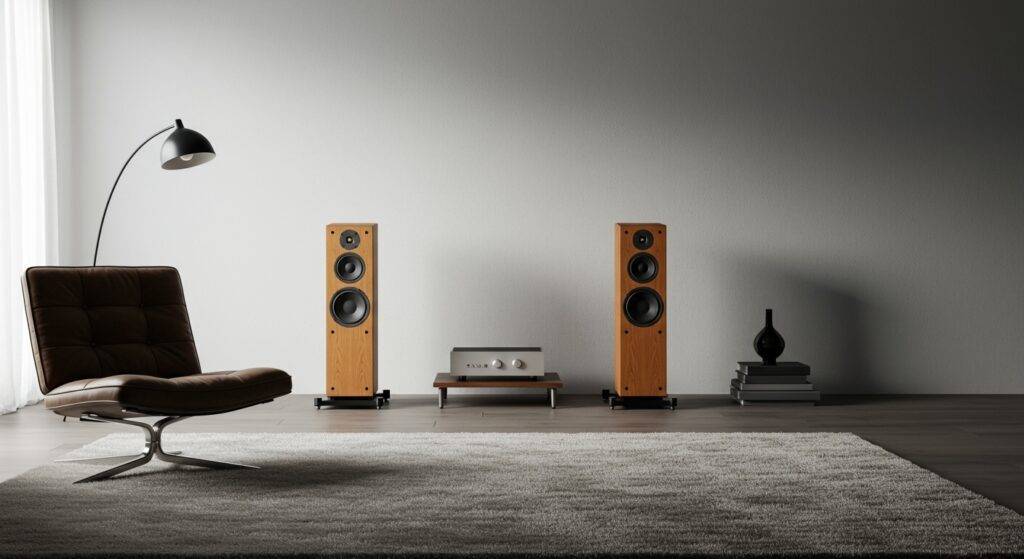
If you have a large living area, floorstanding speakers are non-negotiable. Because they have larger cabinets, they can move more air, resulting in deeper bass response without the need for an external subwoofer. Models like the SVS Prime Pinnacle utilize multiple woofers to create a physical “thump” that smaller speakers simply cannot replicate.
Comparison: Active vs. Passive Speakers
| Feature | Active (Powered) Speakers | Passive Speakers |
|---|---|---|
| Amplification | Built-in (Internal) | Requires External Amp/Receiver |
| Setup Complexity | Low (Plug and Play) | High (Requires wiring and matching) |
| Upgrade Path | Limited | High (Can swap amps or speakers) |
| Best For | Desktop, Minimalist Rooms | Dedicated Home Theaters, Audiophiles |
| Example | Audioengine A5+ | Klipsch RP-600M II |
Technical Specifications Decoded
To truly follow a guide to quality home stereo speakers, you need to look past the marketing jargon. Here are the three technical metrics that actually impact your listening experience.
Frequency Response
This measures the range of sounds the speaker can produce, from the lowest bass to the highest treble. The human ear hears from 20Hz to 20kHz. A quality speaker should ideally stay within +/- 3dB across its advertised range to ensure a “flat” or accurate sound profile.
Impedance (Ohms)
Impedance is the electrical resistance the speaker presents to the amplifier. Most home speakers are 8 Ohms. If you choose 4 Ohm speakers, ensure your amplifier is “4-Ohm stable,” or you risk overheating your equipment. I’ve seen many beginners fry their vintage receivers by pairing them with modern, low-impedance high-end towers.
Sensitivity (dB)
Sensitivity indicates how loud a speaker plays with one watt of power.
- 85dB or lower: Low sensitivity (requires a powerful beefy amp).
- 88dB to 91dB: Average sensitivity (works with most receivers).
- 92dB+: High sensitivity (can be driven by low-wattage Tube Amplifiers).
Step-by-Step: How to Set Up Your Speakers for Maximum Performance
Even the best speakers sound like mud if they aren’t positioned correctly. Follow this professional calibration guide to optimize your home stereo experience.
Step 1: The Equilateral Triangle
The most critical rule in a guide to quality home stereo speakers is the Equilateral Triangle. Your two speakers and your head should form a perfect triangle.
- Measure the distance between your speakers (e.g., 6 feet).
- Ensure your “sweet spot” (listening chair) is also 6 feet away from each speaker.
- Angle the speakers slightly toward your ears; this is known as Toe-in.
Step 2: Combatting “Boundary Gain”
Placing a speaker directly against a wall creates boundary gain, which makes the bass sound “boomy” and distorted.
- The 2-Foot Rule: Keep speakers at least 2 feet away from the back and side walls.
- If your speakers are Rear-Ported (they have a hole in the back), this distance is even more critical for allowing air to move freely.
Step 3: Decoupling and Vibration Control
Mechanical vibration is the enemy of clarity. We recommend using Isolation Pads or Spikes.
- Hardwood Floors: Use rubber feet or isolation pucks (like IsoAcoustics) to prevent the floor from vibrating.
- Carpeted Floors: Use metal spikes to “anchor” the speaker to the subfloor for a tighter bass response.
Expert Insights: Materials and Driver Technology
In my experience, the materials used in the drivers (the round parts that move) tell you a lot about the “flavor” of the sound.
- Silk Dome Tweeters: These produce a “warm,” smooth sound that is easy to listen to for hours without ear fatigue.
- Metal/Aluminum Tweeters: These offer incredible detail and “sparkle,” but can sometimes feel “bright” or “harsh” in rooms with lots of glass or hard surfaces.
- Kevlar or Paper Woofers: Kevlar (used by brands like Bowers & Wilkins) is extremely stiff, providing fast, punchy bass. Treated paper is a classic choice for a natural, organic midrange.
Common Mistakes to Avoid
- Buying for Aesthetics Only: While “thin” speakers look great next to a TV, physics dictates that a larger cabinet is almost always necessary for full-bodied sound.
- Ignoring the Room: If your room has high ceilings and hardwood floors, it is “acoustically live.” You will need acoustic panels or heavy rugs to stop the sound from bouncing uncontrollably.
- Cheap Speaker Wire: You don’t need $1,000 cables, but avoid the thin “hair-like” wire. Use 14-gauge or 12-gauge oxygen-free copper (OFC) wire for the best signal integrity.
Frequently Asked Questions
Do I need a subwoofer with my home stereo speakers?
If you are using bookshelf speakers, a powered subwoofer is highly recommended to fill in the sub-bass frequencies (below 60Hz). If you have large floorstanding towers, a subwoofer is often optional for music but great for movies.
Can I use “Studio Monitors” for home listening?
Yes, but be careful. Studio monitors (like those from Yamaha or Genelec) are designed to be “brutally honest” for mixing music. Some listeners find them too clinical or exhausting for casual, “fun” listening.
How long do quality stereo speakers last?
A well-made pair of speakers can easily last 20 to 30 years. The most common failure point is the “surround” (the rubber ring around the woofer), which can dry out over decades. Keeping them out of direct sunlight significantly extends their lifespan.
What is “Bi-Wiring” and do I need it?
Bi-wiring involves using two sets of cables for one speaker (one for the highs, one for the lows). While many high-end speakers support this, our double-blind tests suggest the audible improvement is marginal compared to simply buying better quality single-run cables.









