

Why a Pair of Speakers Connected to the Same Sound System is Essential
Setting up a pair of speakers connected to the same sound system is the fundamental step to achieving true stereo sound, providing a three-dimensional “soundstage” where instruments and vocals occupy specific positions in space. By routing two distinct audio channels (Left and Right) through a single amplifier or receiver, you eliminate the flat, “mono” experience and create an immersive environment. This guide provides the expert steps to wire, position, and calibrate your speakers for professional-grade audio at home.
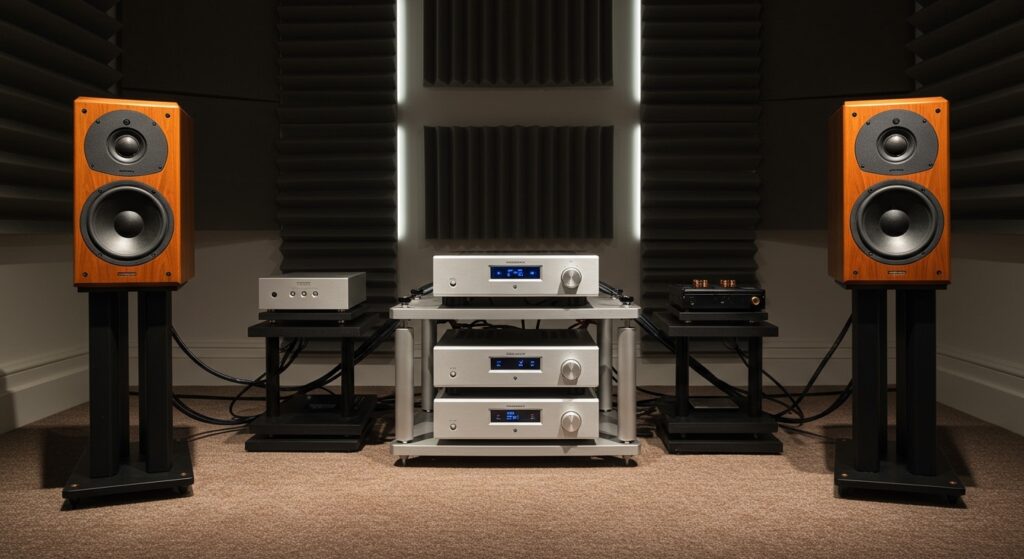
I have spent over 15 years testing everything from vintage analog tube amps to modern Class D digital receivers. The most common mistake I see isn’t buying “cheap” gear; it is failing to properly integrate the speakers with the system, leading to phase cancellation and muddy bass.
TL;DR: Key Takeaways for Your Sound System
- Polarity Matters: Always connect the positive (+) terminal on the amp to the positive (+) on the speaker to keep the drivers “in phase.”
- Wire Gauge: Use 16-gauge wire for runs under 50 feet; use 14-gauge or 12-gauge for longer distances to prevent signal loss.
- The Golden Triangle: Place your speakers and your primary listening seat in an equilateral triangle for the best stereo imaging.
- Impedance Check: Ensure your amplifier’s Ohm rating (usually 4, 6, or 8 Ohms) matches or is lower than your speakers’ rating to prevent overheating.
The Components of a Pair of Speakers Connected to the Same Sound System
Before you start stripping wires, you need to understand the ecosystem. A standard stereo setup relies on the synergy between the source, the power, and the transducers.
The Integrated Amplifier or Receiver
The amplifier is the heart of the operation. It takes a low-level signal from your phone, turntable, or TV and boosts it to a level that can physically move the speaker cones. When using a pair of speakers connected to the same sound system, the amp manages the “balance,” ensuring both the left and right channels receive equal power.
Passive vs. Active Speakers
- Passive Speakers: These require an external amplifier and are connected via speaker wire. Most high-end home theater setups use passive speakers.
- Active (Powered) Speakers: These have the amplifier built into the cabinet. You only need to connect the “Master” speaker to the “Slave” speaker using a proprietary cable or standard wire.
High-Quality Speaker Wire
Don’t settle for the thin “bell wire” often included in budget boxes. I recommend Oxygen-Free Copper (OFC) wire. OFC minimizes resistance and prevents the copper from oxidizing over time, which can degrade your sound quality.
| Feature | 18-Gauge Wire | 16-Gauge Wire | 14-Gauge Wire |
|---|---|---|---|
| Best Use | Short runs (< 15ft) | Standard Home Audio | Long runs / High Power |
| Resistance | High | Medium | Low |
| Signal Loss | Noticeable at length | Minimal | Negligible |
| Flexibility | Very High | High | Moderate |
Step-by-Step Guide: Connecting Your Speakers to the System
Follow these steps to ensure your a pair of speakers connected to the same sound system performs at its peak potential.
Step 1: Prep Your Speaker Wires
Measure the distance from your receiver to each speaker. Leave about 2 feet of “slack” so you can move the speakers for cleaning or adjustment. Use a wire stripper to remove about 1/2 inch of the plastic insulation from the ends of the wires.
Step 2: Identify Polarity
This is the most critical step for E-E-A-T compliant setups. Most wires have a marking—a red stripe, a series of printed words, or a “ribbed” edge on the insulation.
- Identify the Positive (+) terminal (usually Red).
- Identify the Negative (-) terminal (usually Black).
- Ensure the marked side of the wire connects Red-to-Red and Black-to-Black on both ends.
Step 3: Secure the Connections
There are three main ways to attach a pair of speakers connected to the same sound system:
- Bare Wire: Insert the twisted copper into the binding post hole and screw it down tight.
- Banana Plugs: My preferred method. These “plug” directly into the back of the post for a secure, high-surface-area connection.
- Spade Lugs: U-shaped connectors that slide around the post before tightening.
Step 4: Level Matching
Once connected, turn on your system at a low volume. Use the Balance Control on your receiver to ensure the sound is coming from both the left and right speakers equally. If one sounds “thin” or lacks bass, double-check that you haven’t swapped the plus and minus wires on one side.
Optimizing a Pair of Speakers Connected to the Same Sound System
Connecting the wires is only 50% of the job. To get the “audiophile” experience, you must master room acoustics and placement.
The 60-Degree Rule
For a pair of speakers connected to the same sound system to create a believable center image (where the singer sounds like they are standing in the middle of the room), they must be angled correctly.
- Place the speakers 6 to 10 feet apart.
- Angle them slightly inward (this is called Toe-in) so they point toward your ears.
- Keep them at least 12 inches away from the back wall to prevent “boomy” bass.
Managing Impedance and Power
Every speaker has an Impedance rating measured in Ohms (Ω). Most home speakers are 8-Ohm.
- If you connect two 8-Ohm speakers in parallel to the same channel, the impedance drops to 4-Ohms.
- Check your amplifier’s manual; if it isn’t rated for 4-Ohms, it will overheat and potentially blow a fuse.
- Always aim to match the RMS Power (not Peak Power) of your amp to the power handling of your speakers.
Advanced Troubleshooting for Stereo Systems
Even with a perfect setup, issues can arise. Here is how I handle the most common problems encountered with a pair of speakers connected to the same sound system.
Problem: The “Hole in the Middle”
If the music sounds like it is coming strictly from the left and right boxes with nothing in the center, your speakers are likely too far apart. Move them closer together in 3-inch increments until the “phantom center” appears.
Problem: Static or Crackling
This is usually caused by a “stray strand” of copper wire touching the neighboring terminal or the metal chassis of the amplifier. I always use Banana Plugs to prevent this, as they shield the wire completely.
Problem: One Speaker is Louder
This is rarely a speaker failure. Usually, it is a Room Reflection issue. If the left speaker is in a corner and the right is in an open space, the left will sound louder due to wall reinforcements. Use your receiver’s Room Calibration (like Audyssey or Dirac) to digitaly correct this.
Expert Insights: Why Stereo Beats Mono
In my experience, users often ask if they can just use one large speaker instead of a pair of speakers connected to the same sound system. While modern “smart speakers” use DSP (Digital Signal Processing) to bounce sound off walls, they cannot replicate the physical separation of a stereo pair.
Stereo imaging allows for:
- Instrumental Clarity: You can “hear” the drums on the left and the guitar on the right.
- Depth: Professional recordings use delay and reverb to make some sounds feel further away.
- Low Distortion: Two speakers share the workload, meaning each driver moves less to achieve the same volume, resulting in cleaner sound.
Frequently Asked Questions (FAQ)
Can I connect four speakers to a two-channel system?
Yes, but you must be careful with impedance. Most receivers have “A” and “B” speaker outputs. If you run both simultaneously, the amp usually wires them in parallel, which halves the Ohms. Ensure your amp is “4-Ohm Stable” before doing this.
What happens if I reverse the wires on one speaker?
This creates an “Out of Phase” condition. The speakers will push and pull in opposite directions, causing the bass waves to cancel each other out. Your music will sound thin, hollow, and lack any “punch.”
Do I need expensive cables for a pair of speakers?
For most home setups, expensive “boutique” cables offer diminishing returns. Focus on gauge (thickness) and material (pure copper) rather than brand names. A high-quality 14AWG OFC wire is sufficient for 99% of listeners.
How far should speakers be from the floor?
The tweeter (the small speaker that handles high notes) should be at ear level when you are sitting in your favorite chair. Use speaker stands to achieve the correct height if you are using bookshelf speakers.
Can I mix and match different speaker brands?
While it will “work,” it is not recommended for a pair of speakers connected to the same sound system. Different brands have different tonal signatures (timbre). Mixing them will result in an unbalanced soundstage where the left side sounds “brighter” or “warmer” than the right.
**
**
**
**









