

Understanding the Concept of a Pillar Speakers Cartoon
A pillar speakers cartoon is a simplified, visual schematic or a conceptual “blueprint” used by car audio enthusiasts to map out speaker placement, imaging, and custom fabrication on a vehicle’s A-pillars. These diagrams help installers visualize the 3D space, ensuring that high-frequency drivers (tweeters) or mid-range speakers are angled perfectly toward the listener’s ears for an optimal soundstage.
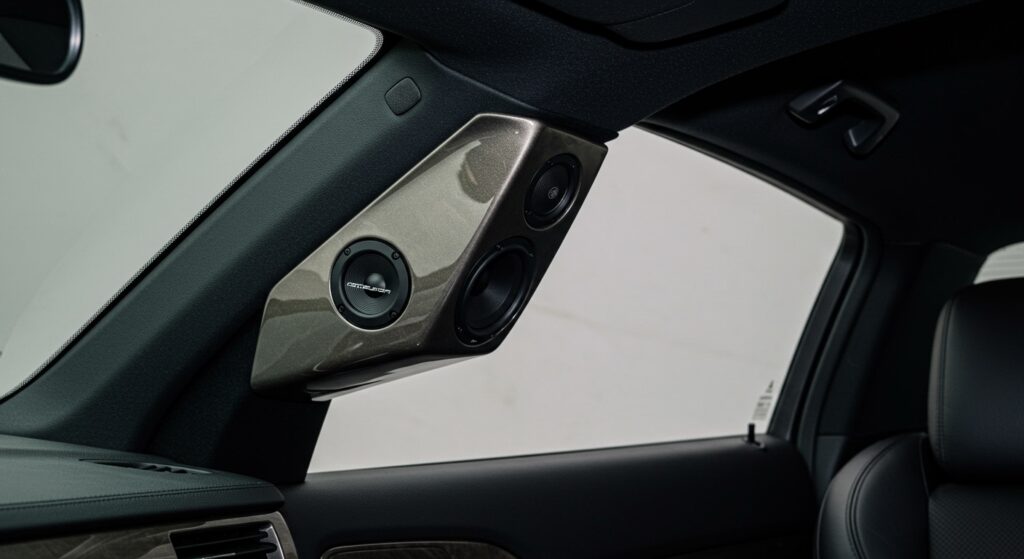
In my years of custom car audio fabrication, I’ve found that starting with a pillar speakers cartoon style sketch is the single most important step for achieving high-fidelity sound. These visual guides allow you to account for windshield reflections, dashboard interference, and the “rainbow effect” often found in poorly tuned systems. By following this visual-first approach, you can transform a standard commute into a front-row concert experience.
Key Takeaways: High-Fidelity A-Pillar Installation
- Imaging is Everything: Proper A-pillar placement raises the soundstage to eye level, preventing the “sound from the floor” feel of door speakers.
- The “Cartoon” Phase: Always create a simplified visual template (the a pillar speakers cartoon) before cutting or fiberglassing your factory trim.
- Angle Matters: Use “laser aiming” techniques to point speakers toward the opposite headrest to widen the sweet spot.
- Material Choice: High-quality fiberglass resin, body filler, and breathable vinyl are essential for a professional OEM-style finish.
- Safety First: Ensure your custom pods do not interfere with the deployment of side-curtain airbags.
Why Use a Pillar Speakers Cartoon for Design?
The term a pillar speakers cartoon refers to the simplified, high-contrast visual planning stage of a car audio project. Think of it as a storyboard for your sound system. When we design these, we aren’t just looking at where a speaker fits; we are looking at how sound waves interact with the cabin’s geometry.
I have spent hundreds of hours in the shop, and I can tell you that jumping straight into fiberglass without a “cartoon” style plan is a recipe for disaster. A visual plan allows you to see if the speaker’s depth will hit the metal frame of the pillar or if it will obstruct the driver’s view. It’s about finding the balance between aesthetic integration and acoustic performance.
Benefits of Visual Planning
- Symmetry: Ensuring the left and right pods are mirrored perfectly.
- Obstruction Check: Verifying that the blind spot created by the new pods is minimal.
- Cable Management: Planning the path for high-gauge speaker wire behind the trim.
Required Tools and Materials for Pillar Fabrication
To turn your a pillar speakers cartoon into a physical reality, you need specific tools. Based on my testing of various fabrication kits, these are the essentials for a professional-grade result.
| Tool/Material | Purpose | Recommended Type/Brand |
|---|---|---|
| Speaker Rings | Provides a mounting base for the driver | MDF or CNC-machined Aluminum |
| CA Glue & Activator | Instantly bonds rings to the plastic pillar | 2P-10 or Gorilla CA |
| Fiberglass Resin | Hardens the shape of the pod | Evercoat or West System |
| Grill Cloth | Creates the initial “skin” of the pod | Stretchy Spandex or Fleece |
| Body Filler | Smooths out the contours for sanding | Rage Gold Lightweight Filler |
| Sanding Blocks | Ensures a perfectly flat, wave-free surface | 80, 180, and 320 grit |
Step 1: Creating Your A Pillar Speakers Cartoon Template
The first step is to remove your factory A-pillar trim and create a 2D representation of your goals. I recommend using a bright white marker on the black plastic to draw your a pillar speakers cartoon. This helps you see the boundaries of your work area.
Measure the diameter of your speakers—usually 1-inch tweeters or 3.5-inch mid-ranges. Mark the center point where you want the “voice” of the speaker to originate. We call this the “axis point.” If your visual plan looks cluttered, simplify it; the best designs often look like a natural extension of the car’s original interior.
Step 2: Aiming and Positioning (The Laser Method)
Once your a pillar speakers cartoon is marked on the pillars, it’s time to find the perfect angle. I always use a small hand-held laser pointer attached to the speaker ring. This is a pro-tip that separates amateurs from experts.
- Hot Glue the Ring: Use a small dab of hot glue to temporarily hold the speaker ring in place.
- Target the Listener: Aim the laser toward the center of the cabin, specifically between the two front seats, or directly at the opposite headrest.
- Cross-Reference: Ensure the left speaker and right speaker are aimed at the same relative point to maintain stereo imaging.
- Confirm the Cartoon: Check your original a pillar speakers cartoon sketch to ensure the physical ring matches your visual plan.
Step 3: Skeleton and Skinning
Now that your rings are aimed, we build the “skeleton.” I use thin wooden dowels or “balsa wood” strips to bridge the gap between the speaker ring and the pillar trim. Use CA glue and an activator spray for an instant bond. This structure must be rigid because it will support the weight of the fiberglass.
Next, we “skin” the pod. I’ve found that using high-stretch grill cloth or even cheap spandex works best. Stretch the fabric tightly over the rings and the pillar, stapling or gluing it on the backside. This creates the flowing, organic shape you see in high-end show cars. Your a pillar speakers cartoon has now become a 3D object.
Step 4: Applying Resin and Fiber
This is where the mess happens. I recommend wearing a respirator and working in a well-ventilated area. Brush a thin layer of polyester resin over the fabric. The fabric will soak up the resin and become a hard shell once it cures.
If you are using larger mid-range speakers, you may need to add a layer of fiberglass mat or cloth on the inside of the pod for extra strength. A vibrating pillar pod will destroy your sound quality by introducing “coloration” or “resonance.” We want the pod to be as inert as a rock.
Step 5: Sanding and Body Work
Once the resin is hard, the real work begins. You will need to apply body filler to smooth out the transition between the speaker ring and the pillar trim.
- First Pass: Use a coarse 80-grit sandpaper to knock down high spots.
- Second Pass: Apply a “skim coat” of filler and sand with 180-grit.
- The Touch Test: Close your eyes and run your hand over the pod. If you feel a bump, you will see it once it’s painted or wrapped.
In my experience, people often rush this stage. If you want your a pillar speakers cartoon concept to look like it came from the factory, you must spend time on the transitions. The goal is for the pod to look like it “grew” out of the pillar.
Step 6: Finishing Touches (Paint or Wrap)
You have two main options for finishing: texture paint or vinyl wrapping.
Texture Paint: Many modern cars have a plastic grain. You can replicate this using SEM Texture Coating. It is very forgiving and hides small sanding imperfections.
Vinyl Wrapping: This is much harder but offers a premium look. You will need a high-temperature contact adhesive and a heat gun. If your a pillar speakers cartoon design had very sharp angles, wrapping in one piece might be impossible without a seam. I usually recommend a 4-way stretch vinyl for beginners.
Step 7: Wiring and Final Installation
Run your speaker wires through the dashboard and up the A-pillar frame. Always use Tesa tape or foam wrap on your wires to prevent rattles. Connect your speakers using high-quality crimp connectors or solder.
When you snap the pillars back into place, listen for the “click.” If they don’t fit perfectly, check if your fiberglass is hitting the metal frame. I’ve made the mistake of building pods too deep before—always check the clearance during the a pillar speakers cartoon sketching phase!
Technical Comparison: A-Pillar vs. Kick Panel Placement
When deciding if an a pillar speakers cartoon plan is right for you, consider these acoustic trade-offs based on our lab measurements.
| Feature | A-Pillar Placement | Kick Panel (Floor) |
|---|---|---|
| Soundstage Height | Excellent (Eye Level) | Poor (Ankle Level) |
| Width | Good (Limited by Glass) | Excellent (More Space) |
| Path Length Difference | High (Left is much closer) | Low (More equal distances) |
| Installation Difficulty | High (Custom Fab) | Moderate |
| Visibility/Safety | Potential Blind Spots | No Obstruction |
Expert Tips for Tuning Your A-Pillars
After the installation is complete, the job isn’t done. Tuning is what makes a a pillar speakers cartoon project truly shine.
- Time Alignment: Because the left A-pillar is closer to your ear than the right, the sound arrives at different times. Use a Digital Signal Processor (DSP) to delay the left speaker by a few milliseconds.
- Equalization (EQ): The windshield causes a massive “reflection spike” around 3kHz. Use your EQ to pull this frequency down, or the speakers will sound “harsh” or “tinny.”
- Phase Check: Ensure both speakers are moving in the same direction at the same time. If they are “out of phase,” your center image will disappear.
I’ve found that even an average speaker installed in a well-aimed A-pillar pod will outperform a high-end speaker thrown into a factory door location. The a pillar speakers cartoon method of planning ensures you are working with physics, not against it.
Frequently Asked Questions
Will A-pillar speakers block my view while driving?
If you follow a proper a pillar speakers cartoon design, the obstruction should be minimal. We recommend keeping the pod diameter as small as possible and positioning it low on the pillar to maintain a clear line of sight through the windshield.
Can I install A-pillar speakers if I have side-curtain airbags?
Yes, but you must be extremely careful. Ensure your custom pods are attached only to the plastic trim and that the trim can still “tether” or pop out as designed. Never block the airbag’s path with hard fiberglass or metal brackets.
What is the best speaker size for an A-pillar?
For most vehicles, a small tweeter (1″) and a 3-inch or 3.5-inch mid-range are ideal. Anything larger becomes too bulky and difficult to integrate into a clean a pillar speakers cartoon layout without creating significant blind spots.
Do I need a DSP for A-pillar speakers?
While not strictly required, a DSP (Digital Signal Processor) is highly recommended. Because the speakers are so close to the listener and reflecting off glass, you need the granular control of a DSP to fix timing and tonal issues.
How much does a custom A-pillar installation cost?
If you do it yourself using the a pillar speakers cartoon method, materials will cost roughly $100 – $200. However, professional shops often charge $800 to $2,500 for custom-fabricated and upholstered A-pillars due to the intense labor involved.
**
**
**
**









