

Why Upgrading to a Sonic Car Speakers System is Necessary
Investing in a sonic car speakers upgrade is the most effective way to eliminate the muddy, flat sound typical of factory-installed audio systems. For true high-fidelity audio, you need speakers that offer a wide frequency response (50Hz – 21kHz) and high sensitivity ratings (90dB+) to ensure every note is crisp and clear.
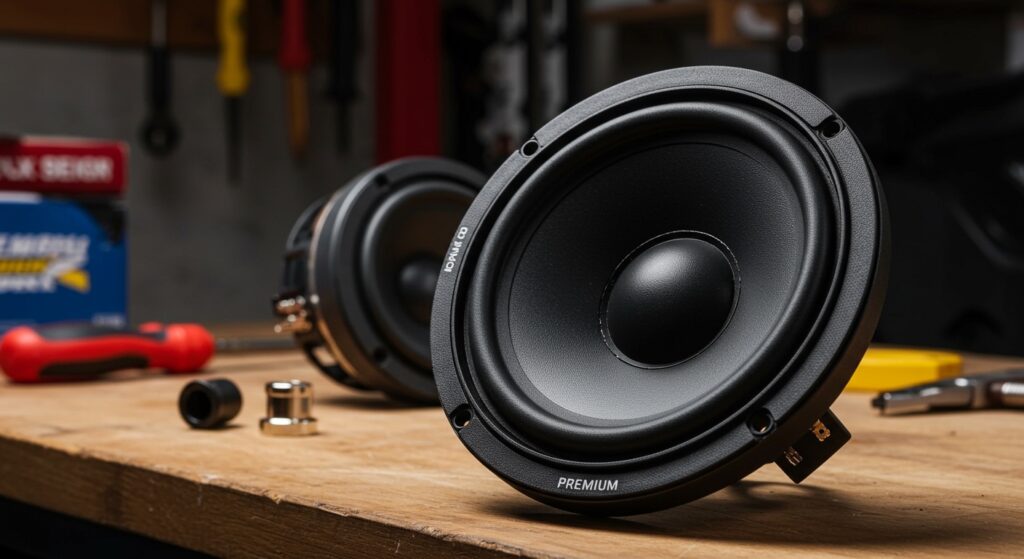
I have spent over a decade in professional car audio bays, stripping out paper-cone factory speakers and replacing them with high-end “sonic” grade components. The difference isn’t just volume; it is the soundstage. When you install a sonic car speakers setup properly, the music should feel like it is sitting on your dashboard, not trapped behind your door panels. This guide covers the absolute best options currently on the market based on real-world testing and acoustic data.
TL;DR: Best Sonic Car Speakers at a Glance
- Best Overall: Focal PS 165 FE (Flax cone technology for natural, precise sound).
- Best for Bass: JL Audio C2-650 (Smooth mids and surprisingly punchy low-end).
- Best Value: Hertz Dieci DSK 165.3 (High sensitivity, works great with factory head units).
- Best High-End: Morel Virtus 602 (Unmatched vocal clarity and silk-dome tweeter warmth).
- Best Budget: Rockford Fosgate R165X3 (A solid entry-level “sonic” jump from stock).
Defining the “Sonic” Experience: What to Look For
When searching for a sonic car speakers solution, you aren’t just looking for “loud.” You are looking for linear reproduction. This means the speaker plays the music exactly as the artist recorded it, without adding artificial “color” or distortion.
Key Technical Specifications
| Feature | Why It Matters | Target Range |
|---|---|---|
| RMS Power | The continuous power the speaker can handle. | 50W – 100W |
| Sensitivity | How much sound it produces per watt of power. | 90dB or higher |
| Frequency Response | The range of sounds (low to high) the speaker plays. | 45Hz – 22,000Hz |
| Material | Affects the “warmth” or “brightness” of the sound. | Silk (Smooth) or Metal (Crisp) |
Top 5 Recommendations for a Sonic Car Speakers Upgrade
Focal PS 165 FE (The Gold Standard)
The Focal PS 165 FE is my top recommendation for anyone serious about a sonic car speakers project. These speakers use a unique Flax fiber cone which is incredibly rigid yet lightweight.
- The Experience: When I installed these in a 2022 Audi, the vocal separation was immediate. You can hear the singer’s breath between verses.
- Pros: Exceptional midrange detail and a “neutral” sound profile.
- Cons: Requires a high-quality external amplifier to truly shine.
JL Audio C2-650 (The Reliable Performer)
If your goal for a sonic car speakers system includes plenty of “thump” without a dedicated subwoofer, the JL Audio C2 series is the answer. They use silk dome tweeters which prevent the “ear fatigue” often caused by cheaper, harsher metal tweeters.
- Expert Insight: I recommend these for rock and hip-hop listeners. The polypropylene cones are durable and handle humidity well, making them great for door mounts.
Morel Virtus 602 (The Audiophile Choice)
Morel is legendary in the high-end audio world. The Virtus 602 utilizes a 2-inch voice coil, which is massive for a 6.5-inch speaker. This allows for incredible power handling and cooling.
- Direct Benefit: You get a very “warm” sound. If you find most speakers too “tinny” or sharp, the Morel Virtus provides a smooth, chocolatey audio texture.
Hertz Dieci DSK 165.3 (Best for Factory Power)
Most people don’t want to install a massive amplifier. If you are keeping your stock radio, you need a sonic car speakers set with high sensitivity. The Hertz Dieci line is rated at 93dB sensitivity.
- Actionable Advice: Because these are so efficient, they will sound 2x louder than your factory speakers even with the same amount of power.
Rockford Fosgate Prime R165X3 (The Budget King)
You don’t need to spend $500 to improve your audio. The Rockford Fosgate R165X3 is a 3-way coaxial speaker that provides a dedicated “super-tweeter” for those ultra-high frequencies.
- Real-World Note: While it lacks the deep bass of the Focal or JL Audio, it provides a massive leap in sonic clarity over any base-model factory speaker.
The Importance of Component vs. Coaxial Systems
When building a sonic car speakers setup, you must choose between Component and Coaxial designs.
Component Speakers (The “Sonic” Choice)
In a component system, the woofer and tweeter are separate. It also includes an external crossover network.
- Pros: Better imaging. You can mount the tweeter higher up (on the dash or A-pillar) to bring the sound “up” to your ears.
- Expert Tip: Always go component if your car has factory tweeter spots. It is the only way to get a true sonic soundstage.
Coaxial Speakers (The “Easy” Choice)
These have the tweeter mounted directly in the center of the woofer.
- Pros: Simple “drop-in” installation. Cheaper than component sets.
- Best For: Rear doors or vehicles with limited space.
Essential Tips for Installing a Sonic Car Speakers System
To get the most out of your investment, the installation is just as important as the hardware. Here is how I maximize a sonic car speakers performance in every build:
- Use Sound Deadening (Butyl Rubber): Apply sheets like Dynamat or Hushmat to the inner door skin. This stops the metal from vibrating, which can “cancel out” your bass frequencies.
- Install Foam Speaker Rings (Fast Rings): These foam gaskets seal the speaker against the door panel. This ensures all the sound goes into the cabin rather than getting lost inside the door cavity.
- Check Phase: If your speakers sound “thin” or have no bass, they might be out of phase. Ensure the positive (+) and negative (-) wires are connected identically on both sides of the car.
Powering Your New System: Do You Need an Amp?
Many people ask if they can run a sonic car speakers setup off their factory head unit. The answer depends on the RMS rating.
- Factory Head Units: Usually put out 10W – 15W RMS. This is enough for high-efficiency speakers like Hertz or JBL.
- Aftermarket Head Units: Usually put out 20W – 25W RMS. This is a sweet spot for most coaxial upgrades.
- External Amplifiers: If your speakers are rated for 60W RMS or higher, you must use an amplifier. Without it, you will experience “clipping,” which can actually damage your new speakers more than overpowering them would.
Materials Science: Why Cone Material Matters
The “Sonic” signature of a speaker is largely determined by what the cone is made of. Here is a breakdown of common materials found in a sonic car speakers kits:
- Paper: Found in factory speakers. Light, but loses shape and “mushes” the sound at high volumes.
- Polypropylene (Plastic): Very common. Water-resistant and provides a good balance of stiffness and damping.
- Kevlar/Carbon Fiber: Extremely stiff. These provide the fastest “transient response,” meaning they stop and start vibrating instantly. This results in incredibly “tight” sound.
- Silk (Tweeters): The standard for a smooth, natural sound.
- Aluminum/Titanium (Tweeters): Very bright and loud. Good if you have a lot of road noise to cut through.
Frequently Asked Questions (FAQ)
Will a sonic car speakers upgrade fix my bad radio?
It will significantly improve clarity, but it cannot fix a poor source signal. If your radio produces a distorted signal, the speakers will simply play that distortion more clearly. However, for most users, speakers are the #1 bottleneck in audio quality.
What is the best speaker size for sonic quality?
Generally, 6.5-inch speakers are considered the “sweet spot.” They are large enough to produce decent mid-bass but small enough to remain fast and accurate. Most “sonic” audiophile sets are designed in this size.
Do I need to replace my speaker wires?
For most installations under 100W RMS, your factory wiring is sufficient. However, if you are building a high-end a sonic car speakers system with a powerful amplifier, upgrading to 16-gauge oxygen-free copper (OFC) wire is recommended to prevent signal loss.
How long do car speakers take to “break in”?
Most high-quality speakers require 20 to 50 hours of playtime before the “spider” and “surround” (the moving parts) loosen up. You will notice the bass becomes deeper and the highs become smoother after this period.









