The Gold Standard of Presentation Design
When delivering a presentation, a speakers visual aid should not be a transcript of the speech, nor should it be so distracting that it pulls attention away from the presenter. Ideally, visual aids serve as a supportive tool to clarify complex data and reinforce your message. If the audience is spending more time reading your slides than listening to your voice, your visual aid has failed its primary purpose.
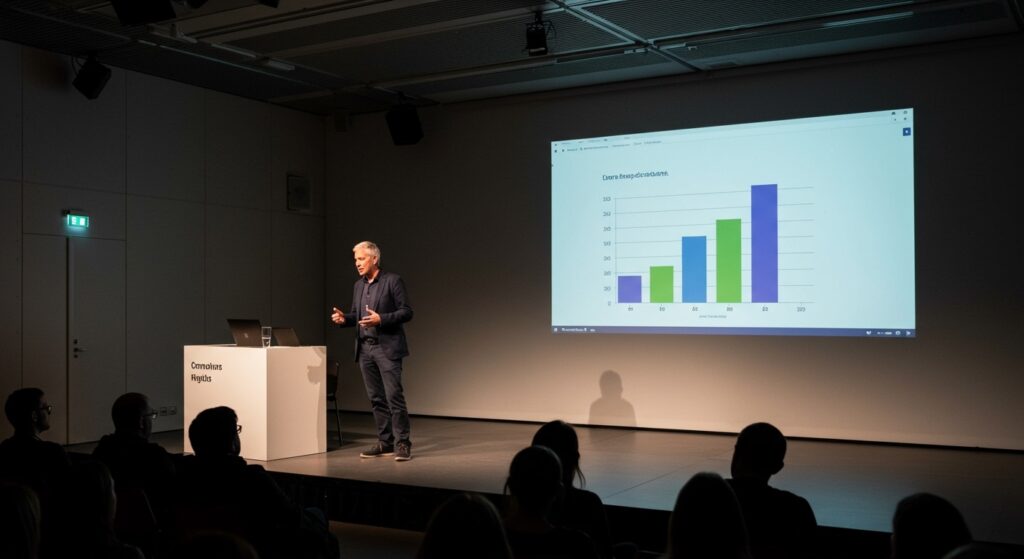
In my years of professional speaking and coaching executives, I’ve found that the most common mistake is treatings slides as “teleprompters.” This results in Cognitive Overload, where the audience’s brain struggles to process competing sensory inputs (reading while listening). To maximize engagement, your visuals must be complementary, legible, and minimalist.
TL;DR: Quick Tips for High-Impact Visuals
- Rule of Six: Use no more than six words per slide to maintain focus.
- Visibility First: Ensure fonts are at least 30 points for readability in large rooms.
- High Contrast: Use dark text on light backgrounds or vice versa to accommodate accessibility.
- Zero Distraction: A speakers visual aid should not be filled with unnecessary animations or sound effects.
- The “B” Key: Use the “B” key on your keyboard to black out the screen when the focus needs to be 100% on you.
Why a Speakers Visual Aid Should Not Be Your Script
The most important rule in public speaking is that you are the presentation, not your PowerPoint. When a speakers visual aid should not be used as a script, it forces the speaker to engage more deeply with the audience. If you read directly from your slides, you lose eye contact, which is the primary driver of audience trust and authority.
Avoiding the “Death by PowerPoint” Trap
We have all experienced “Death by PowerPoint”—the glazed eyes and heavy sighs of an audience faced with a wall of text. Scientific research on Dual-Coding Theory suggests that humans process verbal and visual information through different channels. When you present a slide full of text, those channels compete, leading to a significant drop in information retention.
To avoid this, treat your slides like billboards, not book pages. A billboard on a highway must convey its message in three seconds or less. Your slides should follow the same logic. If an audience member can’t understand the core message of a slide in under five seconds, it is too complex.
The Psychology of Visual Focus
When you show a new slide, the audience’s attention naturally shifts to the screen. If a speakers visual aid should not be cluttered, they will quickly absorb the visual and return their gaze to you. However, if the slide is a dense spreadsheet or a long list of bullet points, they will continue reading, effectively tuning out your spoken words.
Expert Insight: I always recommend the 10/20/30 Rule popularized by Guy Kawasaki:
- 10 Slides: The maximum number for a standard presentation.
- 20 Minutes: The maximum time you should speak.
- 30-Point Font: The minimum size for any text.
Core Mistakes: A Speakers Visual Aid Should Not Be Cluttered
Clutter is the enemy of clarity. When we talk about why a speakers visual aid should not be cluttered, we are talking about Visual Noise. This includes excessive logos, footer text, page numbers, and decorative clip art that adds no value to the message.
The Danger of Over-Animation
Modern software like Prezi, Canva, and Google Slides offers dozens of transition effects. However, professional speakers know that a speakers visual aid should not be an animation showcase. Swirling text and “shattering” transitions are distracting and can even cause motion sickness in some audience members.
Use transitions only when they serve a functional purpose, such as “building” a list one item at a time. This keeps the audience from reading ahead while you are still discussing the first point.
Graphic Complexity and Data Visualization
If you are presenting data, remember that a speakers visual aid should not be a raw data dump. Do not copy and paste a complex Excel table into a slide. Instead, create a simplified chart that highlights the One Key Insight you want the audience to remember.
| Aid Type | Best Use Case | Mistake to Avoid |
|---|---|---|
| Slides | High-level concepts & images | Including full paragraphs |
| Physical Props | Demonstrating scale or function | Being too small to see |
| Video Clips | Showing real-world examples | Being longer than 60 seconds |
| Whiteboard | Brainstorming & real-time math | Turning your back to the audience |
| Handouts | Complex data/reference info | Distributing during the talk |
Design Principles for Maximum Engagement
To ensure your presentation is effective, you must follow specific design principles. These aren’t just about “looking pretty”—they are about how the human brain processes information.
Leveraging Negative Space
White space (or negative space) is the area of a slide that is left empty. It is not “wasted” space; it is a tool that guides the audience’s eye to the most important element. Professional designers use negative space to create a sense of balance and importance.
Choosing the Right Typography
A speakers visual aid should not be written in “fancy” or “script” fonts. While Monotype Corsiva might look elegant on an invitation, it is illegible on a projector. Stick to Sans-Serif fonts like Helvetica, Arial, or Open Sans for the best readability.
- Header Size: 36-44 points.
- Body Size: 28-32 points.
- Font Choice: Stick to one or two fonts maximum for the entire presentation.
Color Theory and Contrast
Color is a powerful emotional trigger, but it can also be a barrier. Approximately 8% of men have some form of color blindness. If you use red text on a green background to show “good vs. bad” results, a significant portion of your audience may see only a muddy brown mess. Always use high-contrast combinations, such as Navy Blue and White or Black and Yellow.
Hardware and Setup: A Speakers Visual Aid Should Not Be a Technical Failure
I’ve seen brilliant presentations ruined by a “No Signal” message or a flickering adapter. Your visual aid includes the hardware you use to display it. Being a professional means being prepared for technical glitches.
The Essential “Tech Kit” for Speakers
Never rely solely on the venue’s equipment. I always carry a “Presenter’s Emergency Kit” which includes:
- HDMI to USB-C Adapters: Necessary for modern MacBooks.
- Wireless Clicker: Do not stay tethered to your laptop; use a Logitech Spotlight or similar remote.
- USB Backup: Have your presentation in PDF format on a thumb drive in case the software fails.
- Local Copy: Never rely on the venue’s Wi-Fi for Prezi or Google Slides; have an offline version ready.
Positioning the Screen and the Speaker
A speakers visual aid should not be placed directly behind the speaker. If possible, angle the screen to the side. You should stand in the “power position” (center-stage), and the visual aid should be in the “supporting position.” This prevents you from casting a shadow on your own slides and allows you to maintain better eye contact.
Accessibility: A Speakers Visual Aid Should Not Be Exclusive
In the modern era of Inclusive Design, your visuals must be accessible to everyone, including those with visual impairments.
Alt-Text and Screen Readers
If you are sharing your slides digitally after the presentation, ensure every image has Alt-Text. This allows screen readers to describe the image to users who are blind or low-vision.
Verbal Descriptions
A pro-tip for high-level E-E-A-T: Describe your slides verbally. Instead of saying “As you can see on this chart,” say “This bar chart shows a 20% increase in revenue over the last quarter, represented by a rising blue line.” This serves two purposes: it helps those with visual impairments and it reinforces the data for everyone else.
Actionable Strategy: The 4-Step Visual Audit
Before your next presentation, run your visual aids through this audit to ensure they meet professional standards.
- The Squint Test: Look at your slide and squint your eyes until everything is blurry. What stands out? If nothing is clearly dominant, the slide is too cluttered.
- The 5-Second Rule: Show a slide to a colleague for 5 seconds, then hide it. Ask them what the main point was. If they can’t answer, simplify the slide.
- The “So What?” Test: For every slide, ask yourself “So what?” If the slide doesn’t directly support your core message or provide necessary evidence, delete it.
- The Contrast Check: View your slides on a low-brightness setting. If the text is hard to read, you need more contrast.
Frequently Asked Questions
What is the most important rule for a speaker’s visual aid?
The most important rule is that a speakers visual aid should not be the focus of the presentation. It must remain a secondary tool that supports the speaker’s verbal message. If the visual aid can stand alone without the speaker, it is a document, not a presentation aid.
How many words should be on a slide?
Most experts recommend the Rule of Six: no more than six words per line and no more than six lines per slide. However, for maximum impact, aim for even fewer. The most memorable slides often contain just one striking image and a single powerful word or phrase.
Should I use props instead of slides?
Props can be incredibly effective because they are three-dimensional and tactile. However, a speakers visual aid should not be a prop if it is too small for the back row to see. If you are using a physical object, ensure it is large enough to be visible or use a document camera to project it onto the screen.
Is it okay to use humor in visual aids?
Yes, humor can be a great way to build rapport. However, a speaker’s visual aid should not use “inside jokes” or potentially offensive memes. Keep humor relevant to the topic and ensure it doesn’t distract from the key takeaway of the presentation.
What should I do if my visual aid fails during the speech?
Always have a “Plan B.” If the projector dies, continue your speech without the visuals. A professional speaker knows their material well enough to deliver it without any aids. Mentioning the technical failure briefly and then moving on with confidence actually increases your perceived authority and E-E-A-T.
**
**
**
**