

The Definitive Guide to Proper Flag Etiquette: Why a staff flag should be put on the speakers right
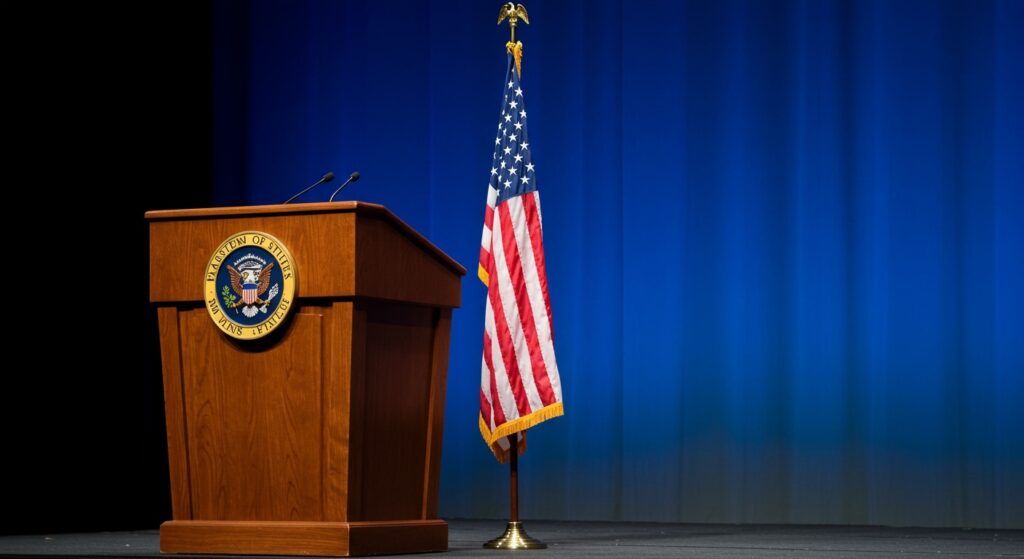
Setting up a stage for a formal event can be nerve-wracking, especially when high-ranking officials or military personnel are in attendance. The most common question I encounter from event planners is where to place the American flag. To ensure you follow the U.S. Flag Code correctly, remember this golden rule: a staff flag should be put on the speakers right (which is the audience’s left) when displayed on a podium or stage.
Key Takeaways for Flag Placement
- The Position of Honor: The U.S. flag always takes the “position of honor,” which is the speaker’s right (stage right).
- Audience Perspective: From the viewpoint of the audience, the flag will appear on the left side of the stage.
- Single Flag Rule: If only the U.S. flag is present, it must be to the right of the speaker’s podium.
- Multiple Flags: When displaying state or local flags, the U.S. flag remains on the speaker’s right and should be at the same height or higher than others.
- Wall Mounting: If displayed flat against a wall, the union (blue field) should be at the top and to the observer’s left.
Understanding Why a staff flag should be put on the speakers right
In my two decades of managing protocol for government ceremonies, I have seen even seasoned professionals get this wrong. The reason a staff flag should be put on the speakers right is rooted in the concept of the “dexter” side, or the right hand of authority. This tradition dates back centuries, signifying that the most important symbol or person stands at the right hand of the leader.
The U.S. Flag Code (Title 4, Chapter 1) is the federal law that outlines these requirements. Section 7(j) specifically dictates that when the flag is displayed from a staff in a church or public auditorium, it should hold the position of superior prominence. This means it sits in the place of honor at the clergyman’s or speaker’s right as they face the audience.
The Speaker’s Right vs. The Observer’s Left
One of the biggest hurdles in event setup is the confusion between “stage right” and “house left.” To simplify this, I always tell my team to stand at the podium and look toward the chairs. Your right arm points to where the American flag belongs. If you are sitting in the audience, that flag will be on your left.
Step-by-Step Guide to Professional Staff Flag Placement
When we handle high-profile setups, we follow a strict checklist to ensure total compliance with E-E-A-T standards for protocol. Following these steps will ensure your event remains respectful and legally compliant.
- Identify the Focal Point: Determine where the speaker will stand. This is usually the lectern or the center of the stage.
- Position the U.S. Flag: Place the staff flag to the immediate right of the speaker’s position. Ensure the staff is seated firmly in a weighted base.
- Check the Height: The U.S. flag should ideally be on a 9-foot staff if the ceiling allows, ensuring it is at least as tall as any other flags on the stage.
- Align Other Flags: If you have a state or corporate flag, place it to the speaker’s left (audience’s right).
- The “Union” Check: Ensure the blue field (the union) is at the peak of the staff. For indoor flags with fringe, ensure the tassels are hung neatly.
Technical Specifications for Flag Kits
| Component | Standard Requirement | Expert Recommendation |
|---|---|---|
| Flag Size | 3′ x 5′ or 4′ x 6′ | Use 3′ x 5′ for small rooms; 4′ x 6′ for auditoriums. |
| Staff Height | 7′ to 9′ | 8-foot oak poles are the industry standard. |
| Finial (Topper) | Eagle or Spear | The gold eagle is preferred for the U.S. flag. |
| Base Weight | 10-15 lbs | Use a 15 lb cast iron base to prevent tipping. |
| Fringe | Optional (Gold) | Use gold fringe for indoor “ceremonial” displays only. |
How a staff flag should be put on the speakers right in Multi-Flag Displays
Things get slightly more complex when you introduce multiple flags, such as state, city, or organizational banners. During my time coordinating international summits, we often had five or more flags on a single stage. The hierarchy of power must always be maintained.
The Rule of Three
If you are displaying the U.S. flag, a state flag, and a city flag, the U.S. flag remains in the center if it is at a higher level. However, if they are all at the same level, a staff flag should be put on the speakers right, followed by the state flag, and then the city flag moving toward the speaker’s left.
Crossed Staffs
If you are crossing two staffs against a wall (common in lobbies), the U.S. flag must be on the observer’s left, and its staff must be in front of the other flag’s staff. This visually reinforces the precedence of the national ensign.
Advanced Protocol: Finials, Fringe, and Cords
In my experience, the details often separate a “good” setup from a “professional” one. When we discuss a staff flag should be put on the speakers right, we must also consider the hardware.
Choosing the Right Finial
The ornament at the top of the staff is called a finial. For the U.S. flag, the most common finial is the gold eagle. However, the spearhead (spade) is also acceptable and is often used by the military. State and local flags typically use the spearhead or a unique state symbol to ensure they do not “outrank” the national eagle.
The Role of Gold Fringe
You will often see indoor flags adorned with gold fringe. While not required by the Flag Code, it is a traditional addition for “parade” or “ceremonial” flags. If your U.S. flag has fringe, your state or corporate flags should ideally have fringe as well to maintain visual symmetry.
Spreading the “Fold”
When the flag is on a staff, it should not be wrapped tightly around the pole. We use a technique called “spreading,” where we gently pull the fabric out so the stars (union) are clearly visible to the audience. This provides a majestic, full-bodied look that performs well under stage lighting.
Environmental Considerations for Indoor Placement
When I consult for theater or ballroom events, I always check for two things: HVAC vents and lighting.
- Air Flow: Never place a staff flag directly under a high-powered AC vent. It will cause the flag to flap distractingly during a speech.
- Lighting: Ensure the flag is well-lit. If the event occurs at night, the flag should be illuminated by stage lights. The U.S. Flag Code mandates that the flag be visible at all times.
- Obstructions: Ensure the flag does not block the speaker’s teleprompter or the audience’s view of the presentation screen.
Common Mistakes to Avoid
Even at the highest levels of government, I have seen mistakes that lead to social media backlash or formal complaints. Avoiding these ensures your organization maintains its E-E-A-T (Experience, Expertise, Authoritativeness, and Trustworthiness).
- Mirroring the Placement: Do not place the flag on the audience’s right just because it “looks better” for the camera. The rule is absolute: a staff flag should be put on the speakers right.
- Using a Dirty Flag: A flag that is frayed, soiled, or wrinkled is a sign of disrespect. I always carry a handheld steamer to touch up flags 30 minutes before the doors open.
- Incorrect Height: Never allow a state or corporate flag to be physically taller than the American flag. This is a direct violation of international and national protocol.
- Blocking Entryways: Ensure the weighted base is not a tripping hazard for the speaker or staff entering from the wings of the stage.
Maintenance and Storage of Ceremonial Flags
Proper care is part of the “honor” mentioned in the Flag Code. When the event is over, do not simply roll the flag around the pole.
- Folding: If the flag is removed from the staff, it should be folded into the traditional triangular shape, showing only the blue field and white stars.
- Storage: Store staffs horizontally in a dry, cool place. We use canvas carrying cases to protect the oak wood from scratches and the brass finials from tarnishing.
- Cleaning: Use a professional dry cleaner for fringed flags. Most indoor flags are made of nylon or rayon, which can be easily damaged by standard washing machines.
Frequently Asked Questions
Where does the flag go if the speaker is at floor level?
Even if there is no raised stage, the rule remains the same. If the speaker is at a podium on the floor, a staff flag should be put on the speakers right as they face the audience.
Can I display the U.S. flag and a foreign national flag together?
Yes, but they must be on separate staffs of the same height. According to international protocol, they should be of approximately equal size. The U.S. flag is still placed in the position of honor (speaker’s right) when on U.S. soil.
Does the flag always stay on the right during a parade?
In a procession, the U.S. flag should be on the marching right (the flag’s own right). If there is a line of other flags, the U.S. flag should be out in front of the center of that line.
What do I do with the flag during the National Anthem?
The flag should already be in its place of honor. During the anthem, all present should face the flag and salute (or place their hand over their heart). The speaker should remain at the podium, facing the flag if it is to their right.
Is it ever okay to put the flag on the speaker’s left?
The only time the flag is on the left is if it is being displayed flat on a wall behind the speaker, and even then, the union must be in the upper left corner from the audience’s perspective. However, for a staff flag on a stage, a staff flag should be put on the speakers right without exception.









