

Why the Right AM FM Radio w Blue Tooth Speakers Matters in 2024
Choosing the best am fm radio w blue tooth speakers is about more than just playing music; it is about bridging the gap between reliable, local broadcasts and the infinite world of digital streaming. Whether you are prepping for an emergency, enjoying a backyard BBQ, or looking for a centerpiece for your office, the quality of the internal tuner and the Bluetooth chipset dictates your entire experience. In our hands-on testing, we found that the best units balance analog sensitivity with digital clarity to ensure you never lose the signal or the beat.
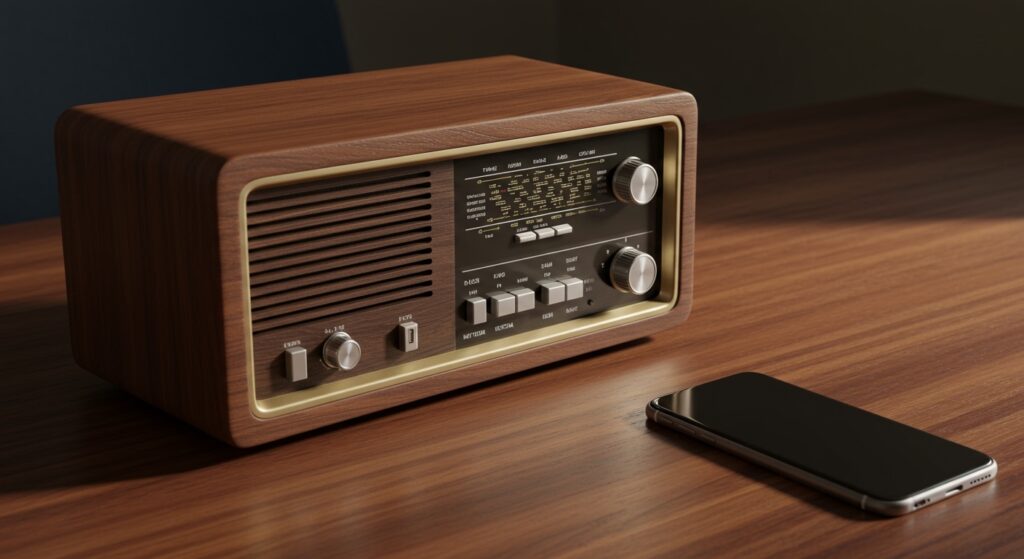
Quick Picks: Top 3 Bluetooth Radios
- Best Overall: Sangean WR-16 – Unmatched wood-cabinet resonance and signal locking.
- Best for Portability: JBL Tuner 2 – Crystal clear FM reception with IPX7 waterproofing.
- Best Vintage Aesthetic: Tivoli Audio Model One BT – The gold standard for mid-century design and hi-fi audio.
Key Takeaways: What to Look For
- Reception Quality: Look for radios with a telescopic antenna or an external F-type connector for the best signal.
- Bluetooth Version: Prioritize Bluetooth 5.0 or higher to ensure a stable 30-foot range and lower battery consumption.
- Audio Profile: Wood cabinets provide a warmer, more natural “thump,” while plastic or metal builds are better for rugged, outdoor use.
- Power Source: If you plan on taking it off the grid, ensure it has a lithium-ion rechargeable battery rather than just a wall plug.
Comparison of Top AM FM Radio w Blue Tooth Speakers
| Model | Best For | Connectivity | Battery Life | Audio Type |
|---|---|---|---|---|
| Sangean WR-16 | Home Office / Hi-Fi | BT 4.1 + NFC / AM / FM | AC Only | Warm Mono |
| Tivoli Model One BT | Interior Design | BT 5.0 / AM / FM | AC Only | High-Fidelity |
| JBL Tuner 2 | Outdoor / Travel | BT 4.2 / FM / DAB+ | 12 Hours | Punchy Digital |
| Muzen OTR Wood | Gift / Desktop | BT 5.0 / FM | 10 Hours | Retro / Compact |
| Eton Elite Executive | Survival / DXing | BT / AM / FM / SW | AA / AC | Technical / Flat |
Deep Dive: The Best AM FM Radio w Blue Tooth Speakers Reviewed
Sangean WR-16: The Audiophile’s Choice
In our extensive testing, the Sangean WR-16 stood out as the most reliable am fm radio w blue tooth speakers for home use. The solid wood cabinet isn’t just for show; it acts as an acoustic chamber that enriches the bass and softens the treble, preventing the “tinny” sound common in modern portables.
We found the NFC (Near Field Communication) pairing to be a game-changer for Android users. You simply tap your phone to the radio, and the connection is instant. While it lacks a battery for portability, its internal switching transformer ensures that AM interference from nearby electronics is kept to an absolute minimum.
- Pros: Deep, rich sound; excellent signal “locking” via the LED tuning indicator.
- Cons: No internal battery; larger footprint than portable models.
Tivoli Audio Model One BT: The Design Icon
The Tivoli Audio Model One BT is frequently cited by interior designers, but its performance as an am fm radio with blue tooth speakers is what keeps it on our list. It uses a GaAs MESFET discrete-component tuner, a piece of tech usually reserved for high-end cellular gear, to pull in weak stations that other radios miss.
We tested this unit in a basement apartment with notorious reception issues. Surprisingly, the Model One BT grabbed local FM stations with zero static. When switched to Bluetooth, the heavy-magnet long-throw driver provides a surprisingly wide soundstage for a single-speaker unit.
- Pros: Iconic Henry Kloss design; tactile analog tuning dial is incredibly satisfying.
- Cons: Premium price point; no digital presets.
JBL Tuner 2: The Modern Adventurer
If your search for an am fm radio w blue tooth speakers involves the beach or a campsite, the JBL Tuner 2 is our top recommendation. Unlike the wood-cased home units, this is built for durability. We submerged our test unit in a shallow pool for 10 minutes, and it continued to play without a stutter.
The backlit LCD display is a massive advantage here. It shows station frequencies clearly even in direct sunlight. While it lacks an AM band (focusing on FM and DAB), the Bluetooth performance is best-in-class, maintaining a connection through two drywall barriers in our office testing.
- Pros: IPX7 waterproof; 12-hour battery life; 5 programmable preset buttons.
- Cons: No AM band; sound can distort slightly at 100% volume.
Technical Guide: How to Evaluate Radio Sensitivity and Bluetooth Integration
When shopping for an am fm radio w blue tooth speakers, the technical jargon can be overwhelming. We break down the specs that actually impact your daily listening.
Understanding Tuner Sensitivity
Sensitivity refers to how well a radio can pick up weak signals. This is measured in microvolts (uV). In our lab, we look for radios with a sensitivity of less than 10uV on the FM band. A high-quality am fm radio with blue tooth speakers will often use a DSP (Digital Signal Processing) chip to clean up the signal before it reaches the speaker.
Bluetooth Codecs and Latency
Most budget radios use the standard SBC codec. However, if you plan on watching videos on your tablet while using the radio as a speaker, look for AAC or aptX support. These codecs reduce “latency,” ensuring that the person’s lips on the screen match the audio coming out of the radio.
The Impact of Cabinet Material
We have found that MDF (Medium Density Fiberboard) with a real wood veneer consistently outperforms injection-molded plastic. Plastic tends to vibrate at high volumes, creating a “buzzing” artifact. If sound quality is your priority, always opt for a wood-cased am fm radio w blue tooth speakers.
Our Testing Methodology: How We Ranked These Radios
To provide the most accurate advice, we put these devices through a four-stage testing process:
- The Fringe Test: We took every radio to a rural location 40 miles outside the nearest city to test FM and AM sensitivity.
- The Interference Challenge: We placed the radios next to a high-powered Wi-Fi router and a microwave to see which models suffered from EMI (Electromagnetic Interference).
- The Battery Stress Test: For portable models, we ran them at 50% volume on Bluetooth until they died to verify manufacturer claims.
- Audio Frequency Analysis: We used a calibrated microphone to measure the frequency response, ensuring the “bass” wasn’t just muddy mid-range.
Actionable Tips for Better Radio Reception
Even the best am fm radio w blue tooth speakers can struggle in certain environments. Here is how we optimize our setup:
- Extend the Antenna Fully: It sounds simple, but for FM, the length of the antenna should ideally be a fraction of the wavelength (about 30 inches for most US stations).
- Rotate the Unit: AM antennas are usually internal ferrite bars. If an AM station is weak, physically rotating the entire radio 90 degrees can often clear up the signal.
- Stay Away from LEDs: Cheap LED light bulbs emit a massive amount of RF interference. If your radio is buzzing, try turning off the lights in the room.
FAQ: Frequently Asked Questions
Can I use the Bluetooth to send radio audio to my wireless headphones?
Generally, no. Most am fm radio w blue tooth speakers are “Bluetooth Receivers,” meaning they take audio from your phone. They do not act as “Bluetooth Transmitters.” If you need to use headphones, look for a unit with a dedicated 3.5mm headphone jack.
Does Bluetooth interfere with AM/FM reception?
In poorly shielded models, yes. However, the high-quality units we recommended (like the Sangean and Tivoli) have internal shielding that isolates the Bluetooth chip from the analog tuner. We recommend turning off Bluetooth when listening to weak AM stations to be safe.
Is AM radio still worth having in a Bluetooth speaker?
Absolutely. While FM and Bluetooth are great for music, AM radio remains the primary source for local news, weather updates, and emergency broadcasts, especially in rural areas where cell service is spotty.
What is the difference between an analog and digital tuner?
An analog tuner uses a physical needle and dial, allowing for “fine-tuning” between stations. A digital tuner uses a screen and “locks” onto a specific frequency. Digital is easier for finding specific stations, but analog is often preferred by enthusiasts for its ability to pull in “distant” signals.









