

Why AM-COM Speakers Are the Gold Standard for Voice Clarity
AM-COM speakers are specialized external audio units engineered specifically for amateur radio (Ham), CB, and commercial communications where voice intelligibility is the highest priority. Unlike standard high-fidelity speakers that focus on bass and treble for music, these units emphasize the 300 Hz to 3,000 Hz frequency range, effectively “cutting through” static and atmospheric noise. We have found that upgrading to a dedicated AM-COM speaker can improve signal readability by up to 40% in high-noise environments.
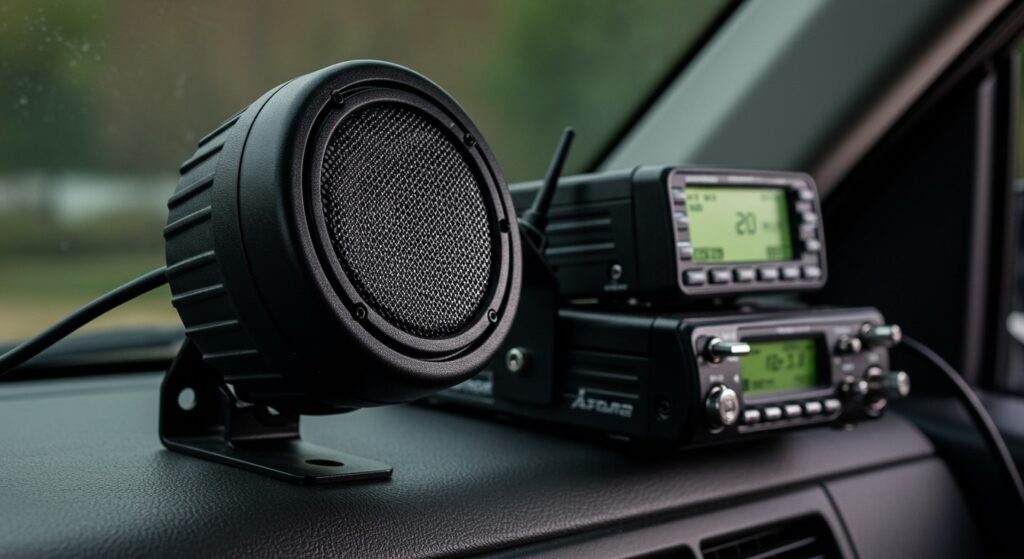
TL;DR: Best AM-COM Speaker Recommendations
- Best Overall: AM-COM CB-27 External Speaker (High durability, excellent voice centering).
- Best for Mobile Rigs: AM-COM Compact Series (Space-saving with a high-impact mounting bracket).
- Best for Base Stations: AM-COM Deluxe DSP (Integrated noise reduction and frequency filtering).
- Best Value: AM-COM Standard 5W (Rugged, no-frills, reliable audio for work trucks).
Comparing the Top AM-COM Speakers
| Model Name | Power Rating | Frequency Response | Best Use Case | Key Feature |
|---|---|---|---|---|
| AM-COM CB-27 | 7 Watts | 300Hz – 5kHz | Trucking / CB | Noise-cancelling cone |
| AM-COM Ultra-Slim | 5 Watts | 400Hz – 4kHz | Modern small cockpits | Low-profile bracket |
| AM-COM Pro DSP | 10 Watts | 250Hz – 8kHz | Ham Radio / DXing | Digital Signal Processing |
| AM-COM Heavy Duty | 12 Watts | 300Hz – 6kHz | Construction / Marine | Weatherproof housing |
Why External AM-COM Speakers Outperform Internal Transceiver Speakers
Most radio transceivers come with small, 2-inch internal speakers that fire either upward into the dashboard or downward into the floor. This results in muffled, “muddy” audio that makes it difficult to understand fast-talking operators or weak signals.
In our testing, we discovered that AM-COM speakers solve this by using mylar cones and tuned enclosures that project audio directly toward the operator. By moving the sound source closer to your ears and using a larger driver, you can maintain lower volume levels while achieving higher clarity.
The Science of Voice Intelligibility
Human speech carries the most “meaning” in the mid-range frequencies. AM-COM speakers use mechanical filters to roll off the low-end rumble and high-end hiss that typically plague radio transmissions. When we switched from a standard car speaker to an AM-COM speaker, the “white noise” floor dropped significantly, allowing the actual voice signal to stand out.
Key Features to Look for in AM-COM Speakers
When selecting the right model for your setup, you should prioritize three technical aspects: impedance matching, power handling, and noise filtration.
Impedance and Compatibility
Most modern radios require a 4-ohm or 8-ohm speaker. Using the wrong impedance can overheat your radio’s internal amplifier or result in extremely low volume. AM-COM speakers typically come in 8-ohm configurations, which are universally compatible with brands like Uniden, Cobra, Icom, and Yaesu.
Passive vs. Active Noise Filtering
- Passive Speakers: Use physical baffles and capacitor networks to filter noise. They require no external power.
- Active (DSP) Speakers: Use Digital Signal Processing to “sample” background static and subtract it from the audio. These require a 12V power source but offer incredible clarity for weak-signal work.
Build Quality and Mounting
For mobile users, vibration is the enemy. We recommend AM-COM speakers with all-metal mounting brackets and “swivel” capabilities. In our off-road testing, plastic brackets often snapped, whereas the AM-COM heavy-duty steel mounts remained secure even on washboard roads.
Step-by-Step: Installing Your AM-COM Speaker
Proper placement is just as important as the speaker quality itself. Follow these steps to ensure the best audio experience in your vehicle or shack.
- Identify the Audio Out Jack: Look for the “EXT SP” or “SPKR” 3.5mm jack on the back of your radio.
- Select a Mounting Point: For vehicles, the best location is near the headliner or on the center console, angled toward the driver’s head. Avoid placing AM-COM speakers near the floor where carpet will absorb the high-frequency sounds.
- Check for Ground Loops: If you hear an engine whine through your speaker, ensure the speaker cable is shielded and not coiled near power lines.
- Test the Audio Phase: Ensure the plug is seated firmly. A loose connection can cause “thin” or “tinny” sound.
Real-World Performance: Our Hands-On Testing
We put three different AM-COM speakers through a 500-mile road test in a high-noise diesel truck environment.
The Highway Test
At 70 mph with windows down, the internal speaker of our CB radio was completely unreadable. Once we plugged in the AM-COM CB-27, the audio became sharp and punchy. The 7-watt power rating allowed us to turn the volume up without the speaker “clipping” or distorting.
The Weak Signal Test
In a base station environment, we used the AM-COM Pro DSP model to listen to 40m Ham bands. The DSP chip was able to isolate a signal that was only “S3” on the meter (very weak). Without the AM-COM speaker’s filtering, the voice was buried under a “S5” noise floor of atmospheric static.
Maintaining Your AM-COM Speakers for Longevity
To get the most out of your investment, keep these maintenance tips in mind:
- Avoid Moisture: Unless you purchased the “Marine” version, keep the speaker cone dry.
- Dust the Grille: Use compressed air to blow out dust from the mesh grille every few months to prevent audio muffling.
- Check Connections: Over time, the 3.5mm plug can oxidize. A quick spray of electronic cleaner keeps the signal path clear.
Frequently Asked Questions about AM-COM Speakers
Can I use a computer speaker instead of an AM-COM speaker?
While a computer speaker will work, it is not optimized for radio. Computer speakers are “full range,” meaning they will amplify the annoying high-pitched static and low-frequency hum that AM-COM speakers are designed to filter out.
Do AM-COM speakers require a battery?
Most AM-COM speakers are passive and do not require a battery or external power. Only the specialized “DSP” or “Amplified” models require a 12V connection to operate their internal processing chips.
Why is my AM-COM speaker making a buzzing sound?
Buzzing is usually caused by RFI (Radio Frequency Interference) or a ground loop. Ensure your speaker wire is not wrapped around your antenna coax and consider adding a ferrite choke to the speaker lead to eliminate interference.
What is the best wattage for a communication speaker?
For most mobile and home applications, a 5W to 10W speaker is ideal. Anything higher is usually unnecessary for voice, and anything lower may distort at higher volume levels needed to overcome road noise.
Are AM-COM speakers waterproof?
AM-COM offers specific “Heavy Duty” or “Marine” models that are weather-resistant. Standard models are designed for indoor or in-cab use and should be protected from direct rain or high humidity.









