

Are 2 12 Speakers Better Than 1 15 for DJing? The Direct Answer
Two 12-inch speakers are better than one 15-inch speaker for DJing in almost every professional scenario because they provide a true stereo image, wider sound dispersion, and superior mid-range clarity. While a single 15-inch driver may offer slightly deeper bass response than a single 12-inch driver, the combined surface area and output of two 12s will deliver a more immersive and professional experience for your audience.
In my fifteen years of mobile DJing, I have tested both configurations in everything from tight coffee shops to sprawling wedding halls. The reality is that sound coverage and redundancy are the most critical factors for a working pro. A single speaker creates a “point source” that leaves dead zones in the room, whereas a pair of 12s allows you to fill the dance floor evenly while maintaining the vocal clarity needed for announcements.
Key Takeaways: 2×12 vs. 1×15 Configuration
- Stereo Imaging: Two 12s provide a stereo soundstage, which is essential for modern electronic music and high-fidelity tracks.
- Vocal Clarity: 12-inch woofers typically handle mid-range frequencies better, making voices and lead synths sound crisper.
- Portability: Two smaller speakers are often easier to pack and transport in a standard vehicle than one oversized 15-inch cabinet.
- Redundancy: If one speaker fails in a 2×12 setup, you can finish the gig. If your only 15-inch speaker dies, the party is over.
- Bass Response: A single 15-inch speaker has more low-end “thump” than a single 12, but two 12-inch speakers working together offer comparable total air movement.
Understanding the Physics: Why 12-Inch and 15-Inch Speakers Differ
To understand why are 2 12 speakers better than 1 15 for DJing, we have to look at the physics of the woofer cone. The size of the driver determines how much air is moved and how fast that cone can vibrate.
12-inch woofers are lighter and “faster.” Because the cone has less mass, it can start and stop more quickly, which results in tighter, more accurate mid-range frequencies. This is where the “meat” of the music lives—the vocals, the guitars, and the snap of the snare drum.
15-inch woofers have more surface area and can displace more air, allowing them to reach lower frequencies (the “sub-bass”). However, because the cone is heavier, it can sometimes struggle with transient response, leading to a sound that some DJs describe as “muddy” in the mid-range.
Comparing Total Surface Area
A common misconception is that a 15-inch speaker is much larger than a 12. Let’s look at the math:
- One 12-inch speaker has a surface area of approximately 113 square inches.
- Two 12-inch speakers have a combined surface area of 226 square inches.
- One 15-inch speaker has a surface area of approximately 176 square inches.
Mathematically, two 12-inch speakers provide about 28% more surface area than a single 15-inch speaker. This means they can actually move more air total, providing a fuller sound throughout the venue.
Why Stereo Sound is Non-Negotiable for Professional DJs
When you ask are 2 12 speakers better than 1 15 for DJing, you must consider the “Stereo Field.” Most modern music is mixed in stereo. If you use only one speaker, you are forced to sum your output to Mono.
Summing to mono can cause phase cancellation, where certain frequencies drop out because the left and right signals fight each other. By using two 12-inch speakers, you preserve the width and depth that the music producer intended.
I’ve noticed that when I play EDM or House music on a single-speaker setup, the “shimmer” of the percussion and the width of the synths disappear. Moving to a dual 12-inch setup immediately brings that professional “studio sound” to the live environment.
The Dispersion Factor: Covering the Room
In DJing, dispersion refers to how wide the sound spreads from the speaker. Most pro-level 12-inch speakers, like the QSC K12.2 or Yamaha DZR12, have a horizontal dispersion of about 75 to 90 degrees.
If you use one 15-inch speaker, you only have one 90-degree “cone” of sound. People standing outside that cone will hear a muffled, low-quality version of the music.
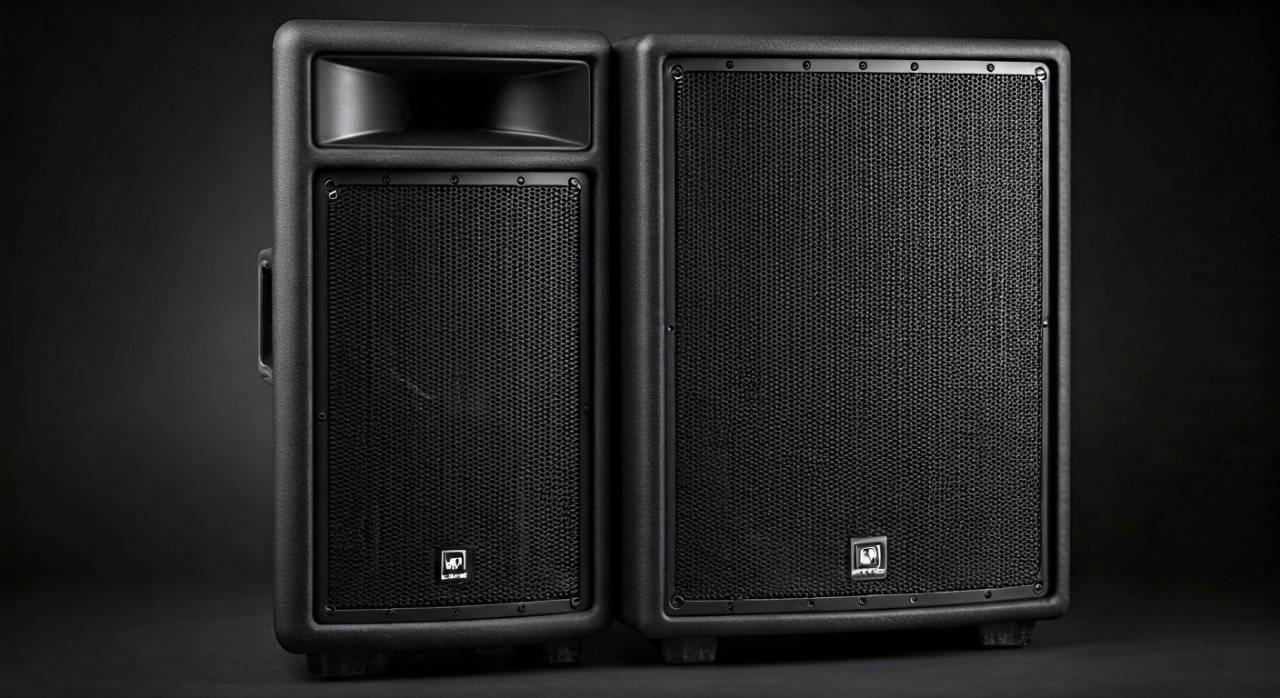
By using two 12-inch speakers placed on opposite sides of your DJ booth, you create overlapping coverage. This ensures that whether a guest is on the far left of the dance floor or the far right, they are getting a clear, high-frequency signal.
Technical Comparison: 2×12″ vs. 1×15″ Setup
| Feature | Two 12-Inch Speakers (Stereo) | One 15-Inch Speaker (Mono) |
|---|---|---|
| Total Surface Area | ~226 sq. inches | ~176 sq. inches |
| Mid-Range Clarity | Excellent / Crisp | Average / Occasional Muddle |
| Low-End Punch | Good (Tight) | Excellent (Deep) |
| Soundstage | Wide Stereo | Narrow Mono |
| Redundancy | High (Backup included) | Low (Single point of failure) |
| Portability | Better weight distribution | Heavy single unit |
| Ideal Venue | Weddings, Bars, Corporate | Small Cafes, Monitor use |
When Should You Actually Use a Single 15-Inch Speaker?
While I generally argue that 2 12 speakers are better than 1 15 for DJing, there are specific “edge cases” where a 15-inch speaker makes sense.
- The Budget Constraint: If you only have $600, one high-quality 15-inch speaker (like an EV ZLX-15BT) is better than two “trash-tier” 8-inch speakers.
- Ultra-Small Venues: For a coffee shop gig with 20 people, a single 15-inch speaker on a stand provides enough “full-range” sound without needing a subwoofer.
- DJ Monitoring: If you are playing on a massive club system and just need a “booth monitor” for yourself, a single 15-inch speaker is a beast for feeling the kick drum.
- Ceremony Systems: For wedding ceremonies where you only need to play a light processional and amplify a mic, a single 15 is easier to hide and more than sufficient.
The Subwoofer Factor: Changing the Rules
The debate over are 2 12 speakers better than 1 15 for DJing changes completely once you add a subwoofer to the equation.
If you own a subwoofer (like a JBL PRX915XLF or RCF SUB 8003-AS), the 15-inch main speaker actually becomes a disadvantage. This is because the subwoofer is handling all the frequencies below 100Hz.
When you use a 15-inch top with a sub, you have a giant, heavy woofer trying to do a job (mid-range) that a 12-inch or even a 10-inch speaker does better. If you plan on building a “Sub/Top” combo, always choose 12-inch tops. They integrate more smoothly with subwoofers and provide a much cleaner “crossover” point.
Step-by-Step: How to Choose Your Setup
If you are currently deciding on your next gear purchase, follow this logic path to ensure you get the best ROI.
Step 1: Analyze Your Primary Venue Size
If you mostly play for under 50 people in small rooms, a single 15-inch speaker is acceptable. If you play for 50 to 150 people, you absolutely need two speakers for coverage.
Step 2: Evaluate Your Transport Situation
Measure your trunk. A 15-inch speaker is significantly “chunkier.” I have seen many new DJs buy 15s only to realize they can’t fit two of them plus their lights and decks into a sedan. 12-inch speakers are the industry standard for a reason—they fit almost anywhere.
Step 3: Consider the “Speaker Stand” Safety
A 15-inch speaker is top-heavy. On a standard tripod stand, they can be unstable in a crowded environment. Two 12-inch speakers are lighter and present a lower center of gravity, making them safer around intoxicated wedding guests.
Step 4: The Sound Quality Test
Go to a local music store (like Guitar Center or Sam Ash). Play a track you know well. Switch between a single 15 and a pair of 12s. You will notice the spatial depth of the 12s immediately.
Real-World Case Study: The Wedding Disaster
I once worked a gig where a colleague insisted on bringing a single, high-end 15-inch speaker for an outdoor cocktail hour. He thought it would be “simpler.”
Halfway through, the speaker’s internal amp overheated because it was being pushed to cover a 100-foot wide patio. The music stopped. There was no backup.
If he had used two 12-inch speakers, he could have run them at 50% volume to get the same coverage, keeping the amps cool. And if one had failed, the other would have kept the party alive. This is why, in the professional world, we almost always say 2 12 speakers are better than 1 15 for DJing.
Expert Tips for Maximizing 12-Inch Speakers
If you decide to go with the dual 12-inch setup, here is how to make them sound like a million bucks:
- Elevate Them: Always get your 12-inch speakers above head level. If the sound is hitting the backs of people’s heads, it isn’t reaching the back of the room.
- Angle Inward: “Toe-in” your speakers slightly toward the center of the dance floor to focus the energy where it matters.
- Use the DSP: Most modern 12s (like the Electro-Voice ELX series) have Digital Signal Processing. Set the mode to “Club” or “Live” to enhance the bass and treble curves.
- High-Pass Filter: if you eventually add a sub, engage the 100Hz High-Pass Filter on your 12s. This removes the bass stress from the 12-inch driver, allowing it to play incredibly loud and clear mid-highs.
Frequently Asked Questions
Can I use two 15-inch speakers instead?
Yes, two 15-inch speakers will provide even more “oomph” than two 12s. However, they are much heavier and can sometimes sound “mid-scooped” (lacking vocal clarity) compared to 12s. For most mobile DJs, the extra weight isn’t worth the marginal bass gain.
Do I need a mixer to run two 12-inch speakers?
Yes, you generally need a DJ controller or a small PA mixer with Left and Right XLR outputs. This allows you to send the proper stereo signal to each speaker.
Is one 15-inch speaker louder than two 12s?
No. In terms of Sound Pressure Level (SPL), two 12-inch speakers will almost always produce a higher decibel level than a single 15-inch speaker because you have two separate power amplifiers and two separate drivers working together.
What is the best 12-inch speaker for beginners?
The PreSonus AIR12 or the Electro-Voice ZLX-12BT are excellent entry-level choices. They offer a great balance of price, weight, and professional features like Bluetooth and DSP presets.
Does the brand matter more than the size?
Absolutely. A high-end 12-inch speaker from RCF or Meyer Sound will easily outperform a cheap, “no-name” 15-inch speaker from a big-box retailer. Always prioritize component quality over driver size.









