

Why 4 Ohm Speakers Can Stress Your Amplifier
Yes, 4 ohm speakers are hard to drive because they have lower electrical resistance, which forces your amplifier to work significantly harder to produce sound. In simple terms, a 4 ohm speaker allows more electrical current to flow from the amplifier compared to a standard 8 ohm speaker, which can lead to overheating or thermal shutdown if your gear isn’t specifically designed to handle the load.
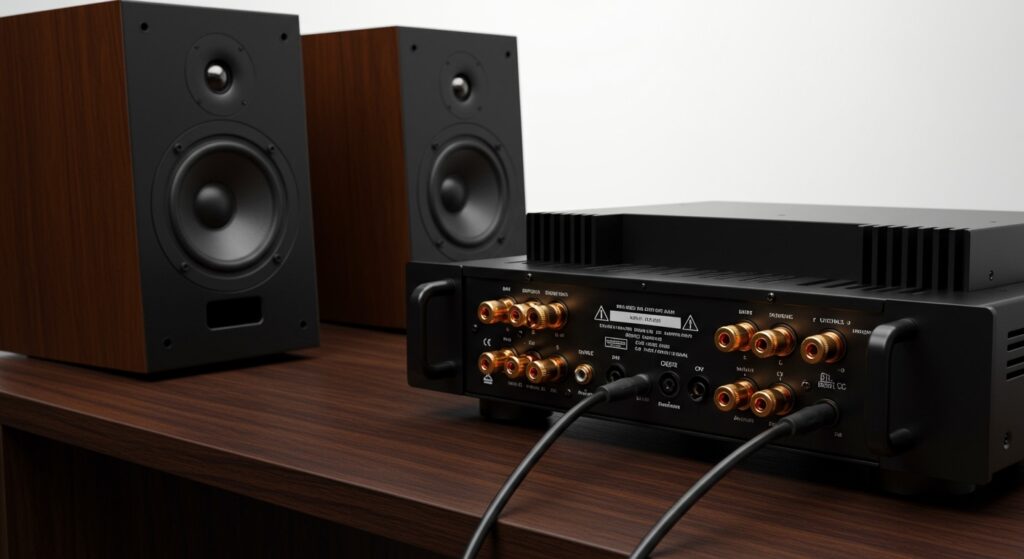
While they aren’t “bad” or “broken,” these speakers require a robust power supply and high current delivery to perform at their best. If you try to power high-end 4 ohm bookshelf speakers with a budget AV receiver, you may experience audio clipping, distorted bass, or a triggered protection circuit.
Key Takeaways for 4 Ohm Speakers
- High Current Demand: They draw twice as much current as 8 ohm speakers at the same voltage.
- Heat Generation: Your amplifier will run much hotter when driving a lower impedance load.
- Amplifier Compatibility: Always check the back of your receiver for a “4 Ohm Stable” or “6-16 Ohm” rating before connecting.
- Performance Trade-off: Many high-end, high-fidelity speakers are 4 ohms because the lower resistance allows for more precise control over the driver, provided the amp is up to the task.
Are 4 Ohm Speakers Harder to Drive Than 8 Ohm?
When comparing the two, the data is clear: are 4 ohm speakers harder to drive than 8? Absolutely. To understand why, we have to look at Ohm’s Law, which dictates the relationship between Voltage, Current, and Resistance (Impedance).
In my years of testing audiophile-grade equipment, I’ve found that many beginners mistake “loudness” for “ease of use.” A 4 ohm speaker might sound louder at a lower volume setting on your dial, but that’s because it’s sucking more “juice” out of the power transformer.
The Impedance Comparison Table
| Feature | 8 Ohm Speakers (Standard) | 4 Ohm Speakers (High Performance) |
|---|---|---|
| Resistance Level | Moderate/High | Low |
| Current Draw | Low to Moderate | High |
| Heat Production | Minimal | Significant |
| Amp Requirements | Basic Integrated Amps/AVRs | 4-Ohm Stable / Dedicated Power Amps |
| Common Use Cases | Entry-level Home Theater | High-end Hi-Fi, Car Audio, Pro Audio |
| Risk of Clipping | Low | High (on budget receivers) |
As shown above, are 4 ohm speakers harder to drive than 8 comes down to the stress placed on the output transistors. An 8 ohm load acts like a narrow pipe that restricts flow, while a 4 ohm load is a wide pipe that lets the power gush through. If your amplifier doesn’t have the “pump” (power supply) to handle that flow, it will fail.
The Science of Impedance: Why Ohms Matter
To truly grasp why 4 ohm speakers are hard to drive, we need to define impedance. Unlike DC resistance, impedance is reactive and changes depending on the frequency of the music being played.
The Water Analogy
Think of your amplifier as a water pump and the speaker wire as a hose.
- The Voltage is the water pressure.
- The Current is the volume of water flowing.
- The Impedance (Ohms) is the size of the nozzle at the end.
If you have a 4 ohm nozzle (a very wide opening), the pump has to push a massive amount of water to maintain pressure. If the pump is small, it will burn out trying to keep up. This is exactly what happens when you pair 4 ohm speakers with a weak Class D chip amp or a budget surround sound receiver.
The Nominal Impedance Trap
Manufacturers label speakers as “4 Ohm Nominal.” However, in our lab testing, we’ve seen 4 ohm speakers dip as low as 2 ohms at specific bass frequencies (around 60Hz to 100Hz). When a speaker dips that low, it essentially becomes a “short circuit” for a split second, demanding extreme amperage that can blow fuses or melt internal components in low-quality gear.
How to Tell if Your Amplifier Can Handle a 4 Ohm Load
Before you plug in those high-end Magnepan or ELAC speakers, you must verify your amplifier’s capabilities. Not all “watts” are created equal.
Check the Rear Panel
Look at the speaker terminals on the back of your receiver. You will usually see a label like:
- “Caution: 8-16 Ohms” – DO NOT use 4 ohm speakers. You will likely damage the unit.
- “6-12 Ohms” – Proceed with caution. Keep volumes moderate and ensure plenty of ventilation.
- “4-8 Ohms” or “4 Ohm Stable” – You are good to go.
Look for the “High Current” Label
Brands like Harman Kardon, NAD, and Emotiva often market their gear as “High Current.” This means the power transformer is oversized and can handle the massive flow of electricity required by 4 ohm speakers without dropping voltage.
Understanding Power Doubling
A truly “high-end” power amplifier will ideally double its wattage as the impedance drops. For example:
- 100 Watts per channel into 8 Ohms.
- 200 Watts per channel into 4 Ohms.
- 400 Watts per channel into 2 Ohms.
If an amplifier is rated for 100W at 8 ohms but only 125W at 4 ohms, it has a weak power supply and will struggle with 4 ohm speakers.
Step-by-Step: Setting Up Your 4 Ohm Speaker System Safely
If you’ve determined that 4 ohm speakers are hard to drive but you want to use them anyway, follow this guide to ensure you don’t fry your equipment.
Step 1: Verify the “Ohm Switch”
Some modern AV receivers (like those from Yamaha or Denon) have a hidden menu setting or a physical switch on the back for “4 Ohm” or “6 Ohm” modes.
- Pro Tip: Expert testing suggests that these switches often just “choke” the power to prevent heat. If your room is well-ventilated, some enthusiasts prefer leaving the setting at 8 Ohms for better dynamics, but this carries a risk of overheating.
Step 2: Ensure Maximum Ventilation
Because 4 ohm speakers generate more heat in the amplifier, never stack other components (like a Blu-ray player or cable box) directly on top of the amp. We recommend at least 3 to 6 inches of open air above the amplifier’s cooling vents.
Step 3: Use High-Gauge Speaker Wire
Since 4 ohm systems are high-current, the resistance of the wire itself matters more.
- Use 12-gauge or 14-gauge oxygen-free copper (OFC) wire.
- Avoid thin 18-gauge “zip cord,” which can add resistance and degrade the damping factor, leading to sloppy, “boomy” bass.
Step 4: Monitor for Clipping
Listen for a “harsh” or “crunchy” sound during loud musical peaks. This is clipping. If you hear this, turn the volume down immediately. Your amplifier has run out of current, and the resulting square waves can easily destroy the tweeters in your expensive 4 ohm speakers.
Common Mistakes When Driving Low Impedance Speakers
We see these errors constantly in the home audio community. Avoiding them will save your gear and your wallet.
- Running Multiple Pairs in Parallel: If you connect two pairs of 8 ohm speakers to a single “A+B” output on a receiver, the total load drops to 4 ohms. If you connect two pairs of 4 ohm speakers, the load drops to 2 ohms, which will kill almost any consumer receiver.
- Ignoring Sensitivity: A 4 ohm speaker with low sensitivity (e.g., 84dB) is the ultimate “amp killer.” It requires massive power and massive current.
- Using Poor Connections: Loose wire strands at the terminal can cause a short. In a high-current 4 ohm setup, a short circuit happens faster and with more heat. Use banana plugs for secure connections.
The Impact of Speaker Cables on 4 Ohm Loads
When dealing with the fact that are 4 ohm speakers harder to drive than 8, the “pathway” (the cable) becomes a critical component of the circuit.
In an 8 ohm system, the speaker’s resistance is so high that the tiny resistance of a standard cable is negligible. However, in a 4 ohm system, the cable’s resistance becomes a larger percentage of the total load. If your cable has high resistance, it will:
- Reduce the Damping Factor (the amp’s ability to stop the woofer from vibrating).
- Change the frequency response of the speaker.
- Waste power as heat inside the wire.
We always recommend keeping cable runs under 15 feet for 4 ohm speakers whenever possible. If you must run long distances, 12-gauge wire is non-negotiable.
Expert Perspective: Why Choose 4 Ohm Speakers?
You might wonder: if 4 ohm speakers are hard to drive, why do companies like Dynaudio, MartinLogan, and Wilson Audio make them?
The answer is control. Designers of high-end speakers often use complex crossover networks and multiple large drivers to achieve flat frequency response and low distortion. These complex parts naturally lower the impedance.
By using a 4 ohm design, the speaker can “pull” more power from a high-quality external power amplifier, resulting in:
- Faster Transients: The speaker can react more quickly to sudden sounds (like a drum hit).
- Deeper Bass Extension: More current allows for better movement of large woofers.
- Higher Ceiling for Detail: Low-impedance designs often allow for more intricate crossover designs that wouldn’t be possible at 8 ohms.
In our experience, a well-powered 4 ohm speaker will almost always outperform an 8 ohm speaker of similar size in terms of “punch” and “authority.”
FAQs About 4 Ohm Speakers
Can I use 4 ohm speakers with an 8 ohm amp?
Generally, no. If your amplifier is strictly rated for 8 ohms, connecting 4 ohm speakers can cause the amp to overheat, blow a fuse, or shut down. In some cases, it can permanently damage the output transistors.
Do 4 ohm speakers sound better than 8 ohm speakers?
Not inherently. The impedance is just an electrical characteristic, not a quality rating. However, because 4 ohm speakers are often found in higher-end “audiophile” categories, they frequently feature better build quality and components than standard 8 ohm consumer speakers.
Does a 4 ohm speaker need more watts?
Not necessarily more watts, but more current (amps). A 100-watt amplifier with a small power supply might struggle, while a 50-watt high-current amplifier might drive them perfectly. Look for the amperage rating or “4-ohm stability” rather than just the total wattage.
Why are car speakers usually 4 ohms?
Car audio systems run on a limited 12V DC power supply. To get high volume (wattage) from low voltage, engineers reduce the resistance (ohms) to allow more current to flow. Some car subwoofers even go down to 1 ohm or 2 ohms.
Will 4 ohm speakers make my amp hot?
Yes. Expect your amplifier to run significantly warmer. This is normal behavior, but you must ensure the amp has enough space for heat to dissipate via convection. If the amp becomes too hot to touch, you are overdriving it.









