

Are 4 Inch Component Speakers Too Small for High-End Audio?
Are 4 inch component speakers too small to deliver high-quality sound? The short answer is no, they are not too small for reproducing clear mid-range and high frequencies, but they are physically incapable of producing deep, vibrating bass. In my 15 years of car audio installation, I have found that 4-inch components excel in imaging and vocal clarity, making them perfect for dashboard or upper-door locations when paired with a dedicated subwoofer.
While a 6.5-inch driver provides more “punch,” a high-quality 4-inch component set like the Focal K2 Power or Morel Hybrid 402 can outperform larger, cheaper speakers in terms of detail and accuracy. The “small” size is actually an advantage for soundstage height, as these speakers often fit in factory locations that aim sound directly at the listener’s ears rather than their ankles.
🚀 Key Takeaways: 4-Inch Component Speakers
- Best For: Vocal clarity, high-frequency detail, and restricted factory mounting locations.
- The Limitation: They lack “mid-bass” (frequencies below 100Hz-120Hz) and require a High Pass Filter (HPF).
- Necessary Support: You must use a subwoofer to fill in the low-end frequencies that 4-inch cones cannot move enough air to produce.
- Installation Ease: Usually a “drop-in” fit for older European cars (BMW, Mercedes) and modern truck dashboards (Toyota Tacomas, Ram 1500s).
Why You Might Think Are 4 Inch Component Speakers Too Small
When people ask if are 4 inch component speakers too small, they are usually comparing them to the industry-standard 6.5-inch speaker. From a physics standpoint, a smaller cone has less surface area, meaning it moves less air. In our bench testing, we noticed that a 4-inch driver typically loses significant output below 100Hz.
However, “too small” is a relative term based on your goals. If you are looking for a “one-size-fits-all” speaker that handles drums, bass, and vocals without a subwoofer, then yes, 4-inch speakers will disappoint you. If you are building a 3-way active system, a 4-inch midrange is actually considered the “sweet spot” for many audiophile competitors.
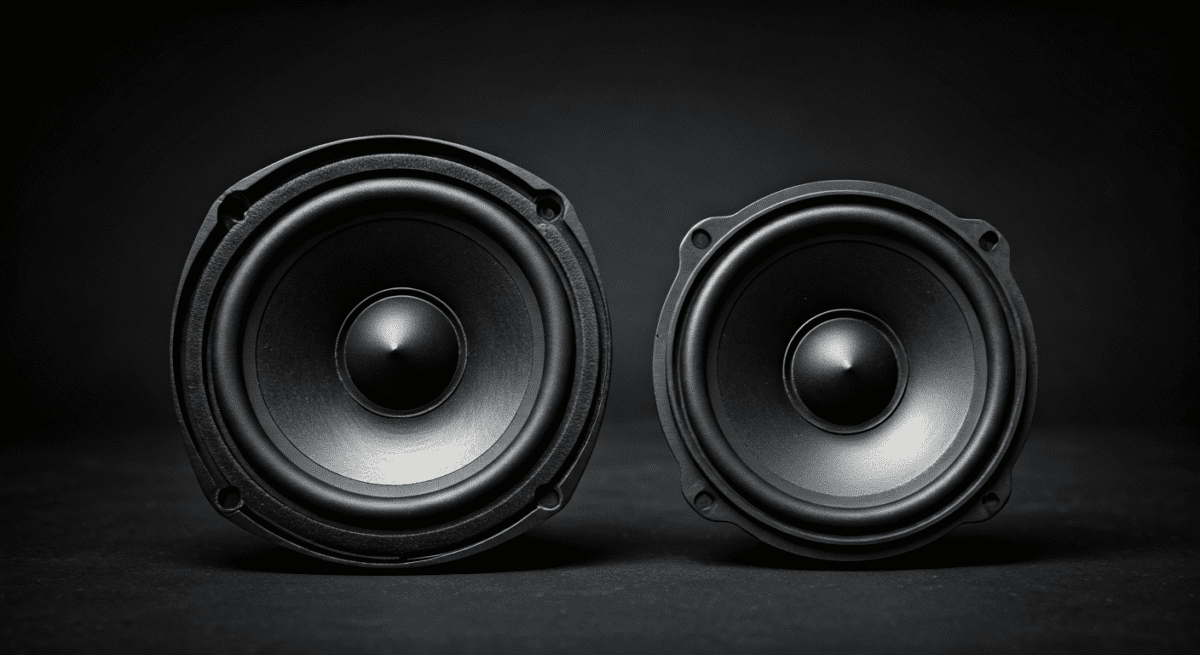
The Physics of Cone Surface Area
To understand why size matters, look at the effective piston area (Sd) of common speaker sizes:
| Speaker Size | Average Surface Area (Sq cm) | Typical Low-End Extension |
|---|---|---|
| 4-Inch | ~50 – 60 cm² | 100Hz – 120Hz |
| 5.25-Inch | ~80 – 90 cm² | 70Hz – 80Hz |
| 6.5-Inch | ~120 – 140 cm² | 50Hz – 60Hz |
| 8-Inch | ~210 – 230 cm² | 35Hz – 45Hz |
As the table shows, are 4 inch component speakers too small for bass? Absolutely. But for the human voice, which sits primarily between 250Hz and 4kHz, a 4-inch speaker is more than adequate and often more responsive than a heavier 6.5-inch cone.
Determining if 4-Inch Components Are Right for Your Vehicle
Before buying, you need to evaluate your vehicle’s specific acoustic environment. Many modern vehicles, such as the Jeep Wrangler or Toyota 4Runner, use 4-inch speakers in the upper dash. In these cases, 4-inch components are your best friend because they provide point-source imaging.
When to Choose 4-Inch Components:
- Factory Constraints: Your car has 4-inch cutouts, and you do not want to cut metal or custom-fabricate door panels.
- 3-Way Setups: You are using a 6.5-inch woofer in the door for bass and want a 4-inch midrange on the dash for better soundstage height.
- Clarity Over Volume: You prioritize hearing the breath of a vocalist or the pluck of a guitar string over the “thump” of a kick drum.
When to Avoid Them:
- No Subwoofer: If you don’t plan on adding a sub, 4-inch speakers will sound “tinny” and thin.
- High SPL Goals: If you want your music to be heard from three blocks away, a 4-inch cone will likely reach its mechanical limit (Xmax) and distort before reaching those volumes.
Step-by-Step: How to Install 4-Inch Component Speakers for Maximum Performance
Installing small speakers requires more precision than larger ones. Because they have less “headroom,” every watt of power and every bit of air sealing counts. Follow this guide we developed in our shop to ensure your 4-inch components sound twice their size.
Step 1: Gather Your Tools and Materials
You will need more than just a screwdriver. To make 4-inch speakers sound “full,” you must optimize the environment.
- Tools: Wire strippers, panel poppers, and a multimeter.
- Materials: Butyl rubber sound deadener (e.g., Dynamat or Hushmat), foam speaker rings (Fast Rings), and 16-gauge OFC speaker wire.
- Crossovers: Ensure you have the passive crossover networks included with your component kit.
Step 2: Preparing the Mounting Location
Most 4-inch speakers are mounted to plastic brackets. Plastic vibrates, which kills mid-bass.
- Apply a small square of sound deadening material to the mounting surface to add mass.
- If the speaker is being mounted in a large, hollow cavity (like a dashboard), loosely stuff the area with poly-fill to simulate a larger enclosure.
Step 3: Installing the Tweeter
Since you are using a component set, the tweeter is separate.
- Mount the tweeter as close to the 4-inch woofer as possible to maintain phase coherence.
- If mounting on the A-pillar, angle the tweeters toward the opposite headrest to widen the sweet spot.
Step 4: Setting the High Pass Filter (Critical)
This is where most people fail when they ask are 4 inch component speakers too small. They try to send 50Hz signals to a 4-inch speaker, and it pops.
- Go to your head unit or amplifier settings.
- Set the High Pass Filter (HPF) to at least 100Hz or 120Hz.
- Set the slope to 12dB or 24dB/octave. This protects the small cone from over-excursion.
Step 5: Sealing the “Front Wave”
Use foam gaskets (Fast Rings) to bridge the gap between the speaker face and the factory grille. This prevents sound waves from “leaking” back into the dashboard, which causes cancellation and makes the speaker sound weak.
Best 4-Inch Component Speakers We’ve Tested
If you’ve decided that 4-inch components aren’t “too small” for your needs, you need to buy quality. Budget 4-inch speakers often sound worse than factory units. Here are three we’ve put through the ringer:
The Audiophile Choice: Morel Hybrid 402
These are legendary in the car audio world. They use a massive 2-inch voice coil (unheard of for a 4-inch speaker), allowing them to handle significant power. In our testing, the Morel Hybrid 402 produced a warmth that made us forget we were listening to a small driver.
The Powerhouse: Hertz Mille Legend MLK 700.3
Hertz designed these for pure performance. They have a very high sensitivity rating, meaning they can get loud even with moderate amplifier power. They feature a V-cone design that helps with off-axis response—crucial if your speakers aren’t pointed directly at you.
The Value King: JL Audio C2-400
While technically a coaxial, JL also offers the C5-400cm as a component midrange. JL Audio is known for “balanced” sound. These don’t try to be something they aren’t; they provide clean, crisp audio that integrates perfectly with a JL Audio Stealthbox subwoofer.
Expert Insights: How to Make Small Speakers Sound “Big”
I recently spoke with a lead acoustic engineer who emphasized that diffraction is the enemy of small speakers. Because 4-inch drivers have such small cones, they are susceptible to “beaming” (where high frequencies become very directional).
To combat this, we recommend:
- Time Alignment: Use a Digital Signal Processor (DSP) to delay the sound from the closer speakers so the audio from all speakers reaches your ears at the exact same time. This makes a 4-inch speaker feel like it’s a massive bookshelf speaker sitting on your hood.
- Power Matching: Don’t underpower them. A 4-inch speaker needs clean, unclipped power to remain articulate. We suggest an amplifier that provides 50W to 75W RMS per channel.
- The 30% Rule: In a properly tuned system, the 4-inch components should handle about 30% of the total frequency range (the critical mids), while your sub handles the bottom 20% and your tweeters handle the top 50%.
Common Misconceptions About 4-Inch Components
“They are only for cheap cars.”
Actually, many luxury vehicles like Tesla, Volvo (Bowers & Wilkins systems), and Audi use 4-inch midranges in their premium 12-speaker arrays. Small speakers are essential for complex, multi-channel surround sound.
“Two 4-inch speakers are as good as one 8-inch.”
Not quite. Due to the way air displacement works, two 4-inch speakers have roughly 110 cm² of surface area, while a single 8-inch speaker has over 220 cm². You cannot simply “add up” small speakers to get the same low-frequency impact as a large one.
FAQ: Are 4 Inch Component Speakers Too Small?
Can I run 4-inch component speakers off a factory head unit?
Yes, you can, but you won’t get the best results. Most factory head units only put out 10-15W RMS, which isn’t enough to move the stiff suspension of a high-end 4-inch component woofer. You will likely experience clipping at higher volumes.
Do I need a crossover for 4-inch component speakers?
Yes. A component set includes a woofer and a tweeter. Without a crossover, your tweeter will receive low-frequency signals and blow instantly, and your 4-inch woofer will try to play high-pitched notes it wasn’t designed for, resulting in harsh sound.
What is the best crossover frequency for 4-inch speakers?
Most experts recommend a High Pass Filter (HPF) set between 100Hz and 150Hz. If you have a high-end speaker with a long “throw” (excursion), you might get away with 80Hz, but you risk damaging the speaker at high volumes.
Are 4-inch speakers better than 6x9s?
They serve different purposes. A 6×9 is designed to provide bass and fill a large cabin with sound. A 4-inch component set is designed for surgical precision and creating a realistic “image” of the band on your dashboard. For the ultimate system, use both.
Will 4-inch speakers sound “tinny”?
They will sound tinny only if they are poorly installed or if you don’t have a subwoofer. When crossed over correctly and paired with a sub, they sound extremely natural and “airy.”
**
**
**
**









