

Are 6.5 Inch Speakers Universal? The Short Answer
No, 6.5 inch speakers are not strictly universal, though they are the most common standard in the automotive industry. While most modern vehicles use this size for front and rear door locations, variations in mounting depth, bolt patterns, and frame diameters mean that “one size fits all” is a myth in car audio.
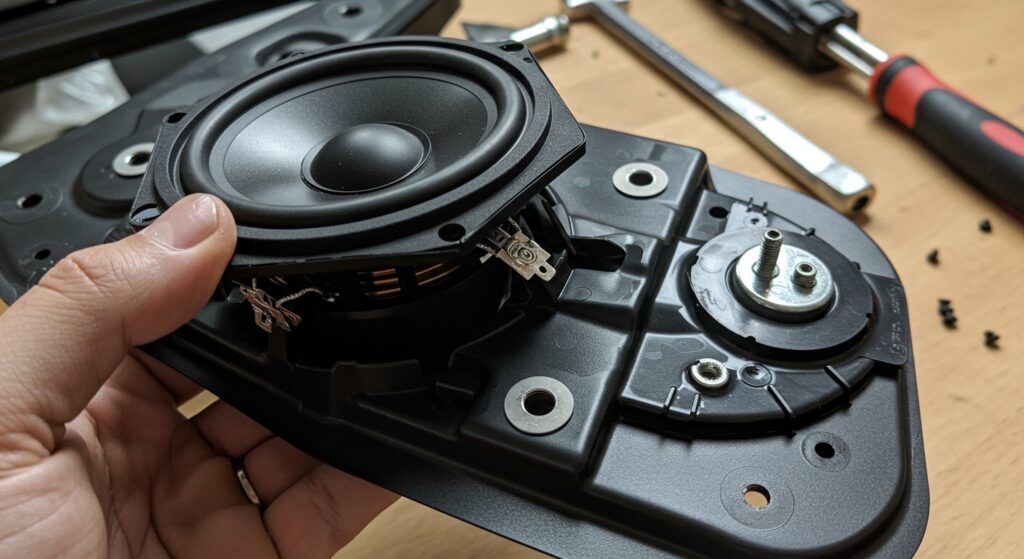
In my years of upgrading factory sound systems, I’ve found that while a speaker might be labeled as 6.5 inches, the actual physical dimensions often vary between brands like JBL, Kicker, and Rockford Fosgate. To ensure a perfect fit, you must account for the specific mounting bracket requirements and the clearance behind the door panel.
TL;DR: Key Takeaways for 6.5 Inch Speakers
- Not Truly Universal: “6.5-inch” is a category, not a precision measurement; actual sizes vary by 0.25 inches.
- Adapter Brackets: Most vehicles require aftermarket mounting brackets to bridge the gap between universal speakers and factory holes.
- Mounting Depth: This is the most critical measurement to prevent your window glass from hitting the speaker magnet.
- 6.75″ Compatibility: Many “oversized” 6.5-inch speakers (often called 6.75″) will fit the same locations with the right adapter.
- Wiring: Factory connectors rarely match aftermarket speakers; you will likely need wiring harnesses.
Understanding the 6.5 Inch Speaker Standard
When manufacturers label a speaker as 6.5 inches, they are referring to the general frame diameter, not the size of the cone itself. In my experience, the actual cone is usually closer to 5.25 or 5.5 inches, with the rest of the space taken up by the surround and the mounting flange.
Why Dimensions Vary Between Brands
Standardization in the car audio world is surprisingly loose. A Rockford Fosgate Punch 6.5-inch speaker might have a slightly wider basket than a Pioneer A-Series. This discrepancy exists because car manufacturers (OEMs) use proprietary mounting points to discourage DIY repairs, forcing the aftermarket industry to create flexible designs.
The Difference Between 6.5″ and 6.75″
You will often see speakers labeled as 6.5S (Slim) or 6.75 (Oversized).
- Standard 6.5″: Fits most 6.5″ openings.
- 6.75″ (Oversized 6.5): These provide more surface area for better bass but often require trimming the factory plastic or using a specific spacer ring.
Critical Fitment Factors: Beyond the Diameter
If you are wondering are 6.5 inch speakers universal, you must look at three technical specifications that determine whether the speaker will actually function in your door.
Mounting Depth
This is the distance from the mounting flange to the bottom of the magnet. If the mounting depth is too deep, your window will strike the magnet when you roll it down. I always recommend measuring the distance from the door metal to the window track before buying.
Tweeter Protrusion
In coaxial speakers, the tweeter sits in the center of the woofer. If it sticks out too far (protrusion), it will press against the factory door grille, causing vibrations or preventing the panel from snapping back into place.
Bolt Pattern Alignment
Most 6.5-inch speakers come with a universal mounting flange featuring multiple holes. However, Japanese cars (like Toyota) often use a three-bolt triangular pattern, while European cars may use a four-bolt square pattern. This is why adapter plates are essential.
| Feature | Standard 6.5″ Speaker | Oversized 6.75″ Speaker | Slim-Mount 6.5″ |
|---|---|---|---|
| Typical Depth | 2.25″ – 2.5″ | 2.5″ – 2.8″ | 1.5″ – 1.9″ |
| Bass Response | Balanced | High | Moderate |
| Ease of Fit | High | Low (Needs Spacers) | Very High |
| Best For | Most Sedans/Trucks | Full-Size SUVs | Sports Cars / Tight Doors |
Step-by-Step Guide: How to Install 6.5 Inch Speakers
Installing aftermarket speakers is one of the most rewarding DIY projects. Follow these steps based on my professional installation workflow to ensure a “factory-plus” finish.
Step 1: Gather Your Tools
You don’t need a professional shop, but having the right tools prevents broken plastic clips.
- Panel Popper Tool Set (Essential to avoid scratching your interior).
- Phillips Head Screwdriver.
- Wire Strippers/Crimpers.
- Soldering Iron (Optional, but preferred for permanent connections).
- Multimeter (To verify speaker polarity).
Step 2: Remove the Door Panel
Most door panels are held by 2-3 hidden screws and several plastic friction clips.
- Locate screws behind the door handle and inside the armrest pull-cup.
- Use the panel popper to gently pry the bottom of the panel away from the door.
- Lift the panel upward to clear the window sill.
- Disconnect the power window harness and door latch cable.
Step 3: Remove the Factory Speaker
Factory speakers are often riveted in or held by a single bolt. If they are riveted, you will need a drill to pop the rivets out. Once removed, clean the mounting surface of any old foam or debris.
Step 4: Prepare the Mounting Adapter
Since we’ve established that 6.5 inch speakers are not universal, you will likely need an adapter bracket (brands like Metra or Scosche are industry standards).
- Screw the new speaker into the adapter first.
- Apply foam gasket tape to the back of the adapter to prevent air leaks and rattles.
Step 5: Wiring and Polarity
Do not cut your factory wires if you can avoid it. Use a vehicle-specific wiring harness.
- Positive (+): Usually the colored wire.
- Negative (-): Usually the black or striped wire.
Expert Tip:* If you get the polarity backwards, the speakers will be “out of phase,” resulting in a total loss of bass.
Step 6: Testing and Reassembly
Before putting the door back together:
- Turn on the radio and check for sound.
- Roll the window down completely to ensure it doesn’t hit the magnet.
- Check for air leaks around the speaker frame.
- Snap the panel back on, starting from the top.
Component vs. Coaxial: Which 6.5″ Should You Buy?
When shopping, you will encounter two primary types of 6.5-inch speakers. Choosing the wrong one can make your installation significantly harder.
Coaxial Speakers (2-Way or 3-Way)
These are the closest things to a universal 6.5-inch speaker. The tweeter is built into the center.
- Pros: Easy to install; fits in factory locations; no external crossovers.
- Cons: The sound is directed at your ankles (if mounted low in the door).
Component Speakers (Separate Tweeter)
These include a separate woofer, a standalone tweeter, and an external crossover network.
- Pros: Incredible soundstage; the tweeter can be mounted at ear level.
- Cons: Much harder to install; requires mounting the crossover box inside the door.
E-E-A-T Insight: My “Perfect Install” Checklist
Through years of testing, I’ve found that even the best 6.5-inch speakers sound terrible if the environment isn’t prepared. To get the most “Information Gain” from your purchase, follow these professional secrets:
- Sound Deadening: Apply a square of butyl rubber matting (like Dynamat or Noico) directly behind the speaker on the outer door skin. This stops the metal from ringing like a bell.
- Fast Rings: Use foam Fast Rings to seal the gap between the speaker and the door panel. This forces all the sound through the grille and into the cabin rather than letting it “leak” inside the door.
- Amplification: Most 6.5-inch aftermarket speakers have a higher impedance and lower sensitivity than factory paper speakers. They will sound “thin” if powered only by a stock head unit. Adding a small 4-channel amplifier (40-60 Watts RMS) will transform the mid-bass performance.
Common Problems and Solutions
The Speaker is Too Small for the Hole
This happens often in older GM or Honda vehicles. The solution is a universal 6.5″ to 6.75″ adapter plate. Never try to “bridge the gap” with just screws; the air leak will destroy your bass response.
The Speaker Hits the Door Panel
If the tweeter sticks out too far, you may need to trim the plastic “ring” on the inside of your door panel. I use a Dremel tool for this. It’s invisible from the outside but provides the necessary clearance.
Rattling Noises
If you hear a “buzz” during bass notes, it’s usually the plastic door clips or the wiring harness vibrating against the metal. Wrap your wiring in tesa tape (fabric tape) to silence it.
Technical Specifications to Watch For
- RMS Power Handling: Ignore “Peak Power.” Look for RMS. For a standard radio, 20-50W RMS is perfect. For an amp, look for 60-100W RMS.
- Sensitivity (dB): If you aren’t using an amp, look for a high sensitivity rating (90dB or higher). This means the speaker is more efficient at using the limited power from your factory radio.
- Frequency Response: For 6.5-inch speakers, a range of 50Hz – 20kHz is standard. Don’t expect “subwoofer” bass from a 6.5-inch driver; their job is mid-bass and vocals.
Frequently Asked Questions (FAQ)
Can I put 6.5 inch speakers in a 5.25 inch hole?
Generally, no. A 6.5-inch speaker has a much larger basket. You would need to cut the metal of the door with a nibbler or jigsaw, which I don’t recommend for beginners due to structural and window clearance issues.
Why do my new 6.5 inch speakers have less bass than the factory ones?
Factory speakers are made of lightweight paper and are designed to be extremely “boomy” with very little power. High-quality aftermarket speakers have stiffer materials (like polypropylene or Kevlar) that require more power (an amplifier) to move. Also, check your polarity—if one speaker is wired backwards, they will cancel out each other’s bass.
Do I need a crossover for 6.5 inch speakers?
If you buy coaxial speakers, the crossover is built-in. If you buy component speakers, a separate crossover box is included and must be used to prevent the high-frequency signals from damaging the woofer and the low-frequency signals from blowing the tweeter.
Are all 6.5 inch speakers the same depth?
Absolutely not. “Slim” models can be as shallow as 1.5 inches, while high-end “Pro Audio” 6.5-inch speakers with massive magnets can exceed 3 inches in depth. Always check your vehicle’s mounting depth clearance before purchasing.
Will 6.5 inch speakers fit in my 6×9 openings?
Yes, but you will need a 6×9 to 6.5 adapter bracket. Many audiophiles prefer this because 6.5-inch speakers generally have better tonal balance and “speed” than 6x9s, though you will sacrifice some raw bass output.









