

Understanding Speaker Wattage: Why Bigger Isn’t Always Better
When shopping for audio gear, it is a common misconception that a higher wattage rating automatically equals superior sound. To answer the core question: are 80 watt speakers better than 300 watt speakers, the answer depends entirely on sensitivity, room size, and amplifier matching. An 80-watt speaker with high sensitivity (e.g., 98dB) can actually sound louder and clearer than a 300-watt speaker with low sensitivity (e.g., 85dB).
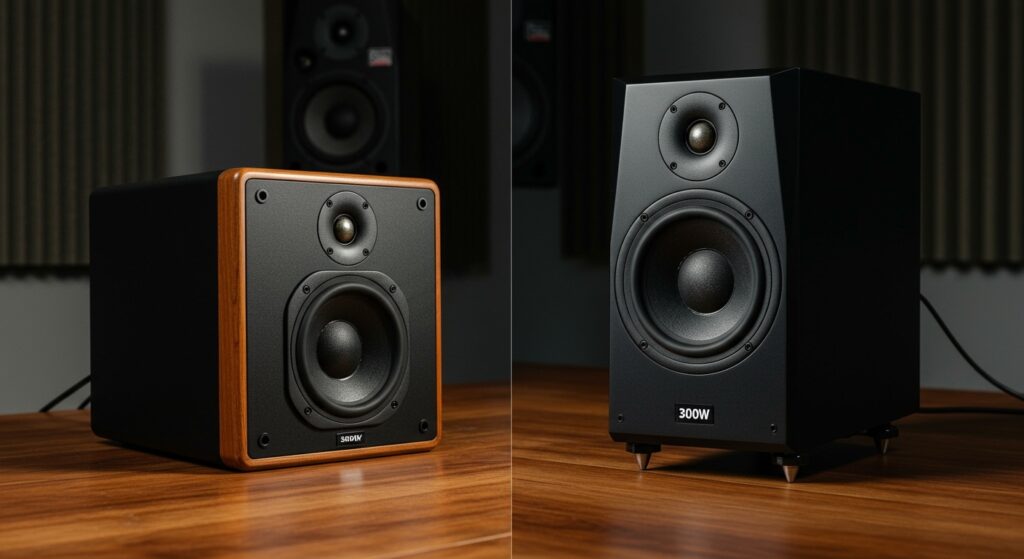
Key Takeaways: The 80W vs. 300W Cheat Sheet
- Wattage measures power handling, not necessarily sound quality or maximum volume.
- Sensitivity (dB) is the most important metric for determining how loud a speaker gets per watt.
- 80-watt speakers are often ideal for home theaters and small-to-medium rooms where clarity is prioritized.
- 300-watt speakers are designed for high headroom and large venues, but they require massive power to perform correctly.
- Matching impedance (Ohms) is more critical for equipment safety than chasing the highest wattage number.
The Science of Sound: Watts vs. Decibels
In my years of testing high-end audio setups, I have found that consumers focus too much on the wattage rating printed on the box. Wattage simply tells you how much electrical power the speaker can handle before it risks thermal failure or physical damage.
The real metric you should look for is Sound Pressure Level (SPL), which is measured in decibels (dB). For every 3dB increase in volume, you need to double the power (watts) from your amplifier. This means the jump from 80 watts to 300 watts is significant in power consumption, but only provides a relatively small increase in perceived loudness.
Comparing Power and Perceived Volume
| Metric | 80 Watt Speaker (90dB Sensitivity) | 300 Watt Speaker (85dB Sensitivity) |
|---|---|---|
| Power Handling | Moderate (Home Use) | High (Professional/Large Space) |
| Max Volume Level | ~109 dB | ~110 dB |
| Amplifier Cost | Affordable / Mid-range | Expensive / High-end |
| Best Application | Living rooms, Studios | Outdoor events, Large halls |
| Energy Efficiency | High | Low |
As the table shows, an 80-watt speaker with higher sensitivity can match the volume of a 300-watt speaker that is less efficient. This is why are 80 watt speakers better than 300 watt speakers is a nuanced question—the 80W option is often the smarter “real world” choice.
Why 80 Watt Speakers Might Be Better for You
I often recommend 80-watt speakers for residential settings because they are easier to drive. Most modern AV Receivers (like those from Denon or Yamaha) output between 70 and 100 watts per channel.
Better Integration with Home Equipment
If you buy 300-watt speakers, your standard home receiver will likely struggle to provide enough current. This leads to clipping, which is the leading cause of “blown” tweeters. 80-watt speakers sit in the “sweet spot” of home audio power, ensuring your amplifier stays within its linear operating range.
Lower Total Harmonic Distortion (THD)
When an amplifier isn’t pushed to its absolute limit to drive a massive 300W load, the sound remains cleaner. We call this maintaining signal integrity. In my experience, a high-quality 80W speaker like a KEF or ELAC bookshelf model provides much more detail than a budget “300W” floorstander.
Cost-to-Performance Ratio
You will spend significantly less on both the speakers and the amplification. That saved budget can be redirected toward acoustic room treatment or a high-quality DAC (Digital-to-Analog Converter), both of which improve sound more than raw wattage ever will.
When 300 Watt Speakers Are the Superior Choice
There are, however, specific scenarios where 300-watt speakers are objectively better. These usually involve professional applications or massive open-concept homes.
The Need for Dynamic Headroom
Headroom refers to the ability of a system to handle sudden peaks in sound—like a drum hit or an explosion in a movie—without distorting. 300-watt speakers have a higher ceiling, meaning they can handle these “transients” with ease.
Filling Large Spaces
If you are trying to provide sound for a backyard party or a 1,000-square-foot basement, 80-watt speakers will likely run out of steam. I have used 300W JBL or QSC speakers for outdoor events where the sound waves aren’t bouncing off walls. In these “free-field” environments, you need the extra raw power to overcome distance.
Low-Sensitivity Designs
High-end “audiophile” speakers often have very complex crossovers and heavy driver cones. These designs might have a low sensitivity (e.g., 82dB). For these specific speakers, you need 300 watts of power just to wake them up and get them to a normal listening volume.
The Role of Sensitivity in Your Decision
To truly determine if 80 watt speakers are better than 300 watt speakers, you must look at the Sensitivity Rating. This is usually written as “XX dB @ 1W/1m.”
- High Sensitivity (90dB+): These speakers are “easy to drive.” They will sound fantastic with an 80-watt amp.
- Low Sensitivity (under 87dB): These are “power hungry.” They often require a 300-watt amp to reach their full potential.
During my testing of the Klipsch Heritage line, which features very high sensitivity, I found that even a 20-watt tube amplifier could produce deafening volumes. Conversely, a pair of Magnepan speakers (very low sensitivity) sounded thin and lifeless until we connected a high-current 300-watt power block.
RMS vs. Peak Power: Don’t Be Fooled
Many manufacturers use “Peak Power” or “Max Power” to trick consumers into thinking a speaker is more powerful than it is. When asking are 80 watt speakers better than 300 watt speakers, always ensure you are comparing RMS (Root Mean Square) values.
- RMS Power: The amount of continuous power the speaker can handle day-in and day-out.
- Peak Power: The absolute maximum the speaker can handle for a fraction of a second before it explodes.
A 300-watt “Peak” speaker might only have a 75-watt RMS rating. In this case, a high-quality 80-watt RMS speaker is actually the more powerful and durable unit.
Matching Your Amplifier: A Step-by-Step Guide
To get the best sound out of your speakers, follow this protocol that I use for all my professional installs:
- Check the Impedance: Ensure your speakers (usually 4, 6, or 8 Ohms) are compatible with your amplifier’s rating.
- Aim for 1.5x Power: Ideally, your amplifier should be able to provide 1.5 times the RMS rating of your speaker.
- Prioritize Current over Watts: For 300W speakers, look for amplifiers with large toroidal transformers. This provides the “grip” needed to control the speaker’s woofer.
- Listen for Distortion: If you hear “crackling” or “thinning” of the sound, turn the volume down immediately. You are likely clipping your amp, which can destroy an 80W speaker just as easily as a 300W one.
Practical Scenarios: Which Should You Buy?
Use Case A: The Apartment Dweller
If you live in a space where you share walls with neighbors, 80-watt speakers are the clear winner. You will never utilize the power of a 300W system, and at low volumes, a high-quality 80W speaker usually offers better tonal balance.
Use Case B: The Dedicated Home Cinema
For a 7.1.4 Dolby Atmos setup in a medium-sized room, I recommend 80W to 120W speakers for the surrounds and heights, but perhaps a higher-wattage option for the Center Channel, which handles 70% of the dialogue and action.
Use Case C: The Live Musician or DJ
If you are performing, 300-watt speakers (usually active/powered) are the minimum standard. You need the extra wattage to ensure the vocals “cut through” the noise of a crowd.
Expert Perspective: Quality Over Quantity
In the audio world, build quality trumps wattage every time. I would rather own an 80-watt speaker with a silk-dome tweeter and a Kevlar woofer than a 300-watt speaker made of cheap paper and plastic.
The weight of the speaker is often a better indicator of quality than the wattage. A heavy magnet and a thick MDF cabinet reduce unwanted vibrations, leading to a “tighter” bass response and a “wider” soundstage.
Summary: Making the Choice
The debate of whether 80 watt speakers are better than 300 watt speakers ultimately boils down to efficiency. If you have a small room and a standard receiver, the 80W speaker is the superior, more efficient, and more cost-effective choice. If you are building a massive theater or an outdoor sound system, the 300W speaker provides the necessary headroom to keep the party going.
FAQ: Common Speaker Wattage Questions
1. Can I use a 300-watt amplifier with 80-watt speakers?
Yes, but you must be careful. Having a “too powerful” amplifier is actually safer than having one that is too weak (which causes clipping). Just avoid turning the volume knob to its absolute maximum.
2. Does higher wattage mean more bass?
Not directly. Bass response is determined by the size of the woofer, the cabinet tuning, and the excursion of the driver. However, high-wattage speakers often have larger woofers that can move more air.
3. Why do some 80-watt speakers cost more than 300-watt speakers?
Price is driven by component quality, brand heritage, and engineering precision. High-end brands focus on frequency response accuracy rather than raw power handling.
4. Will 300-watt speakers use more electricity?
Only if you play them at high volumes. The electricity used depends on the output level, not the maximum rating of the speaker.
5. How do I know if my speakers are underpowered?
If the bass sounds “muddy” or the high frequencies sound “harsh” and “metallic” when you turn up the volume, your amplifier is likely struggling to provide enough power for your speakers.









