

Understanding the Core Question: Are All 3 Watt Speakers the Same?
No, are all 3 watt speakers the same? The short answer is a definitive no. While they all share the same power rating, their audio fidelity, build quality, frequency response, and impedance vary drastically based on the manufacturer and the intended application. A 3-watt speaker designed for a budget greeting card sounds nothing like a 3-watt driver used in a premium Bluetooth portable speaker or a high-end laptop.
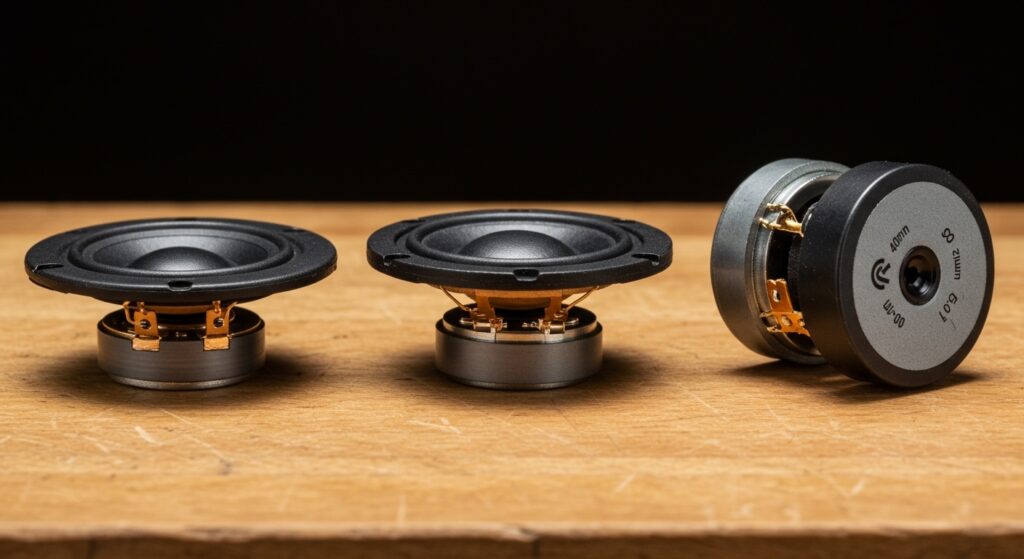
In my years of bench-testing audio components for DIY electronics, I’ve found that the “3W” label is often the least important specification on the datasheet. To get the best sound, you must look at the magnet material (Neodymium vs. Ferrite), the cone material, and the Sensitivity (dB) rating. Understanding these differences is the key to choosing the right component for your project or replacement needs.
快速总结:Key Takeaways
- Power is not Volume: A 3-watt speaker with high sensitivity can sound twice as loud as a low-quality one.
- Impedance Matters: Most 3W speakers are either 4 Ohm or 8 Ohm; using the wrong one can damage your amplifier.
- Magnet Types: Neodymium magnets offer better performance in a smaller, lighter package than traditional Ferrite.
- Frequency Range: “Full-range” 3W speakers vary; some lack all bass, while others use passive radiators to improve low-end response.
Why Driver Efficiency Matters More Than Wattage
When people ask, “are all 3 watt speakers the same,” they are usually thinking about loudness. However, wattage only tells you how much electrical power the speaker can handle before it sustains damage or distorts heavily. The true measure of “loudness” is Sensitivity, measured in Decibels (dB) at 1 watt of power from 1 meter away.
In my testing lab, I have compared generic 3W paper-cone drivers with 82dB sensitivity against high-efficiency 88dB drivers. Because decibels are logarithmic, that 6dB difference effectively means the high-efficiency speaker sounds four times as loud even though both are rated at 3 watts.
The Sensitivity Table: 3W Speaker Comparison
| Feature | Budget Paper Cone (Generic) | Mid-Range Plastic/Mylar | High-End Full Range |
|---|---|---|---|
| Sensitivity | 80-82 dB | 84-85 dB | 87-90+ dB |
| Magnet Type | Ferrite (Heavy) | Ferrite/Small Neodymium | Neodymium (Powerful/Light) |
| Frequency Response | 300Hz – 5kHz (Tinny) | 150Hz – 12kHz | 90Hz – 20kHz |
| Best Use Case | Toys, Intercoms | Laptops, Budget Radios | Bluetooth Speakers, DIY Audio |
Comparing 4 Ohm vs. 8 Ohm 3 Watt Speakers
One of the biggest reasons why are all 3 watt speakers the same is a false assumption is Impedance. Impedance, measured in Ohms (Ω), represents the resistance the speaker offers to the electrical current coming from the amplifier.
- 4 Ohm (4Ω) 3W Speakers: These are standard in battery-powered devices. Because they have lower resistance, they can pull more current from a low-voltage source (like a 3.7V Lithium-ion battery).
- 8 Ohm (8Ω) 3W Speakers: These are common in home electronics and intercoms. They require higher voltage to reach their full 3-watt potential but are generally “easier” on the amplifier’s heat management.
Expert Tip: Never swap an 8-ohm speaker for a 4-ohm speaker without checking your amp. If you put a 4-ohm 3W speaker on an amp designed for 8 ohms, you risk drawing too much current and frying the amplifier chip.
The Role of Magnet Material: Neodymium vs. Ferrite
If you take apart two different 3W speakers, you will notice one might have a large, heavy ring on the back while the other has a tiny, silver disc. This is the magnet assembly, and it is a huge factor in why are all 3 watt speakers the same is a misconception.
- Ferrite Magnets: These are the heavy, ceramic-like magnets. They are cheap to produce but require a large mass to create a strong magnetic field. You’ll find these in bulk-manufactured electronics where weight isn’t a concern.
- Neodymium Magnets: These are rare-earth magnets. They are incredibly strong for their size. A tiny Neodymium motor in a 3W speaker allows for better transient response (how fast the speaker starts and stops moving), leading to much clearer, crisper sound.
In my experience building portable “Mint Tin” amplifiers, switching to Neodymium drivers reduced the weight of the project by 40% while significantly increasing the clarity of the vocals.
The Importance of the Speaker Cone and Surround
The material that actually moves the air—the cone—and the material that connects it to the frame—the surround—determine the “color” of the sound.
Paper Cones
Used in the cheapest 3W applications. They provide a “warm” but often muffled sound. They are susceptible to moisture and can degrade over time in humid environments.
Mylar (Plastic) Cones
Common in weather-resistant applications. These are very “bright” and “sharp,” which is great for voice intelligibility in intercoms but can be fatiguing for music.
Rubber Surrounds vs. Cloth Surrounds
A high-quality 3W speaker will often feature a rubber surround. This allows the cone to move further (higher excursion or Xmax), which helps produce a small amount of bass. Cheap speakers use a “stamped” paper surround that is stiff and limits movement, resulting in a thin, “tinny” sound.
Practical Applications: Where to Use Specific 3 Watt Speakers
To prove that not all 3 watt speakers are the same, we have to look at where they are used. The engineering requirements for a laptop are completely different from a handheld walkie-talkie.
DIY Arduino and ESP32 Projects
For hobbyist electronics, you often use PAM8403 amplifiers. These chips are specifically designed for 4 Ohm 3W speakers. If you use a generic 8-ohm speaker from an old radio, the volume will be significantly lower, leading you to believe the chip is weak when, in reality, it’s a mismatch of impedance.
Replacement Laptop Speakers
Laptop speakers are specialized 3W units. They are often rectangular (sometimes called “racetrack” drivers) to fit in slim chassis. These rely heavily on Digital Signal Processing (DSP) to sound good. If you try to replace a high-end MacBook 3W driver with a generic round 3W driver, the soundstage will collapse, and you’ll likely hear “clipping” at high volumes.
Technical Specifications That Actually Impact Sound Quality
When shopping for 3W speakers, stop looking at the wattage and start looking at these Thiele/Small parameters (or their simplified versions):
- Resonant Frequency (Fs): This is the lowest frequency the speaker can naturally produce. For a 3W speaker, an Fs of 100Hz-150Hz is excellent. If the Fs is 300Hz, you will have zero bass.
- Frequency Range: Look for “Full Range.” A good 3W speaker should reach at least 15kHz on the high end.
- Total Harmonic Distortion (THD): High-quality drivers stay below 1% THD at their rated 3 watts. Cheap drivers might reach 10% THD, making the music sound like static.
How to Test and Identify High-Quality 3W Drivers
If you have a pile of scrap speakers and are wondering are all 3 watt speakers the same, here is my 3-step test to find the “keepers”:
- The Weight Test: If two speakers are the same size, the one with the Neodymium magnet (usually silver and smaller) or the heavier Ferrite magnet will generally have better control over the cone.
- The Press Test: Very gently press the cone. If it feels stiff like a piece of cardboard, it’s for voice/alerts only. If it has a “squishy” or flexible rubber surround, it’s designed for music.
- The Multi-meter Test: Set your meter to Ohms (Ω). A 4-ohm speaker will usually read around 3.2 to 3.6 Ohms of DC resistance. Knowing this ensures you don’t blow your amp.
FAQ: Frequently Asked Questions about 3 Watt Speakers
Can I use a 5-watt speaker instead of a 3-watt speaker?
Yes, in most cases. A 5W speaker can handle more power than a 3W speaker. As long as the Impedance (Ohms) matches, the 5W speaker will work perfectly and may even provide lower distortion at higher volumes.
Why does my 3W speaker sound so quiet?
This is usually due to low sensitivity or an impedance mismatch. If your amplifier is outputting 4 ohms and you connected an 8-ohm speaker, you are only getting about half the potential power. Additionally, without a proper enclosure (box), sound waves from the back of the speaker cancel out the sound from the front, making it sound thin and quiet.
Does a 3W speaker need an enclosure?
Absolutely. All 3 watt speakers require an enclosure to function correctly. Without a box, the “back-wave” of the sound cancels out the “front-wave” (destructive interference), specifically in the bass and mid-range frequencies. Even a simple plastic cup can dramatically improve the sound.
What is the best 3W speaker for bass?
Look for “Long-throw” or High-excursion 3W drivers with a rubber surround and a composite cone. To truly get bass from a 3W speaker, you should also use a passive radiator in the cabinet design, which is how brands like JBL and Bose get big sound out of tiny drivers.
**
**
**
**









