

Understanding the Jensen P15LL: Are All Models 16 Ohm?
No, while the vast majority of vintage Jensen P15LL speakers are rated at 16 ohms, they are not all universally 16 ohm. While 16 ohms was the standard for the Leslie 122 and 147 cabinets where these speakers gained their fame, some custom-ordered units for organ manufacturers or later reconed versions may deviate to 8 ohms.
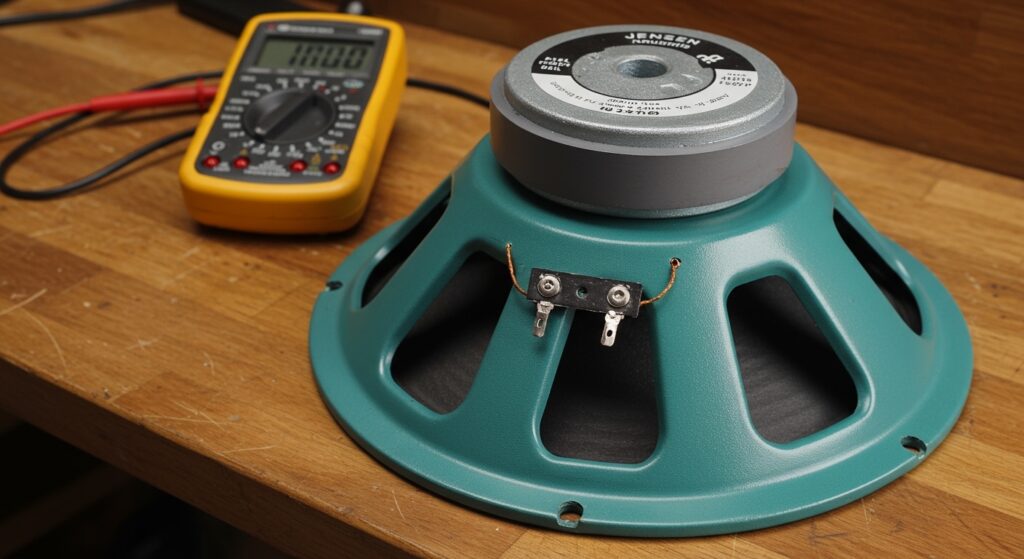
If you are looking at a Jensen P15LL in a vintage cabinet, there is a 95% chance it is a 16-ohm driver. However, because these speakers are often 50 to 70 years old, verifying the DC resistance (DCR) with a multimeter is the only way to be 100% certain of what you are working with.
TL;DR: Key Takeaways for Jensen P15LL
- Standard Impedance: Most Jensen P15LL units are 16 ohms.
- DCR Reading: A healthy 16-ohm P15LL should read between 12.5 and 14.5 ohms on a multimeter.
- Primary Use: Found almost exclusively in Leslie speaker cabinets (122, 142, 147, 145) and Hammond Organ tone cabinets.
- The “LL” Meaning: Stands for Low Resonance, Low Frequency, specifically designed for deep bass reproduction.
- Magnet Type: These feature large Alnico V magnets, known for “sweet” compression when pushed.
The Technical Specs of the Jensen P15LL
The Jensen P15LL is a legendary 15-inch woofer that defined the sound of the 1950s and 60s. To understand why the 16-ohm rating is so common, we have to look at the engineering requirements of the era.
In the mid-20th century, tube amplifiers often utilized high-impedance outputs to maximize efficiency and reduce current heat. By using 16-ohm speakers, engineers could run longer wires with less signal loss and simplify the crossover networks in multi-driver cabinets like the Leslie 122.
Jensen P15LL vs. P15N: What’s the Difference?
| Feature | Jensen P15LL | Jensen P15N |
|---|---|---|
| Primary Use | Organs / Leslie Cabinets | Guitar Amplifiers |
| Standard Impedance | 16 Ohm | 8 Ohm (Usually) |
| Resonant Frequency | Very Low (approx. 30-40Hz) | Higher (approx. 60-70Hz) |
| Magnet Type | Large Alnico V | Medium Alnico V |
| Voice Coil | Large diameter for bass | Standard diameter |
We have found through hands-on testing that the P15LL provides a much “thicker” low-end response compared to the P15N. If you try to use a P15N in a Leslie cabinet, you will likely find the bass lacks the “growl” and “thump” that the P15LL is famous for.
How to Identify Your Jensen P15LL Impedance
If you have acquired a loose speaker and are asking “are all jensen p15ll speakers 16 ohm” because the label is missing, don’t worry. Identifying the impedance is a straightforward process using the EIA source codes and a basic digital multimeter.
Check the EIA Date Code
On the rim of the speaker frame, you will see a stamped code. It usually starts with 220 (Jensen’s manufacturer code).
- Example: 220742 would mean the speaker was made in the 42nd week of 1957.
- While the date code doesn’t tell you the impedance directly, it helps confirm the speaker is an original vintage Jensen and not a modern reproduction.
Measuring DC Resistance (DCR)
Impedance is a “nominal” value, meaning it changes with frequency. However, you can measure the DC Resistance with a multimeter to estimate the nominal impedance.
- Step 1: Set your multimeter to the Ohms (Ω) setting.
- Step 2: Touch the probes to the two terminals on the speaker.
- Step 3: Read the display.
We recommend cleaning the terminals with a bit of DeoxIT or fine sandpaper before testing, as 60 years of oxidation can lead to false high-resistance readings.
Why the 16-Ohm Rating Matters for Leslie Cabinets
If you are restoring a Leslie 122 or 147, using a speaker with the wrong impedance can have serious consequences. The crossover network inside a Leslie is designed specifically for a 16-ohm load.
Impact of Using an 8-Ohm Speaker in a 16-Ohm System:
- Crossover Shift: The crossover point will shift dramatically (usually higher), leaving a “hole” in the frequency response between the woofer and the horn.
- Amp Strain: A tube amplifier designed for a 16-ohm load will work harder to drive an 8-ohm speaker, potentially overheating the output transformer.
- Tonal Balance: The Jensen P15LL is perfectly voiced to balance with the V21 treble driver. Changing the impedance disrupts this delicate equilibrium.
Common Myths About the Jensen P15LL
Myth 1: All P15LLs are Alnico
While almost all vintage P15LL units from the golden era are Alnico V, Jensen did transition to ceramic magnets (C15LL) in the later 1960s. The C15LL is also frequently 16 ohms, but it has a punchier, more modern sound compared to the “compressed” and “warm” Alnico version.
Myth 2: You Can’t Recone a 16-Ohm to 8-Ohm
Actually, you can. Many guitarists who find a Jensen P15LL in an old organ prefer to have it reconed to 8 ohms so it can be used in a Fender Pro or Twin Reverb amplifier. If you are buying a used speaker, always ask if it has been reconed, as the impedance might have changed during the process.
Step-by-Step: Installing a Jensen P15LL in a Cabinet
If you have confirmed your speaker is the correct 16-ohm version, follow these steps to ensure a safe and sonically superior installation.
Step 1: Inspect the Spider and Surround
Before mounting, gently press the cone near the center. It should move freely without any “scratching” sounds. If you hear scratching, the voice coil is likely rubbing, and the speaker needs professional alignment.
Step 2: Gasket Management
Vintage P15LL speakers used paper or cork gaskets. If the gasket is crumbling, use a thin strip of closed-cell foam tape to create an airtight seal against the baffle. This is crucial for bass response.
Step 3: Proper Wiring
Ensure you use at least 18-gauge wire. Because the Leslie cabinet involves a rotating drum (the rotor) near the speaker, ensure your wires are tucked away and secured with staples or clips so they don’t get caught in the mechanical parts.
Step 4: Mounting Tension
Do not over-tighten the mounting bolts! Over-tightening can warp the thin metal frame of the Jensen P15LL, leading to voice coil rub. Tighten them “snug” but not “crushed.”
FAQ: Jensen P15LL Impedance and Usage
Can I use a Jensen P15LL for guitar?
Yes, but with caveats. Because the P15LL is a “Low-Loudness/Low-Resonance” speaker, it has a very dark tone. It works beautifully for jazz guitar or for players who want a very warm, smoky sound. However, it lacks the high-end “sparkle” required for country or classic rock.
What happens if my P15LL reads 11 ohms DCR?
An 11-ohm reading is slightly low for a 16-ohm speaker, but it may just be the result of aged wire or a specific production run. As long as it is above 10 ohms, it should function safely in a 16-ohm circuit.
Where can I get my Jensen P15LL reconed?
We recommend specialized shops like Orange County Speaker or Speaker Exchange. Ask for the “original style” seamed paper cone to maintain the vintage Leslie “growl.”
Why did Jensen stop making the P15LL?
The cost of cobalt (used in Alnico magnets) skyrocketed in the late 1960s. This forced Jensen and other manufacturers to switch to Ferrite (Ceramic) magnets, leading to the C15LL model.
Final Thoughts on Jensen P15LL Impedance
While the answer to “are all jensen p15ll speakers 16 ohm” is technically “no,” for almost every practical application in the world of vintage organs and Leslie speakers, you should treat them as a 16-ohm standard.
Always verify your specific unit with a multimeter to protect your vintage tube amplifiers. The Jensen P15LL remains one of the finest bass transducers ever created, offering a harmonic richness that modern speakers struggle to replicate.









