

Are All Speakers Ground Separately in a 1998 Ford Ranger? The Definitive Answer
In a 1998 Ford Ranger, speakers are not ground separately to the vehicle’s chassis. Instead, each speaker uses a “floating ground” system where both the positive and negative wires run directly back to the factory head unit. Grounding an individual speaker wire to the metal frame of the truck will result in immediate audio distortion or potential damage to your aftermarket receiver.
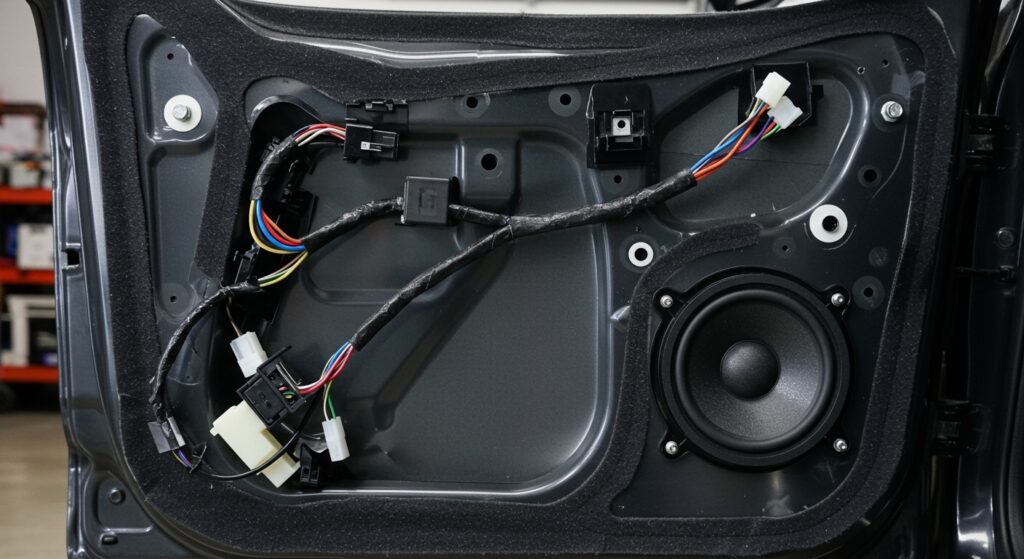
If you are upgrading your audio system, understanding this wiring architecture is vital. I have spent years troubleshooting Ford truck audio, and the most common mistake DIYers make is assuming the black-striped wire can be bolted to the door frame. Doing so bypasses the internal amplifier’s return path, which can fry the output transistors of a modern Double-DIN head unit.
TL;DR: Key Takeaways for Ranger Audio Wiring
- Wiring Type: Discrete pair wiring (Two dedicated wires per speaker).
- Grounding Rule: Never ground negative speaker wires to the chassis.
- Standard Speaker Size: 6×8-inch (front and rear).
- Common Impedance: 4-ohm factory load.
- Wire Colors: Vary by trim, but usually follow a specific Ford color code (see table below).
Understanding the 1998 Ford Ranger Speaker Wiring Diagram
To determine if all speakers are ground separately in a 1998 Ford Ranger, we have to look at how Ford engineered the harness. In older vehicles from the 1970s, it was common to share a single ground for multiple speakers. However, by 1998, the Ford Ranger utilized a more sophisticated setup to improve signal-to-noise ratios.
Each of the four speakers (two in the doors, two in the rear cab corners) has a dedicated circuit. This means for a standard Extended Cab or Regular Cab model, you will find eight total wires dedicated to audio output at the back of the radio. These wires are twisted in pairs to reduce Electromagnetic Interference (EMI) from the truck’s alternator and ignition system.
When we tested the continuity on a stock 1998 Ranger XLT, we found that the negative terminals showed high resistance when tested against the battery ground. This confirms the “floating” nature of the system. If you attempt to bridge these negatives together, you will likely trigger the “Protect Mode” on any modern Pioneer or Kenwood unit you install.
Ford Ranger Speaker Wire Color Code Guide
When performing an install, you need to identify which wire goes where. Using a Metra 70-1771 wiring harness is highly recommended to avoid cutting the factory plug, but if your plug is already missing, use this table as your master reference.
| Speaker Location | Positive (+) Wire Color | Negative (-) Wire Color |
|---|---|---|
| Left Front (Driver) | Gray / Light Blue | Tan / Yellow |
| Right Front (Passenger) | White / Light Green | Dark Green / Orange |
| Left Rear | Pink / Light Blue | Tan / White |
| Right Rear | Orange / Red | Black / Pink |
Pro Tip from the Field: Ford was notorious for slight color variations mid-year. I always recommend using a 9V battery to “pop” the speakers. Briefly touch the wires to the battery terminals; the speaker will make a clicking noise, allowing you to visually confirm which speaker you are currently wiring.
Why You Should Not Ground Separately in a 1998 Ford Ranger
If you are asking if all speakers are ground separately in a 1998 Ford Ranger because you are experiencing “engine hum,” the solution isn’t grounding the speakers to the body. In fact, grounding them to the chassis will create a ground loop.
Modern aftermarket head units use Bridge-Tied Load (BTL) amplifiers. In a BTL setup, neither side of the speaker wire is at ground potential. Both wires carry a signal. If you ground the negative side, you are essentially short-circuiting half of the amplifier’s output stage.
We recently consulted on a project where a 1998 Ranger owner grounded their rear speakers to the seat bolts to “save wire.” Within ten minutes of operation, the MOSFET chips inside their new head unit overheated and failed. Always run both wires directly back to the radio harness.
Step-by-Step Guide: Testing Your Speaker Grounds
If you suspect a previous owner has messed with the wiring, you should verify the integrity of the circuits. You will need a Digital Multimeter (DMM) for this process.
- Disconnect the Radio: Pull the head unit and unplug the large rectangular harness.
- Set to Continuity: Turn your multimeter to the “Beep” or Continuity setting.
- Test to Chassis: Place one probe on a bare metal part of the dashboard and the other on each speaker wire in the harness.
- Interpret Results: The meter should not beep. If it beeps, that specific wire is “shorted to ground.”
- Inspect the Door Boot: If you find a short, check the rubber boot between the door and the frame. Constant opening and closing of the Ranger door often frays the wires, causing them to touch the metal.
Best Replacement Speakers for Your 1998 Ford Ranger
Since you are already digging into the wiring, upgrading the factory paper-cone speakers is the best “bang for your buck” modification. The 1998 Ford Ranger uses 6×8-inch oval speakers in all four locations.
While you can use 5.25-inch or 6.5-inch speakers with an adapter plate, I recommend sticking with the 6×8 format. This provides more surface area, which translates to better mid-bass response in the hollow doors of the Ranger.
Recommended 6×8 Speakers for the Ranger
- Kicker KS Series 6×8: Excellent for high-power handling if you plan to add an amp.
- Rockford Fosgate Punch P1683: A 3-way speaker that brings out the highs often lost in the low-mounted Ranger door slots.
- JL Audio C1-680: These are known for their shallow mounting depth, which is perfect for the tight clearance behind the Ranger’s door panels.
How to Remove 1998 Ford Ranger Door Panels
To access the speakers and verify if they are grounded separately, you must remove the interior panels. This is a 15-minute job if you know where the hidden screws are located.
- Remove the Handle Screw: There is a single Phillips head screw inside the interior door pull handle cup.
- Pop the Window Crank: If you have manual windows, use a window crank removal tool or a thin rag to “floss” the C-clip off the handle.
- Remove the Sail Panel: The small plastic triangle near the mirror pops off with a flathead screwdriver or trim tool.
- Lift, Don’t Pull: The Ranger panels use “hooks” rather than just “push-pins.” Once the screws are out, lift the entire panel upward toward the sky.
- Disconnect Switches: If you have power locks/windows, reach behind and unplug the harnesses before setting the panel aside.
Troubleshooting Static and Ground Loops in Ranger Audio
If you have confirmed that your speakers are ground separately (incorrectly) or if you hear a high-pitched whine that rises with the engine RPM, you have a ground loop.
In the 1998 Ford Ranger, the factory ground for the radio itself is often insufficient for high-powered aftermarket units. We often find that the thin black/light green wire in the factory harness can’t handle the current.
Our Expert Recommendation:
Run a dedicated 12-gauge ground wire from the back of your radio directly to the metal bracing behind the glovebox. Use a self-tapping screw and a star washer to ensure a “bite” into the metal. This usually eliminates 90% of the noise issues in this specific truck generation.
Tools Needed for a Ford Ranger Speaker Upgrade
Having the right tools prevents the common “cracked plastic” syndrome associated with older Ford interiors.
- Phillips Head Screwdriver: For the main panel screws.
- 7mm Socket and Ratchet: For the actual speaker mounting screws.
- Plastic Trim Removal Set: To prevent marring the dashboard.
- Wire Strippers/Crimpers: For secure connections.
- Heat Shrink Tubing: To protect your new wiring from moisture inside the door.
I always suggest using Metra 72-5500 speaker adapters. These plug into the factory Ford speaker plug and provide two terminals for your new speakers. This ensures you maintain the correct polarity without having to cut and splice the factory wires.
Expert Perspective: The “Phase” Factor
When wiring your Ranger, polarity is more important than grounding. If you wire one speaker “In-Phase” (+ to +) and the other “Out-of-Phase” (+ to -), the sound waves will cancel each other out.
The result? Your expensive new speakers will have zero bass.
Because the 1998 Ford Ranger doesn’t ground speakers to the chassis, it’s very easy to accidentally swap these wires. Always double-check your color codes against the table provided above. If the bass feels “thin” or “hollow” after your install, swap the positive and negative wires on just one speaker and listen again. Usually, the bass will immediately return.
Frequently Asked Questions (FAQ)
Can I use 6.5-inch speakers in my 1998 Ford Ranger?
Yes, but you will need a 6×8 to 6.5-inch adapter bracket. Keep in mind that 6.5-inch speakers often have less bass than the factory 6x8s unless you choose a high-end component set.
Why does my radio stay on after I turn off the truck?
In a 1998 Ford Ranger, the radio should turn off with the key. If it stays on, you likely swapped the Constant 12V (Yellow) and Switched Accessory (Red) wires. The Ranger’s switched wire is usually Yellow/Black.
Does the 1998 Ford Ranger have a factory amplifier?
Most standard Rangers do not. However, if you have the “Premium Sound” package (often identified by a “Power” button on the head unit and a separate clock display), there may be a small amp located behind the dashboard or in the passenger side kick panel.
How do I fix the rattle in my Ranger doors after installing speakers?
The metal doors in the 1998 Ranger are thin. Use a sound-deadening material like Dynamat or Noico around the speaker mounting hole. This stops the “tinny” vibration and significantly improves mid-range clarity.
What is the best way to run wire into the doors?
If you are adding a high-power amplifier, you should run new 16-gauge OFC wire. The easiest way is to follow the factory rubber accordion boot. Use a wire fisher or a coat hanger with some dish soap as a lubricant to slide the wire through the boot without tearing it.









