

Understanding the Truth: Are Audio Reference Speakers Any Good?
Are audio reference speakers any good? Yes, they are exceptional for creators and audiophiles who value absolute sonic accuracy and clinical detail over artificial bass boosting or “colored” sound. While casual listeners may find them unforgiving, their ability to reveal every flaw in a recording makes them the gold standard for music production, video editing, and critical listening.
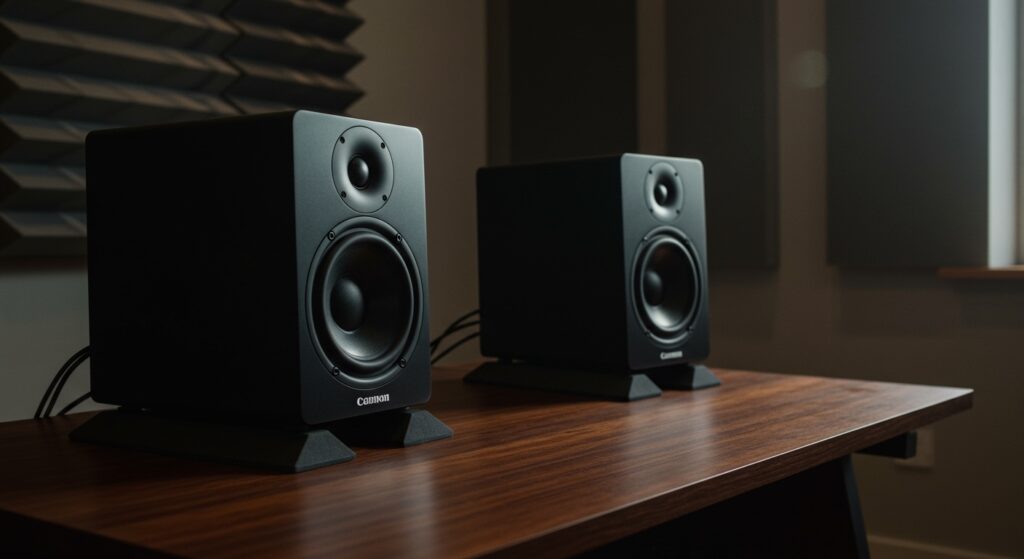
In my decade of building home studios and testing high-end monitors, I have found that the transition to reference gear is often the single biggest “ah-ha” moment for any audio enthusiast. Unlike consumer speakers that “flatter” music by boosting certain frequencies, audio reference speakers (also known as studio monitors) aim for a flat frequency response. This means you hear exactly what the artist and engineer intended—the good, the bad, and the muddy.
Key Takeaways for Quick Scanning
- Accuracy Over Energy: Reference speakers provide a flat response, meaning no frequency is intentionally boosted.
- Near-Field Optimization: Most are designed for near-field listening, placing you 3-5 feet away for maximum detail.
- Active vs. Passive: Most modern reference monitors are active, meaning they have built-in, matched amplifiers.
- Critical Detail: They excel at revealing clipping, hiss, and phase issues that consumer speakers hide.
- Learning Curve: Your ears may need 20-40 hours to adjust to the lack of “hype” in the low-end.
What Exactly are Audio Reference Speakers?
To understand if audio reference speakers are any good for your specific needs, we first have to define what they are. In the professional world, we call these “monitors” because they allow us to monitor the signal without any sugar-coating.
Consumer speakers are usually designed to make music sound “better” by adding a “smiley face” EQ curve (boosted bass and treble). In contrast, reference speakers are built for transparency. We use them in the studio to ensure that if a mix sounds good on them, it will sound good on everything from a smartphone to a club PA system.
Why Translatability Matters
The ultimate test of a reference speaker is translation. During my early days of mixing, I used consumer speakers that sounded “great” but my mixes sounded thin and weak when played in a car. By switching to JBL or Yamaha reference monitors, I could finally see the “truth” of the audio, allowing my work to translate perfectly across all playback devices.
Comparison: Reference Speakers vs. Consumer Hi-Fi
| Feature | Reference Monitors | Consumer Hi-Fi Speakers |
|---|---|---|
| Sound Profile | Flat / Neutral | “Colored” (Boosted Bass/Highs) |
| Amplification | Usually Active (Built-in) | Usually Passive (Needs External Amp) |
| Listening Distance | Near-field (3-5 feet) | Far-field (Whole room) |
| Connection Type | Balanced (XLR / TRS) | Unbalanced (RCA / Speaker Wire) |
| Primary Goal | Analytical Accuracy | Listening Enjoyment |
Are Audio Reference Speakers Any Good for Casual Listening?
This is the most common question I get from people who aren’t necessarily music producers. The answer depends on your personality as a listener.
If you want a speaker that makes every song sound “warm” and “fun” for a party, reference monitors might disappoint you. However, if you are the type of person who wants to hear the breath of the vocalist or the texture of a guitar pick hitting the string, then yes, audio reference speakers are very good.
The “Boring” Factor
Many beginners describe reference speakers as “boring” or “dry” at first. This is because we are conditioned by modern headphones and car stereos to expect massive bass. Over time, however, most people find that they prefer the clarity of a flat response because it reduces ear fatigue during long listening sessions.
Step-by-Step: How to Choose the Right Reference Speakers
Choosing a pair of monitors is a personal journey. Based on my experience testing dozens of units from KRK, Adam Audio, and Genelec, here is the framework I recommend.
Step 1: Evaluate Your Room Size
The size of your room dictates the size of the woofer.
- Small Rooms (under 10×10 ft): Stick to 5-inch woofers. Larger woofers will create “standing waves” that make your bass sound muddy and inaccurate.
- Medium Rooms: 7-inch to 8-inch woofers provide more low-end extension without requiring a separate subwoofer.
- Large Rooms: You can look into 3-way monitors with dedicated drivers for lows, mids, and highs.
Step 2: Understand Driver Materials
The material of the cone affects the “speed” and “transient response” of the sound.
- Kevlar (KRK Rokit Series): Very stiff and light, providing excellent mid-range clarity.
- Polypropylene: Common in budget monitors; provides a smoother, slightly warmer sound.
- Ribbon Tweeters (Adam Audio T-Series): These offer incredibly detailed high frequencies that extend far beyond human hearing, which helps with “air” and spatial imaging.
Step 3: Check Connectivity
Most professional audio reference speakers use balanced inputs (XLR or 1/4″ TRS). You will likely need an Audio Interface (like a Focusrite Scarlett or Universal Audio Apollo) to connect them to your computer. Avoid using simple 3.5mm-to-RCA adapters if you want to avoid ground hum and interference.
How to Set Up Your Speakers for Maximum Performance
Even the most expensive audio reference speakers will sound terrible if they are positioned poorly. Follow these “Golden Rules” of studio ergonomics.
The Equilateral Triangle
Your head and the two speakers should form a perfect equilateral triangle. If the speakers are 4 feet apart from each other, they should each be exactly 4 feet away from your ears. This ensures the stereo image is centered and accurate.
Tweeter Height
The tweeters (the small top speakers) should be at ear level. High frequencies are highly directional. If they are pointing at your chest or over your head, you will lose the “shimmer” and detail of the audio. Use speaker stands or isolation pads to reach the correct height.
Room Decoupling
Never place your speakers directly on a hollow desk. The vibrations will travel through the desk, creating a “boomy” artificial bass. Use Auralex MoPADs or SonaPhonic isolation stands to “decouple” the speaker from the surface.
Critical Features to Look For (Technical Specs)
When reading a spec sheet to determine if audio reference speakers are any good, pay attention to these three metrics:
- Frequency Response: Look for a range like 45Hz – 22kHz. A wider range means the speaker can play lower bass notes and higher treble notes.
- Total Harmonic Distortion (THD): This should be as low as possible (usually <0.5%). Low THD means the speaker doesn’t “break up” or distort at high volumes.
- Class of Amplification: Most high-end monitors use Class AB or Class D amplifiers. Class D is more efficient and stays cooler, while some purists prefer Class AB for a perceived “smoothness” in the high end.
The Role of Acoustic Treatment
I often tell my clients: “A $500 pair of speakers in a treated room sounds better than a $5,000 pair in a glass box.”
If your room has bare walls and hardwood floors, the sound will bounce around, creating phase cancellation. This makes it impossible to know if audio reference speakers are any good because you are hearing the room, not the speakers.
- Bass Traps: Place these in corners to soak up low-end energy.
- Acoustic Panels: Place these at “first reflection points” (the spots on the wall where the sound hits before reaching your ear).
Frequently Asked Questions
Do I need a subwoofer with reference speakers?
It depends on the genre. If you produce EDM, Hip-Hop, or Film Scores, a subwoofer is often necessary to hear sub-bass frequencies (below 50Hz). For rock, indie, or podcasting, a pair of 8-inch monitors usually provides plenty of bass.
Can I use reference speakers for gaming?
Yes, and they are actually incredible for gaming. Because they are designed for spatial accuracy, you will be able to pinpoint footsteps and environmental cues much more accurately than with “gaming” branded speakers.
Why do some reference speakers have switches on the back?
These are Room Correction EQ switches. They allow you to trim or boost the bass and treble based on where the speaker is placed. For example, if your speaker is close to a wall, you might need to engage a “Boundary EQ” to reduce the artificial bass buildup.
Are cheap reference speakers worth it?
Entry-level monitors like the PreSonus Eris or Mackie CR Series are a significant step up from computer speakers. However, they lack the true “flatness” of professional gear. If you are serious about audio, I recommend starting with the “mid-tier” (around $300-$500 per pair).
Is it okay to leave active monitors on all the time?
While many have an “Auto-Standby” mode, it is generally better for the internal components to turn them off when not in use. This prevents heat buildup and extends the life of the internal capacitors.









