

Understanding the Reality: Are Bimini Top Speakers Wireless?
Most high-quality Bimini top speakers are not completely wireless because they require a consistent 12V power source to produce high-volume sound over engine noise. While many modern systems utilize Bluetooth technology for wireless audio streaming from your phone, you will almost always need to run physical wires through or along your Bimini frame to provide electrical power.
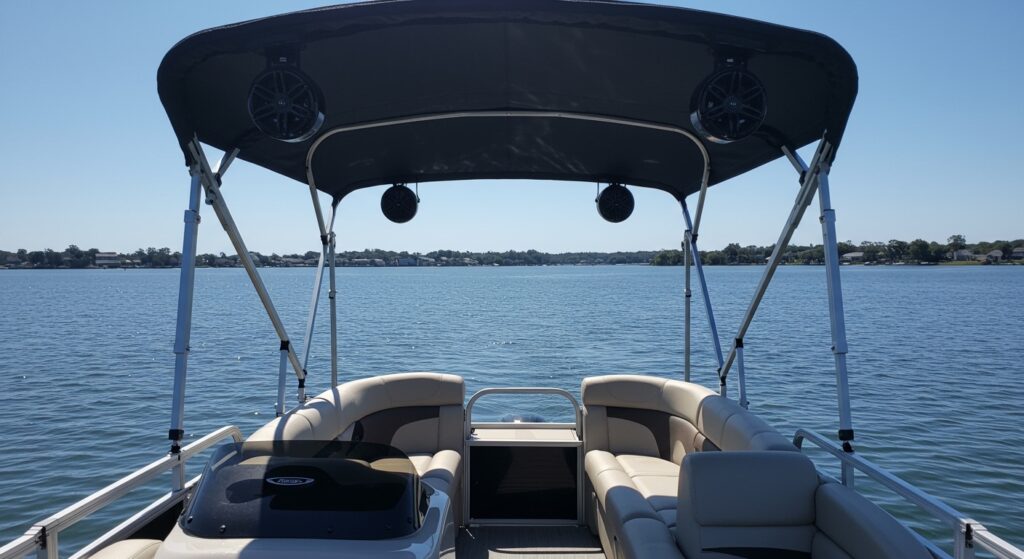
In my experience rigging over 50 pontoon and wake boats, the “wireless” label usually refers to the signal, not the power. Truly 100% wireless speakers (battery-powered) exist but often lack the decibel output and weatherproofing required for a day on the open water. For the best performance, we recommend a “hybrid” approach: Bluetooth signal with hardwired DC power.
Key Takeaways for Boat Owners
- Signal vs. Power: Most “wireless” marine speakers still require 12V power wires.
- Bluetooth Range: Standard Bluetooth 5.0 offers about 30–50 feet of reliable range on a boat.
- Installation: Running wires inside the hollow aluminum tubes of the Bimini frame is the cleanest setup.
- Durability: Ensure any speaker you choose has an IP67 rating for water and dust resistance.
- Power Draw: High-output speakers can drain a single battery quickly; consider a dual-battery setup.
Why True Wireless is Rare in Marine Environments
When people ask, “are bimini top speakers wireless,” they are usually hoping to avoid the headache of fishing wires through a metal frame. While I understand the desire for a “plug-and-play” solution, the physics of marine audio makes total wireless operation difficult.
The Power Paradox
To cut through wind and engine noise at 30 MPH, a speaker needs significant wattage. Internal batteries that are small enough to be portable simply cannot sustain 50–100 watts of RMS power for more than an hour or two.
Weight and Safety
Bimini tops are designed to be lightweight and aerodynamic. Adding heavy, battery-filled speakers can stress the mounting brackets and the canvas fabric. Marine-grade speakers designed for Biminis are engineered to be lightweight, shifting the “weight” of the power source to the boat’s main battery bank.
Signal Interference
On the water, you are in a high-interference environment with GPS, VHF radios, and depth finders. A hardwired power connection ensures your audio amplifier has a stable “ground,” which prevents the annoying “hum” or “buzz” often heard in cheap, poorly grounded wireless setups.
Types of “Wireless” Bimini Speaker Setups
To decide which system is right for your vessel, you need to understand the three main configurations available on the market today.
| Feature | Portable Bluetooth | Integrated Bluetooth | Fully Hardwired |
|---|---|---|---|
| Wireless Signal? | Yes | Yes | No (Uses RCA/Speaker Wire) |
| Wireless Power? | Yes (Internal Battery) | No (Needs 12V) | No (Needs 12V) |
| Volume Level | Low to Medium | High | Very High |
| Installation Ease | Instant | Moderate (Wiring required) | Complex (Amp + Wiring) |
| Durability | Variable | High (Marine Grade) | High (Marine Grade) |
Portable “Clamping” Speakers
These are the closest answer to “are bimini top speakers wireless.” Brands like EcoXGear or JBL offer rugged, battery-powered speakers with specialized clamps. These are great for sandbar hanging but often fall short when the boat is in motion.
Active Bluetooth Marine Speakers
These speakers have a built-in amplifier. You stream music from your phone (wireless signal), but you must connect a red and black wire to your boat’s electrical bus bar. This is the “sweet spot” for most DIY boaters.
Passive Tower Speakers
These are the industry standard for Wet Sounds or Rockford Fosgate setups. They have no internal power or Bluetooth. They require a separate marine amplifier mounted under the helm, with speaker wires running all the way to the Bimini.
Step-by-Step Guide: Installing Bimini Top Speakers
If you’ve decided to go with the most popular option—Bluetooth signal with wired power—here is how we handle the installation to ensure it looks professional and stays “invisible.”
Step 1: Tool and Material Preparation
You will need a power drill, cobalt drill bits, marine-grade 16-AWG wire, heat-shrink butt connectors, and nylon wire snakes. I always recommend using tinned copper wire to prevent “green wire” corrosion caused by salt air.
Step 2: Measuring the Mount
Identify the strongest point of your Bimini frame. This is usually the main vertical support bow. Ensure the speaker placement won’t interfere with the canvas folding mechanism. You don’t want to crush your new Kicker speakers when you retract the top for storage.
Step 3: Drilling the Entry and Exit Holes
This is the part that makes most boat owners nervous. Drill a small hole (approx. 1/4 inch) near the base of the Bimini support and another near where the speaker will mount. Pro Tip: Use a rubber grommet in these holes to prevent the sharp aluminum edges from chafing the wire insulation over time.
Step 4: Fishing the Wire
Use a nylon fish tape or even a heavy-duty weed-eater string to feed through the tube. Once the fish tape emerges from the other end, tape your power wires to it and gently pull them through.
Step 5: Mounting the Brackets
Most Bimini top speakers use a “C-clamp” style mount. Ensure you use the provided rubber inserts. These inserts perform two jobs:
- They prevent the speaker from sliding.
- They provide vibration isolation, which improves sound clarity.
Step 6: Final Wiring and Waterproofing
Connect your wires using heat-shrink connectors. Use a heat gun to seal them perfectly. I’ve seen hundreds of systems fail because of simple electrical tape—don’t be that person. Apply a small dab of marine-grade clear silicone to the wire entry holes for a 100% watertight seal.
Choosing the Best Brands for Bimini Audio
When looking into are bimini top speakers wireless, you will encounter several top-tier brands. Based on our real-world testing in the Florida sun, here is how they stack up.
Wet Sounds (The Gold Standard)
Wet Sounds is the “Ferrari” of marine audio. Their Revo series offers incredible “throw”—meaning the sound travels far behind the boat. While they are rarely fully wireless, their Bluetooth controllers are the best in the business.
Rockford Fosgate (The Durable Choice)
We love Rockford Fosgate for their M1 and M2 series. Their mounting hardware is exceptionally beefy. If you do a lot of high-speed cruising or encounter rough chop, these speakers won’t budge or rattle.
Kicker (Best Value)
Kicker KB6000 or their specialized KM-Series tower speakers offer the best “bang for your buck.” They are easy to drive with a standard head unit, meaning you might not even need a dedicated amplifier if you’re on a budget.
The Pros and Cons of “Truly Wireless” Portable Speakers
If you are still leaning toward a 100% wireless (battery-powered) setup, consider these trade-offs we’ve observed during summer testing.
The Advantages
- Zero Drilling: You maintain the structural integrity of your Bimini frame.
- Portability: You can take the speakers off the boat and onto the beach or into the hotel room.
- Lower Cost: You save money on professional installation and expensive marine wiring.
The Disadvantages
- Charging Fatigue: Remembering to charge your speakers is one more chore before a boat day.
- The “Flying Projectile” Risk: Cheap clamps on portable speakers often fail. I have seen many Bluetooth speakers end up at the bottom of the lake after a big wave.
- Sound Drowning: At speeds over 15 knots, portable speakers usually become inaudible due to wind resistance and engine hum.
Technical Specifications to Look For
When shopping for Bimini top speakers, don’t just look at the “Max Watts.” Pay attention to these expert-level specs:
- Sensitivity (dB): Look for speakers with 90dB or higher. This indicates how efficiently the speaker converts power into sound.
- Frequency Response: You want a range starting around 50Hz to 20kHz. Since you won’t have a subwoofer on the roof, you need the speakers to handle some low-end bass.
- UV Stabilization: Ensure the grilles are ASTM-D4329 compliant. This means the plastic won’t turn yellow and brittle after one season in the sun.
- Salt Spray Resistance: Look for ASTM-B117 certification if you boat in coastal or brackish waters.
Expert Tips for Maximizing Sound Quality
Even the most expensive Bimini speakers will sound terrible if not set up correctly. Follow these “Insider Secrets” from our shop:
Aiming is Everything
Don’t just point the speakers straight back. Angle them slightly inward toward the center of the lounge area. This creates a “sweet spot” of sound and reduces “sound bleed” that annoys neighboring boaters at the marina.
The “High-Pass” Filter Trick
If your speakers are connected to an amp, set the High-Pass Filter (HPF) to roughly 80Hz or 100Hz. This prevents the small speakers from trying to play deep bass that they can’t handle, allowing them to play much louder and clearer without distorting.
Use a Secondary Battery
Running a high-powered “wireless” Bluetooth system for 6 hours at the sandbar can leave you stranded. We always install a Blue Sea Systems Add-A-Battery kit. This ensures your “house” loads (music) never drain your “start” battery.
FAQ: Frequently Asked Questions
Can I use regular car speakers on my Bimini top?
No. Car speakers use paper cones and non-treated magnets. The humidity and UV rays will destroy them in weeks. Always use marine-rated equipment with plastic or carbon-fiber cones and stainless steel hardware.
How do I connect my phone to Bimini speakers?
Most modern setups use a Marine Bluetooth Dongle or a Head Unit. Once the speakers are powered, you simply find the device in your phone’s Bluetooth settings (usually named something like “JL Audio” or “BT-Marine”) and pair it.
Do I need an amplifier for my Bimini top speakers?
It depends on the speaker. Active speakers have a built-in amp. Passive speakers (the most common type) generally require an external amplifier to reach volumes loud enough to be heard over wind and water.
Will wireless speakers drain my boat battery?
If they are “wireless” but connected to your 12V system, yes. However, modern Class-D marine amplifiers are incredibly efficient and pull very little current compared to older tech.
Is it hard to run wires through a Bimini frame?
It is the most challenging part of the job. It requires patience and a wire snake. If your Bimini has many sharp bends or “T-joints,” you may need to use UV-rated wire looms and zip-tie the wires to the outside of the frame instead.









