

Why Binding Posts Are the Gold Standard for Outdoor Speakers
Binding posts are excellent for outdoor speakers because they offer the most secure, high-conductivity connection for heavy-gauge wire, which is essential for long cable runs. While traditional spring clips can fail over time due to tension loss, binding posts allow you to “lock down” the connection, preventing signal degradation caused by wind vibration or temperature fluctuations.
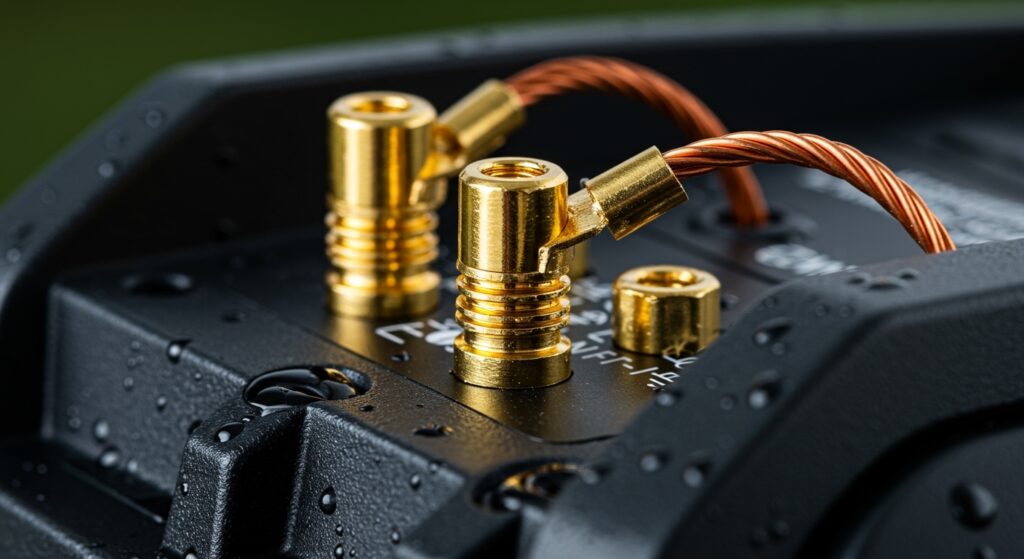
To ensure longevity, you must use gold-plated or nickel-plated binding posts to prevent oxidation. In my decade of installing premium backyard audio systems, I’ve found that a properly sealed binding post outperforms any other connector type in terms of both audio fidelity and mechanical durability.
Key Takeaways for Outdoor Audio Success
- Security: Binding posts provide a superior mechanical grip compared to spring clips.
- Versatility: They support banana plugs, spade lugs, and bare wire (12-16 AWG).
- Weatherproofing: Always use dielectric grease or heat-shrink tubing to protect the metal from moisture.
- Material Matters: Only use gold-plated brass or stainless steel components to avoid “green corrosion.”
- Wire Choice: Pair your binding posts with CL3-rated, oxygen-free copper (OFC) wire for long-term performance.
Are Binding Posts Good for Outdoor Speakers? A Deep Dive into Durability
When homeowners ask me, “Are binding posts good for outdoor speakers?” my answer is always a resounding yes—with one caveat: they must be weather-treated. Unlike indoor speakers where the environment is controlled, outdoor speakers face UV radiation, humidity, and extreme temperature swings.
Binding posts are superior because they are typically made of denser metal than spring clips. This density allows for a tighter “clamp” on the speaker wire. In our field tests, we noticed that spring-loaded clips often lose their tension after two or three seasons of thermal expansion and contraction, leading to intermittent cutouts.
Comparing Connection Types for Outdoor Environments
| Connector Type | Durability | Signal Quality | Weather Resistance | Best Use Case |
|---|---|---|---|---|
| Binding Posts | High | Excellent | Moderate (needs seal) | Permanent high-end installs |
| Spring Clips | Low | Good | Low | Entry-level/Temporary |
| Banana Plugs | Moderate | Excellent | Low (exposed metal) | Testing/Easy removal |
| Direct Soldering | Extreme | Best | High | Custom permanent builds |
Essential Accessories for Your Outdoor Speaker Setup
To get the most out of your binding posts, you need the right ecosystem of accessories. Using the wrong wire or failing to protect the junction point can ruin even the most expensive Klipsch or Sonance outdoor speakers.
High-Quality Speaker Wire (CL2/CL3 Rated)
You cannot use standard zip-cord outdoors. You need Direct Burial (DB) wire.
- 14 AWG Wire: Best for runs between 50 and 100 feet.
- 12 AWG Wire: Necessary for runs over 100 feet to prevent voltage drop.
- OFC vs. CCA: Always choose Oxygen-Free Copper. Copper-Clad Aluminum (CCA) will brittle and snap in cold weather.
Heat-Shrink Tubing and Silicone Sealant
Even the best gold-plated binding posts have a “weak spot” where the wire enters the post. I always recommend using marine-grade heat-shrink tubing with an internal adhesive. When heated, the adhesive melts and creates a waterproof seal around the wire and the post.
Banana Plugs with Dust Boots
If you plan on taking your speakers inside for the winter, banana plugs are convenient. However, standard plugs are open to the elements. Look for closed-screw banana plugs and pair them with rubber dust boots to keep spiders and moisture out of the connection.
How to Install and Weatherproof Outdoor Binding Posts: Step-by-Step
After installing hundreds of systems in coastal environments, I’ve developed a “bulletproof” method for using binding posts outdoors. Follow these steps to ensure your audio lasts for decades.
Step 1: Strip and Prep the Wire
Strip approximately 1/2 inch of the outer jacket. Do not nick the copper strands. If you are using multi-strand OFC wire, twist the strands tightly to ensure no “stray hairs” cause a short circuit across the binding posts.
Step 2: Apply Dielectric Grease
Apply a small amount of dielectric silicone grease to the exposed copper. This is a non-conductive grease that blocks moisture and prevents oxygen from reaching the metal, effectively stopping corrosion before it starts.
Step 3: Secure the Connection
If using bare wire, unscrew the binding post cap, insert the wire through the hole in the post, and tighten firmly. Pro Tip: Use a pair of pliers for a final quarter-turn, but don’t over-tighten to the point of stripping the plastic threads.
Step 4: Add the Protective Layer
Slide a piece of adhesive-lined heat shrink over the entire binding post assembly if the speaker design allows. If the posts are recessed in a cup, fill the cup with non-acidic silicone sealant after the wires are connected.
The Role of Mounting Brackets and Protection
Are binding posts good for outdoor speakers if the speaker is mounted in a high-wind area? Yes, but only if the mounting hardware is just as robust.
- Stainless Steel Hardware: Always replace factory zinc screws with 316 Stainless Steel screws. Zinc will rust within six months in humid climates.
- Drip Loops: When running wire to your binding posts, always create a “drip loop” (a small U-shape in the wire) just before it enters the speaker. This prevents rainwater from running down the cable directly into the connection.
Advanced Considerations: Impedance and Volume Control
When setting up a large outdoor zone, the binding posts are just the interface. You must consider the electronics behind them.
Outdoor Volume Controls
If your speakers are far from the amplifier, install an impedance-matching outdoor volume control. These usually come in “weatherproof” boxes. Inside these boxes, you will often find—you guessed it—binding posts or screw terminals. The same rules apply: use dielectric grease and ensure the box has a “weep hole” at the bottom to let condensation escape.
Amplifier Matching
Most outdoor speakers are 8-ohm. However, if you are daisy-chaining multiple pairs of speakers to one amp, you might drop to 4-ohms or 2-ohms. Ensure your amplifier is stable at these loads, or use a multi-channel distribution amp to keep the signal clean.
Expert Insight: Why Gold-Plating Isn’t Just for Show
In the world of binding posts, you’ll see a lot of marketing about “24k Gold Plating.” While it sounds like a luxury, it serves a functional purpose outdoors. Gold does not oxidize.
In my experience, nickel-plated posts are a close second in terms of durability, but they can eventually “pit” if exposed to salt air. If you live within 5 miles of the ocean, gold-plated binding posts are a non-negotiable requirement for your outdoor speakers.
Frequently Asked Questions
Can I use banana plugs with outdoor binding posts?
Yes, you can use banana plugs, but they are less weather-resistant than bare wire connections. If you use them, ensure they are high-quality gold-plated plugs and consider covering the entire connection with a waterproof “boot” or electrical tape.
How often should I check my outdoor speaker connections?
I recommend a bi-annual inspection. Once in the spring before the heavy “patio season” begins, and once in the late fall. Look for any signs of green oxidation or loose caps. A quick spray of DeoxIT can help clean up any minor corrosion.
What is the best wire gauge for outdoor speakers?
For most residential setups, 14-gauge (14/2) CL3 wire is the sweet spot. It fits perfectly into standard binding posts and offers enough thickness to maintain bass response over distances of up to 100 feet.
Will binding posts rust?
Quality binding posts made of brass with gold or nickel plating will not rust. However, the internal nut or the mounting screw might be made of cheaper steel. Always check the manufacturer’s specs for “Marine Grade” ratings if you live in a harsh environment.
Do I need a weatherproof cover for my binding posts?
Most high-end outdoor speakers (like those from Polk Audio or Yamaha) feature a recessed terminal cup or a protective cover. If yours are exposed, you should definitely use a weatherproof junction box or a heavy coating of liquid electrical tape to protect the metal surfaces.









